
|
Listen Now
Getting your Trinity Audio player ready...
|
- Why You Need a Document Management System (And Why Now)
- The Hidden Cost of “We Use Folders”
- What Makes the Best Document Management System? Six Things That Actually Matter
- 1. Asset-Based Organisation, Not Folder-Based
- 2. Search That Actually Works
- 3. Strict Access Control That Real Teams Need
- 4. Encryption That Protects You Even If The Server Is Compromised
- 5. Renewal Tracking, Not Just Storage
- 6. Self-Hosted, So Your Documents Stay Yours
- How MaMITs DMT Compares to Other Document Management Software
- The Document Lifecycle Inside MaMITs DMT
- Stage 1: Capture
- Stage 2: Enrich
- Stage 3: Encrypt and Obfuscate
- Stage 4: Search and Access
- Stage 5: Share, Renew, or Archive
- Real Use Cases: Who Actually Needs This?
- Use Case 1: HR Teams
- Use Case 2: Legal and Accounting Firms
- Use Case 3: SMEs and Small Businesses
- Use Case 4: Hospitality and Multi-Location Businesses
- Use Case 5: Founders, Directors, and Business Owners
- Secure Sharing: The Feature That Replaces WhatsApp
- Renewal Tracking: Stop Losing Money to Expired Documents
- The Self-Hosted Trust Story
- Built in India, Built for Real Business
- What You Get Out of the Box
- Case Study: How Rajhans Group of Hotels Took Back Control of 1,800+ Documents
- Case Study 2: How The Sarai Resort Made Its Front Desk Audit-Ready in One Week
- Frequently Asked Questions
- If Your Team Still Manages Documents Manually, You Are Already Losing Time
If you have ever spent twenty minutes hunting for a single PDF inside a folder called “Final_FINAL_v3_use-this-one”, you already understand the real cost of bad document management. It is not the missing file. It is the trust your team loses every time someone says “I cannot find it.” And in 2026, with audits getting stricter, GST renewals getting tighter, and remote teams handling sensitive paperwork from five different cities, that trust gap is no longer something a business can afford.
This is the story of why a serious Document Management System is no longer a “nice-to-have” for organised businesses, and why the right Document Management Software can completely change how a team works. We will walk through what to look for, where most tools fall short, and how MaMITs DMT (our self-hosted, encrypted, search-first Document Management Tools platform) was designed from the ground up to solve the problems other systems quietly ignore.
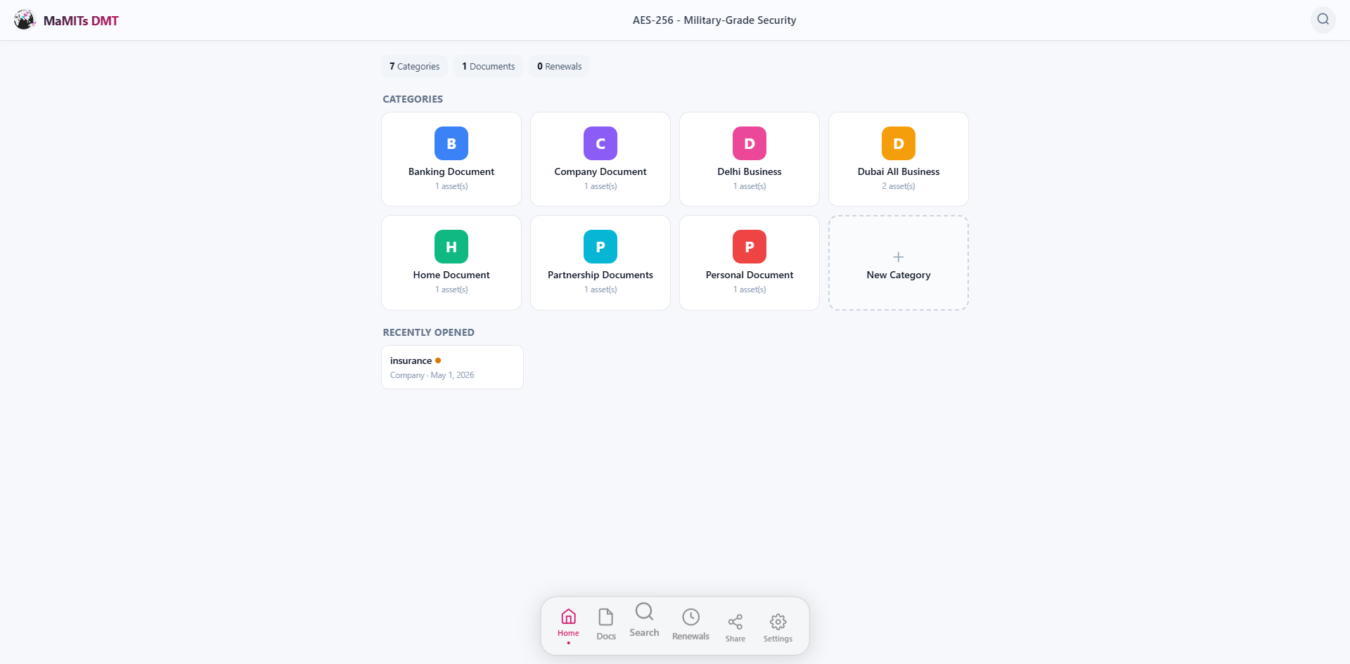
Document Management System : MaMITs
Why You Need a Document Management System (And Why Now)
Let us be honest. Every business already has “a system” for managing documents. It is usually some mix of email attachments, WhatsApp forwards, a shared Drive folder, a desktop full of PDFs named after dates, and one trusted person who “knows where everything is.” That setup works on day one. By month six, it starts costing money. By year two, it is actively dangerous.
The problems creep in quietly. A vendor agreement gets signed but never tagged, so two years later when there is a dispute, nobody can find it. A GST registration certificate sits in someone’s inbox and expires without renewal. An employee leaves and takes the only copy of the office NOC with them. Or worse, a sensitive client document gets shared on WhatsApp, screenshotted, and ends up where it should never be.
A real Document Management System is not just a place to store files. It is a system that knows what each document is, who owns it, when it expires, who can see it, who has seen it, and where the signed copy is. That is a different category of software entirely. And that is where MaMITs DMT lives.
The Hidden Cost of “We Use Folders”
One of our early customers ran a hospitality business with three properties across Madhya Pradesh. They genuinely believed their folder system was working. Then their accountant asked for two years of fire safety NOCs during an audit. It took them four days. Four full working days, across three staff members, calling old vendors and digging through email backups. After they migrated to a proper Document Management Software, the same request took eleven seconds.
This is the gap nobody talks about. The cost of bad document management is not measured in storage fees. It is measured in delayed audits, missed renewal deadlines, lost client trust, and the slow drain of hours that should have been spent growing the business.
What Makes the Best Document Management System? Six Things That Actually Matter
Search for “best Document Management Tools” and you will get a hundred lists, all of them recommending the same big SaaS names. Most of those tools were built for a different problem (collaborative document editing, contract workflow, enterprise compliance). Very few were built for the way real Indian businesses actually handle paperwork. Here are the six things that genuinely separate a great Document Management System from a glorified file uploader.
1. Asset-Based Organisation, Not Folder-Based
Documents do not live in isolation. They belong to something. A registration certificate belongs to a vehicle. A fire NOC belongs to a hotel. A GST certificate belongs to a business entity. The best Document Management Software understands this and organises everything around the real-world thing it represents. MaMITs DMT calls these “Assets” and builds the entire system around them. You create an Asset (Hotel Sunrise, Maruti Swift MP09 AB 1234, MaMITs PVT. LTD.), set the start year, and the system automatically creates year-wise folders from that date all the way to today. On 1st January every year, a new folder is created automatically across all your assets. No manual setup, ever.
2. Search That Actually Works
Most so-called Document Management Systems have search. Almost none of them have search that works. The difference is how rich the metadata is at upload time. If all the system stores is the filename, then searching is hopeless. If the system asks smart questions during upload (what is this document, what other names do you call it, is this a purchase, when does it need renewal, what notes should we remember), every one of those answers becomes a search hook later. Type “fire NOC sunrise 2024” and the right document appears in under a second. That is the search experience MaMITs DMT was built around.
3. Strict Access Control That Real Teams Need
In most teams, the person who uploads a document is not the person who should be able to read it later. An office assistant scans a confidential salary slip; only the HR head should see it after submission. MaMITs DMT enforces this at the system level with a strict two-role model. Uploaders can submit documents but lose access the moment they click submit. Admins can see everything. This is one of the most ignored features in the entire Document Management Software market, and it is non-negotiable for any business handling sensitive paperwork.
4. Encryption That Protects You Even If The Server Is Compromised
Every Document Management System claims to be “secure.” Almost none of them encrypt at multiple layers. MaMITs DMT does three things at once. Every uploaded file is renamed on disk to a random extension-less token (so even someone with raw server access sees only meaningless strings, not “salary_slips_2024.pdf”). The database itself is encrypted at the column level using AES-256-GCM. And every download requires the admin to re-authenticate, with full audit logging. If your laptop is stolen, your data does not walk out with it.
5. Renewal Tracking, Not Just Storage
Half of all important business documents expire. Insurance policies, GST certificates, fire NOCs, vehicle registrations, vendor contracts, employee ID proofs. A real Document Management System does not just store these files; it tracks when they expire and reminds you in advance. MaMITs DMT lets you mark any document as “needs renewal” at upload time, set the next renewal date, and the dashboard shows you everything expiring in the next 7, 30, or 90 days. You also get email reminders before things lapse. No more renewal-day panics.
6. Self-Hosted, So Your Documents Stay Yours
This is the deal-breaker for serious businesses. Cloud-based Document Management Software means your sensitive paperwork lives on someone else’s server, in someone else’s country, governed by someone else’s privacy policy. MaMITs DMT runs on your own server (online VPS, office LAN PC, or completely offline laptop). Same features, same UI, same security in all three modes. Your documents never leave the hardware you control. For lawyers, doctors, accountants, and anyone handling confidential client data, this is the only acceptable answer.
How MaMITs DMT Compares to Other Document Management Software
To understand where MaMITs DMT fits in the Document Management Software landscape, here is an honest side-by-side comparison with the kinds of solutions most businesses are currently using.
| Capability | Drive / Dropbox | Generic Cloud DMS | MaMITs DMT |
|---|---|---|---|
| Self-hosted (your server) | No | Rare | Yes (online, LAN, or offline) |
| Asset-based organisation | No (only folders) | Sometimes | Yes (built around Assets) |
| Auto year-wise folders | No | No | Yes (created on 1st Jan) |
| Smart upload wizard with metadata | No | Limited | Yes (12-step smart questions) |
| Filename obfuscation on disk | No | No | Yes (random tokens, no extension) |
| Column-level AES-256-GCM encryption | No | Rare | Yes |
| Strict uploader-lock-out role | No | No | Yes |
| Renewal tracking with reminders | No | Sometimes | Yes (7/30/90 day alerts) |
| Secure expiring share links | Partial | Yes | Yes (with view limits + audit) |
| Tamper-evident hash-chained audit log | No | Rare | Yes |
| Dynamic 2FA (QR / TOTP) | Yes | Yes | Yes (works fully online & offline also) |
| One-time payment, no monthly fee | No (subscription) | No (subscription) | Yes |
| Made in India, supports Indian use cases | No | Rare | Yes |
The Document Lifecycle Inside MaMITs DMT
To really understand what makes MaMITs DMT different, it helps to walk through the full life of a single document inside the system. Every paper that enters your business follows the same five-stage journey, and at each stage the software does something specific to keep it safe, findable, and traceable.
Stage 1: Capture
A document arrives. Maybe it is a scanned PDF from the office scanner, a photo of a receipt taken on a phone, or a digital file emailed by a vendor. The user opens MaMITs DMT, clicks Upload, and selects the file. If it is an image (JPEG, PNG, WEBP, TIFF, BMP), the system asks if it should auto-convert to PDF in milliseconds. The default is Yes, because PDF is the universal format for archived business documents. (But yes option available you also also store image format data)
Stage 2: Enrich
This is the magic step that almost no other Document Management Software gets right. The upload wizard asks a series of one-question-at-a-time prompts. Which Asset does this belong to? Which year? What do you call this document? What other names might someone search for? Is this a purchase document? Does it need renewal? When? Notes? Each answer is stored as searchable metadata. By the time the document is saved, it is wrapped in everything your team will ever need to find it again.
Stage 3: Encrypt and Obfuscate
The moment the user clicks Submit, three things happen automatically. The file is renamed on disk to a cryptographically random extension-less token. The original filename, MIME type, tags, description, purchase info, and renewal info are all encrypted at the column level using AES-256-GCM and stored in the database. The mapping between the random token and the real document is accessible only to admins. If someone steals the server tomorrow, they get a folder full of meaningless strings.
Stage 4: Search and Access
The document is now part of a searchable index. Anyone with permission can find it in under a second by typing into the global search bar. Filters (category, asset, year range, file type, renewal status) help narrow further. When an admin opens the document, MaMITs DMT uses PDF.js with HTTP range requests so even a 200 MB+, 200-page+ PDF opens in under three seconds without downloading the whole file.
Stage 5: Share, Renew, or Archive
If the document needs to be shared with someone outside the system, the admin can generate a secure expiring link with a maximum view limit (typically 2 views) and password protection. If the document has a renewal date, the system automatically shows it in the dashboard’s “Renewals Due” widget when the date approaches and sends an email reminder. If the document is archived, it stays encrypted, indexed, and searchable forever, with the full audit trail of every view and download preserved in a tamper-evident hash-chained log.
Real Use Cases: Who Actually Needs This?
Use Case 1: HR Teams
HR teams handle some of the most sensitive paperwork in any organisation. Offer letters, employee ID proofs, signed contracts, exit clearance forms, payroll records, leave applications, performance reviews. Most HR teams manage all of this through a mix of shared drives and email. The result is predictable: when an employee leaves and asks for their full document set five months later, it takes hours to compile. Worse, sensitive documents like salary slips often end up visible to people who should not see them. MaMITs DMT solves both problems. Each employee becomes an Asset. Year-wise folders are created automatically. Uploaders can submit but cannot view after submission. Only HR admins can access. Audit log shows every view. When an exit happens, every document for that employee is one search away.
Use Case 2: Legal and Accounting Firms
Legal and finance teams cannot afford lost documents, full stop. A missing contract during a dispute, a missing tax filing during an audit, a missing client agreement during a deal closure – any one of these can cost the firm a client or a case. MaMITs DMT was designed with audit readiness as a first-class requirement. Every action is logged with timestamp, IP, user, and document. The audit log is hash-chained so any attempt to tamper with past entries is detectable. When the auditor asks for “every GST filing for the last three years,” retrieval takes seconds, not days. And because the entire system is self-hosted, sensitive client data never leaves the firm’s own infrastructure.
Use Case 3: SMEs and Small Businesses
Small businesses do not need enterprise complexity. They need document order. A typical Indian SME might have a single GST registration, a few vendor agreements, an annual fire NOC, employee documents, and a couple of vehicle papers. The current system is usually one shared folder, which works for the first six months and falls apart after. MaMITs DMT scales perfectly for this size. The installer takes under five minutes. The admin is up and running by lunch. The renewal tracker quietly handles the GST and fire NOC dates that the owner used to keep in a notebook. The annual saving in missed-renewal late fees alone often pays for the software many times over.
Use Case 4: Hospitality and Multi-Location Businesses
Hotels, resorts, and multi-property businesses have a unique problem: each location has its own set of licenses, NOCs, agreements, and renewals. Trying to manage three properties from a single shared drive is a nightmare. MaMITs DMT lets you create one Asset per property, with its own year-wise document tree, its own renewal calendar, and its own access controls. The owner sees everything from one dashboard. Each property manager only sees their own property. Audit, renewal, and search are unified across the entire business.
Use Case 5: Founders, Directors, and Business Owners
Every founder carries a parallel paperwork stack that nobody else can touch: shareholder agreements, board resolutions, personal guarantees signed for business loans, director KYC filings, DIN renewals, property papers held against collateral, family trust deeds, and the steady flow of signed contracts arriving by courier. Most owners manage this exactly the way they did when the company had three people, which is to say, badly. Critical files end up scattered across personal Gmail, WhatsApp, a desktop folder, the CA’s office, and a physical safe at home. When a due diligence request lands from an investor or a lender asks for three years of financials, the founder becomes the single point of failure for their own business. MaMITs DMT closes that gap. Each entity (the holding company, every subsidiary, personal investments, individual properties) becomes its own Asset, with strict role separation so an EA can upload paperwork without ever viewing what is inside. The tamper-evident audit log makes every access provable during diligence or corporate disputes. Renewal tracking covers DIN deadlines, insurance premiums, and passport expiry alike. The offline mode keeps the most sensitive papers off any cloud server. And because the entire vault can be exported as a single encrypted backup, the day a founder needs to delegate, exit, or plan succession, the handover is clean, auditable, and complete.
Secure Sharing: The Feature That Replaces WhatsApp
Sending documents over WhatsApp feels convenient. It is also one of the most dangerous habits in modern business. The recipient can screenshot the document. They can forward it. They can leave their phone unlocked. They can save it to their gallery and never delete it. And there is zero audit trail of where it ended up.
MaMITs DMT replaces this entire risky workflow with a single feature: secure expiring share links. The admin selects a document, sets a password, sets a maximum view count (typically 2), sets an expiry date, and sends the link via WhatsApp, email, or SMS. The recipient opens the link, enters the password, views the document a maximum of 2 times, and after that the link auto-expires. Every view is logged with timestamp and IP. The admin sees the full audit trail in their dashboard.
If the link is forwarded, the password still protects it. If the password leaks, the view limit still protects it. If the recipient screenshots the document, the audit log still records who they were and when. This is what controlled sharing actually looks like, and it is the single biggest behaviour change MaMITs DMT introduces in most teams.
Renewal Tracking: Stop Losing Money to Expired Documents
Expired documents do not just cause inconvenience. They cause real, measurable financial damage. A lapsed fire NOC can shut a hotel down for weeks. A missed GST renewal can trigger penalties of thousands of rupees. An expired vehicle insurance can void a claim worth lakhs. A forgotten vendor contract can cost a renegotiated rate increase.
The renewal tracking system inside MaMITs DMT is built specifically for this. At upload time, the wizard asks if the document needs renewal. If yes, you set the issue date, validity period, and next renewal date. From that moment, the document lives on a dashboard widget that shows everything expiring in 7, 30, or 90 days. Email reminders go out automatically. When you renew, the new document is linked to the old one as a renewal chain so the full history is preserved forever. You will never miss a renewal again, and the documents themselves will never be lost.
The Self-Hosted Trust Story
One of the most underrated features of MaMITs DMT is that it can run completely offline on a single laptop. Lawyers love this. Doctors love this. Anyone handling confidential client data loves this. There is something profoundly reassuring about knowing that your sensitive documents live on hardware you can physically lock in a drawer, with no internet connection, no cloud sync, no third party with access.
For everyone else, MaMITs DMT also runs perfectly on a standard online PHP host (Hostinger, GoDaddy, BigRock, any cPanel hosting), or on an office LAN where one PC acts as the host and other office PCs access it via the local network IP. The same codebase, the same features, the same security in all three modes. You choose where your documents live based on your business needs, not based on what the vendor decided.
Built in India, Built for Real Business
MaMITs DMT is built by MaMITs PVT. LTD. in Bhopal, India. We built it because we needed it ourselves and could not find a single Document Management Software that took the Indian business context seriously. GST renewals, MSME compliance, regional vendor agreements, multi-property businesses, mixed online/offline operations, these are not edge cases for us, they are the default. Every feature in MaMITs DMT was designed by someone who has personally felt the pain of losing a document during an audit.
What You Get Out of the Box
Just to make it concrete, here is what arrives in the box when you download MaMITs DMT today: a complete PHP-based Document Management System with installer wizard (under 5 minutes to setup), Asset and Year-folder management with auto-creation on 1st January, smart upload wizard with 12 metadata questions, automatic image-to-PDF conversion, in-browser PDF viewer with crop/rotate/resize/page reorder/page delete, global search across every field with AJAX auto-suggestions, advanced filters by category/asset/year/tag/file type/renewal status, role-based access (Admin and Uploader) with strict uploader-lockout, AES-256-GCM column-level encryption, automatic filename obfuscation on disk, dynamic QR-based 2FA (optional), secure download with re-authentication, secure expiring share links with view limits and password, renewal tracking with email reminders, full hash-chained tamper-evident audit log, encrypted backup ZIPs you can store anywhere, support for online/LAN/offline deployment, and Bootstrap 5 responsive UI that works on phone, tablet, and desktop.
Case Study: How Rajhans Group of Hotels Took Back Control of 1,800+ Documents
This is the story we tell every time someone asks us why we built MaMITs DMT. Rajhans Group of Hotels is a respected hospitality brand in central India with multiple properties under its umbrella. By every external measure, the business was thriving. By every internal measure, the founder was drowning.
The problem was not the hotels. The problem was the paperwork. A hospitality group of this scale carries a constant flow of statutory documents: fire safety NOCs (renewed annually), pollution control board certificates (renewed every five years), bar licenses (renewed annually with a brutal application window), GST filings (monthly), staff ESI and PF documents (continuous), vendor contracts (rolling), guest ID proofs (legal requirement to retain), insurance policies (annual), property documents, agreements with travel platforms, contracts with food suppliers, equipment AMCs, and more. Across all properties combined, the team was managing over 1,800+ documents across 30+ categories.
The “system” was a desktop folder organised by year, with sub-folders by department, synced to one external hard drive that lived in the head office. Two staff members could upload to it, but only the owner could find anything. Which meant every renewal reminder, every audit query, every guest dispute that needed an old ID proof, came back to him. He was working 14-hour days not because the business was complex, but because the paperwork was.
The breaking point came in late 2025. A fire safety inspector arrived for a surprise audit at one of the properties and asked for the previous year’s fire NOC. It took 47 minutes to find it, partly because the staffer who had uploaded it had named the file “FIRE_NOC_FINAL_USE_THIS_ONE_v2.pdf” and saved it inside a folder called “DOCS_2024_NEW.” The inspector was patient, but the embarrassment stung. That weekend, the search for a real Document Management System began.
Three solutions were tried before MaMITs DMT. The first was a popular cloud DMS that wanted ₹2,400 per user per month a non-starter for a 12-person team. The second was a free open-source tool that took two days to install and still did not have renewal tracking. The third was an enterprise platform that demanded a sales call before showing pricing. None of them understood that the goal was simple: find a fire NOC in three seconds, not in 47 minutes.
MaMITs DMT was different on day one. The installer ran in under five minutes on a basic Hostinger shared hosting plan. Each property under Rajhans Group was created as a separate Asset with its own start year, and the system auto-generated all the year folders. The existing 1,800 documents were uploaded in batches over four evenings, answering the smart wizard questions for each. By the end of the week, every renewable document was marked with its expiry date.
One month later, the GST renewal date came up. The dashboard had been quietly warning for 30 days. It was renewed in 12 minutes from a phone. Two months later, the bar license renewal was marked done with one click. By the third month, the staff at every property were uploading directly. By the sixth month, the owner had stopped working evenings entirely.
Today, Rajhans Group of Hotels runs its entire document operation through MaMITs DMT unified search across every property, one renewal calendar covering every license and certificate, but separate access control so each property manager only sees their own location. The time reclaimed is now going into what hospitality leaders should actually be doing: guest experience, team building, expansion. The software did not just save time. It gave the founder back his career.
Case Study 2: How The Sarai Resort Made Its Front Desk Audit-Ready in One Week
The Sarai Resort is a boutique getaway tucked into the quieter side of central India, the kind of place guests discover once and recommend for years. Like most independent boutique properties, it lived on reputation, repeat bookings, and a small, deeply loyal team. And like most independent boutique properties, it had one operational weakness that nobody talked about: the front desk was the document graveyard.
Every guest check-in left behind paperwork. Scanned ID proofs (Aadhaar, passport, PAN). Signed registration cards. Foreigner C-forms required by Indian immigration rules. Damage deposit slips. Restaurant tabs settled at checkout. Spa booking forms. Travel desk receipts. On a busy weekend with 40 rooms turning over, that meant 200+ pieces of paper hitting the front desk in 48 hours. The standard practice was the same one used at most boutique properties in India: scan everything, dump it into a shared Google Drive folder named after the date, and hope nothing is needed later.
The trouble started when something was needed later. A guest disputed a restaurant bill three weeks after checkout and asked for the signed slip. Finding it took two staff members an entire afternoon, scrolling through 600+ files dumped into a folder with names like “Scan_001.pdf” and “IMG_20250812_193847.jpg.” Worse, the police verification team showed up one Monday morning asking for the previous month’s foreigner C-form records. The general manager could not produce them in under an hour, and the inspector’s polite frustration was a wake-up call.
The Sarai’s owner had three non-negotiables when he started looking for a Document Management Software solution. First, it had to handle scanned ID proofs with the same security as a bank. Second, the front desk staff (some of whom were not deeply tech-savvy) had to be able to upload without training overhead. Third, the property could not afford a per-user SaaS subscription, because front desk shifts rotated and seasonal staff joined every quarter.
MaMITs DMT was selected after a two-week evaluation. The installation took one afternoon on the resort’s existing in-house server, which was already running the property management system. Within the first week, the document workflow at the front desk was completely re-architected. Each guest stay now becomes a temporary Asset tagged with the booking reference. ID proofs and registration cards are uploaded directly through the smart wizard, which auto-converts phone-camera photos to PDF and asks the smart questions (guest name, room number, check-in date, document type). Once the documents are submitted, the front desk staff lose access to them only the GM and owner can view later. Sensitive ID proofs no longer sit visible in a shared drive that ten people can browse.
The transformation was visible in operational numbers. Average document retrieval time dropped from 22 minutes to under 8 seconds. The C-form audit, which used to take two staff members half a day to compile, now takes one search query and a single export. Renewal tracking quietly handles the resort’s recurring obligations bar license, food safety license, swimming pool sanitation certificate, fire NOC with the dashboard surfacing each one 30 days before expiry.
The most unexpected win came from secure share links. Travel agencies that book corporate retreats often request copies of the resort’s compliance certificates (fire NOC, FSSAI license, GST certificate) before confirming bookings. Earlier, the sales coordinator emailed PDFs as attachments and lost track of where they ended up. Now, each agency receives a password-protected expiring link with a 2-view limit. The audit log shows exactly which agency partner viewed which certificate and when. One agency partner even commented that the level of document professionalism made The Sarai feel like a much larger chain.
The story of The Sarai Resort is not one of dramatic transformation. It is the quieter, more important story of a boutique hospitality business that wanted to operate at the standard of a five-star chain without losing its independent character. MaMITs DMT made that possible not by adding complexity, but by quietly removing the one bottleneck that every small-format hotel knows too well: the paperwork.
Frequently Asked Questions
If Your Team Still Manages Documents Manually, You Are Already Losing Time
The real cost of bad document management is not the missing files. It is the slow drain of focus, the lost trust when something cannot be found, the late-night hunts before audits, the renewal penalties, the WhatsApp leaks, the salary slips visible to the wrong eyes. Every business with more than five people and more than fifty documents is paying this cost right now, whether they have measured it or not.
MaMITs DMT exists because we believe this is a solved problem. The technology is mature. The security is proven. The user experience is finally good enough that even non-technical users can be productive on day one. The only thing standing between most businesses and proper document control is the decision to actually do it.
If you are ready to stop losing time, stop missing renewals, and stop trusting your most sensitive documents to a shared folder, take a closer look at what we have built. Visit www.mamits.com/dmt-document-management-system to see live demos, technical details, and pricing. Or call us directly at +91 8602 741312, or email info@mamits.com. We will show you exactly how MaMITs DMT can fit your specific workflow, whether you are a one-person practice or a multi-location enterprise.
Document chaos is a choice. Document control is a choice too. Pick the right one.