01Book
Booking
App, website, phone or WhatsApp. Walk-ins and online bookings land in one queue per doctor.

Website Designing and Mobile Apps Development in Bhopal, Digital Marketing, SEO Company - MaMITs
Phone No. +91-860-274-1312
Email: info@mamits.com
MaMITs
MaMITs, 144, Durgesh Vihar, JK Road, Bhopal, Madhya Pradesh, India 462022
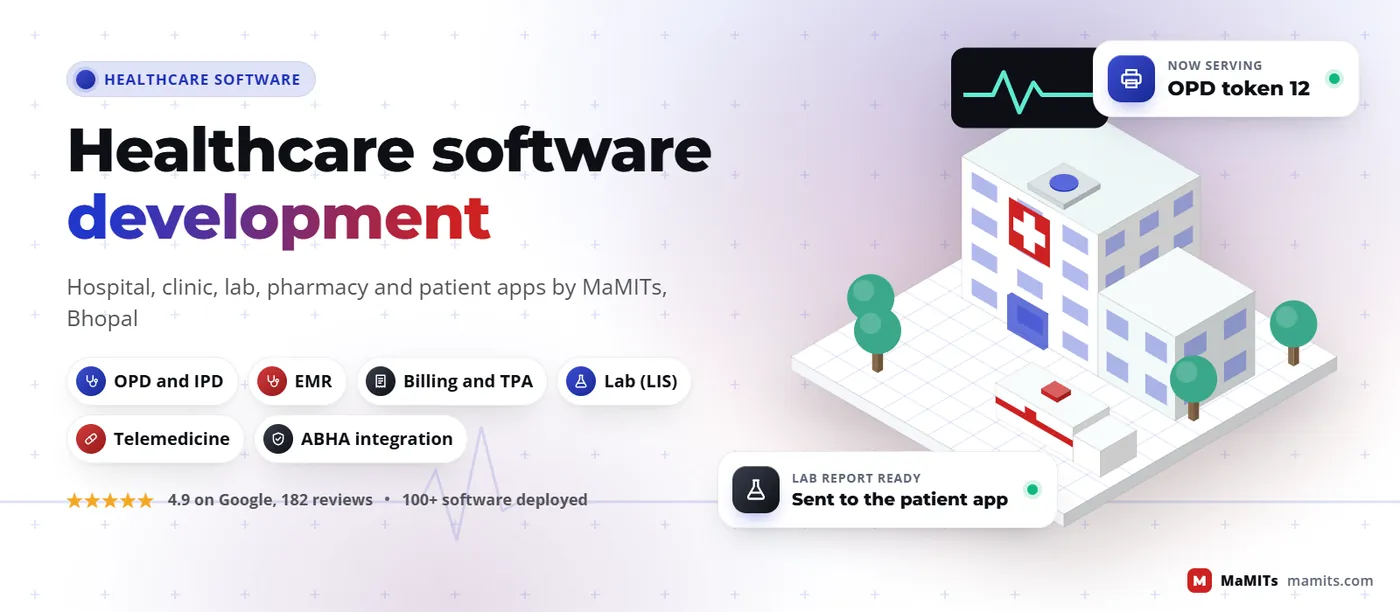
MaMITs is a healthcare software development company in Bhopal that designs and builds hospital management software, clinic software, EMR, lab and pharmacy modules, patient apps and telemedicine that match how your OPD actually runs. We start at the reception desk and the doctor's chair, not at a feature list, then connect what you need: billing, TPA, ABHA, WhatsApp reminders and reports.
Sample data. The same token reaches the patient on WhatsApp.
Quick summary
A healthcare software development company designs, builds and supports software for hospitals, clinics, labs and pharmacies: registration, appointments, EMR, billing, insurance, pharmacy stock, lab reports and patient apps. A good one also handles ABHA and FHIR integration, role-based access, data migration and staff training, so the system holds up on a busy OPD morning.
MaMITs · Bhopal
Definitions first
Real projects are almost always a mix. A small nursing home needs IPD and pharmacy but not a full ERP. A dental chain needs chair scheduling and treatment plans but no wards.
So before we discuss modules, we ask about your busiest hour. The HMS software that survives is the one your front desk can use with twenty people standing in the queue. Teaching hospitals and nursing colleges sit between two worlds, so their academic side (admissions, timetables, exams) is covered on our education software development page.
The patient journey
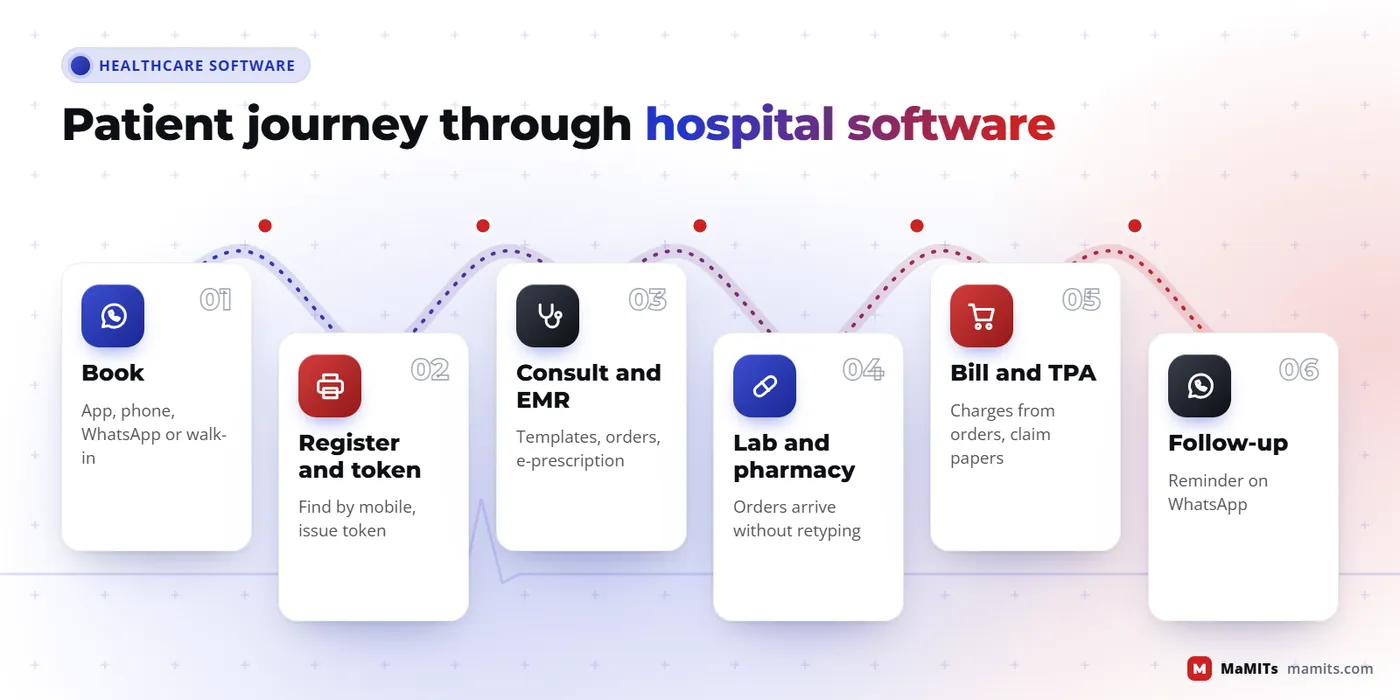
Every facility, from a single-doctor practice in Bhopal to a multispecialty hospital in Delhi, moves a patient along roughly the same path: booking, arrival and registration, token and waiting, consultation, investigations, pharmacy, billing, then follow-up or admission. Software fails when it treats these as separate screens with separate logins and separate patient lists.
App, website, phone or WhatsApp. Walk-ins and online bookings land in one queue per doctor.
A returning patient is found by mobile number in seconds and gets a UHID once, not twice.
The token shows on the display screen and on WhatsApp, so the waiting room is calmer.
Favourites, templates and the last visit on one screen. Orders go to lab and pharmacy from here.
Sample barcode, worklist, pathologist approval and the report reaches the record by itself.
The prescription is already on screen. Batch, expiry and first-expiry-first-out picking.
One running bill. Orders create charges, so the extra dressing is never missed.
A reminder before the next visit, or admission to a bed with the same record and bill.
In OPD, speed decides everything. Registration should find a returning patient by mobile number in seconds, issue a token and push the patient into the right doctor's queue. In IPD, continuity matters more: admission, bed and ward, nursing notes, medication charts, a running bill, deposits, TPA approvals and the discharge summary. A good design keeps one patient record and one running bill, so nothing is retyped between the OPD counter and the ward.
Walk-in heavy clinics can reduce the crowd at the counter with a self check-in kiosk or a token display screen. Kiosks involve hardware (touch screens, thermal token printers, card readers), which we explain on our custom software development page.
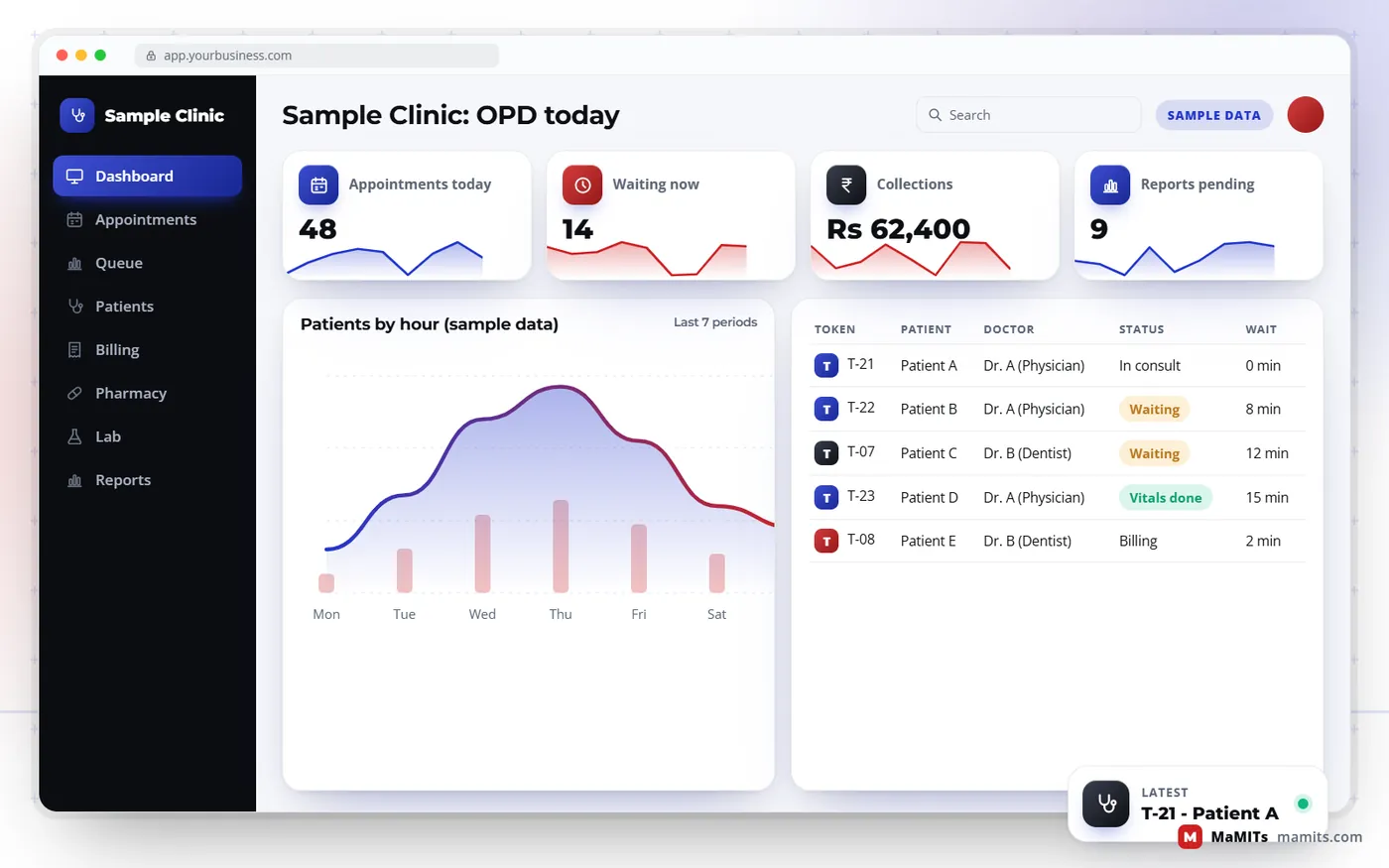
The sample dashboard here shows what a front desk and a clinic owner see: today's appointments, tokens waiting, doctor-wise waiting time, collections and pending reports. Every number opens the list behind it, because a manager who sees '14 waiting' needs to know who is waiting and for which doctor.
The doctor's screen is a different problem. Doctors will not type long notes between patients. We design for clicks and favourites: common complaints, diagnosis lists, prescription templates per doctor, the previous visit on the same screen, and lab results that land in the record without anyone attaching a PDF by hand.
You rarely need all of these on day one. Each card says what the module does and the detail that usually decides whether it works.
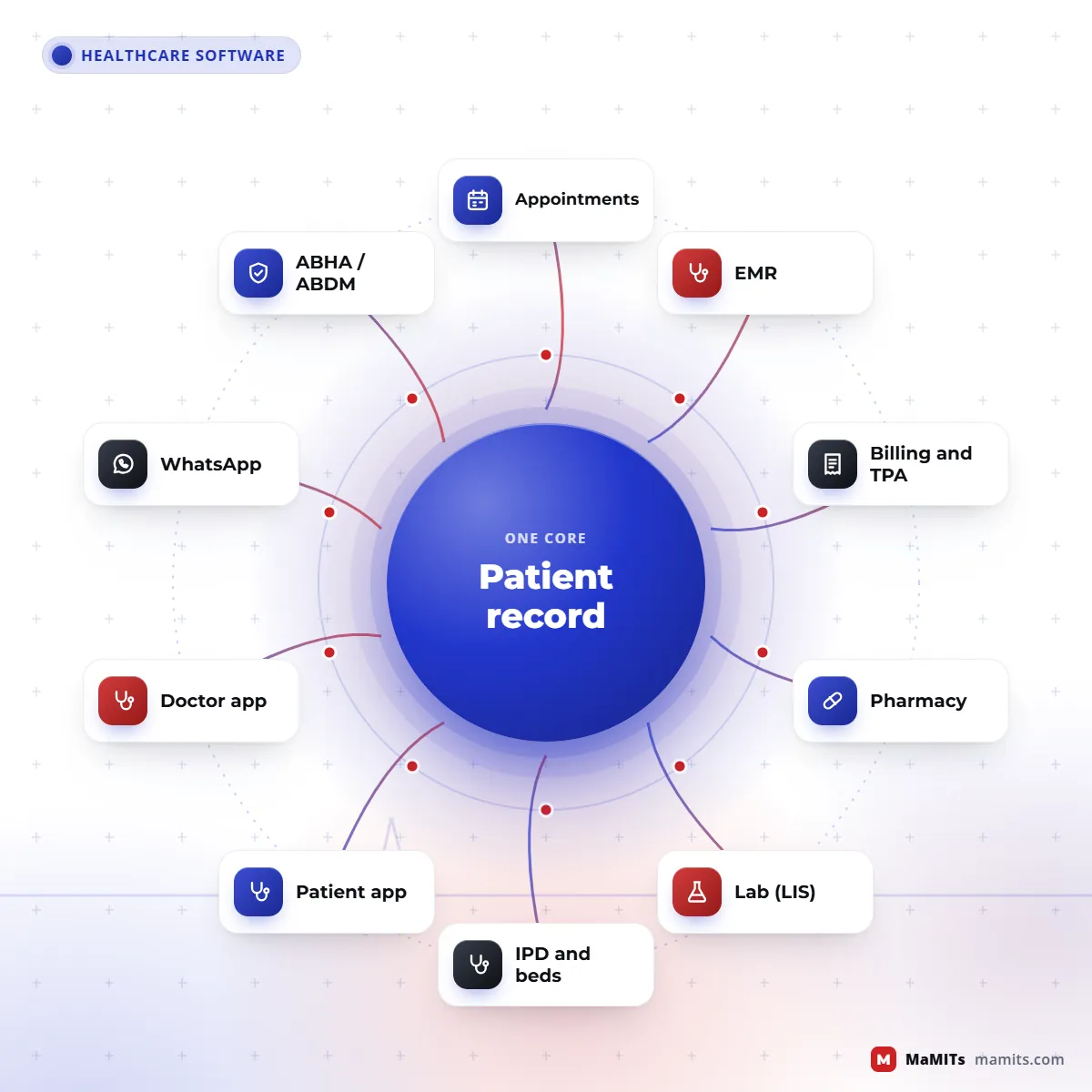
Patient master with a UHID, duplicate checks on mobile and name, family linking, online and walk-in booking. Duplicate patients are the most common data problem we find in older systems.
Vitals, history, diagnosis, orders and printed or digital prescriptions. Specialty templates such as dental charting, eye refraction, IVF cycles or hair and skin grading matter more than a long generic form.
Tariffs, packages, deposits, credit companies and insurance pre-authorisation with document tracking. The National Health Claims Exchange (NHCX), built under ABDM, is moving insurer and TPA claims to a standard format, so claim data should stay structured.
Batch and expiry, first-expiry-first-out picking, purchase orders, returns and ward indents. For deeper purchase and multi-store stock we use the base of our ERP and inventory software.
Sample barcodes, worklists, analyser interfacing where the machine supports it, reference ranges by age and sex, pathologist approval and report delivery on WhatsApp or the patient app.
Bed board, transfers, nursing notes, medication administration, diet, OT scheduling and a discharge summary drafted from data already entered.
Today's list, patient history, quick prescriptions and approvals on a phone, for consultants who move between hospitals during the day.
Footfall, doctor-wise revenue, referral sources, no-show rate, stock value and pending dues. We plan reports with the owner at the start, not as an afterthought.
NeedsOPD, IPD, billing, TPA, pharmacy and lab on one patient record
We buildModular HMS software rolled out department by department
NeedsFast appointments, clean prescriptions, follow-ups that do not slip
We buildClinic management software with doctor templates and WhatsApp reminders
NeedsTreatment plans, packages, consent forms, photos and staged payments
We buildEMR software development for specialty screens, plus package billing
NeedsSample tracking, home collection, B2B billing with referring doctors
We buildLab management software with barcodes and online reports; rider routing as in our logistics software work
NeedsFast billing with batch, expiry and GST, plus purchase
We buildPharmacy software standalone or linked to the hospital; multi-store chains fit our retail software approach
NeedsSession packages, therapist schedules, progress notes
We buildPackage and session tracking with reminders and simple progress charts
NeedsA first version that real patients and doctors will use
We buildTelemedicine app development, patient app, doctor app and admin, with ABDM on the roadmap
NeedsRegistration where the network is weak, camp reports for donors
We buildOffline-first tablet app that syncs later, with short screening forms
India interoperability
The Ayushman Bharat Digital Mission (ABDM), run by the National Health Authority, is India's framework for linking health records with the patient's consent. The parts a buyer meets most are the ABHA number, a 14-digit health ID; the ABHA address, a readable handle the patient can share; the Health Facility Registry and Healthcare Professionals Registry, which verify facilities and doctors; and a consent manager through which the patient approves who sees what.
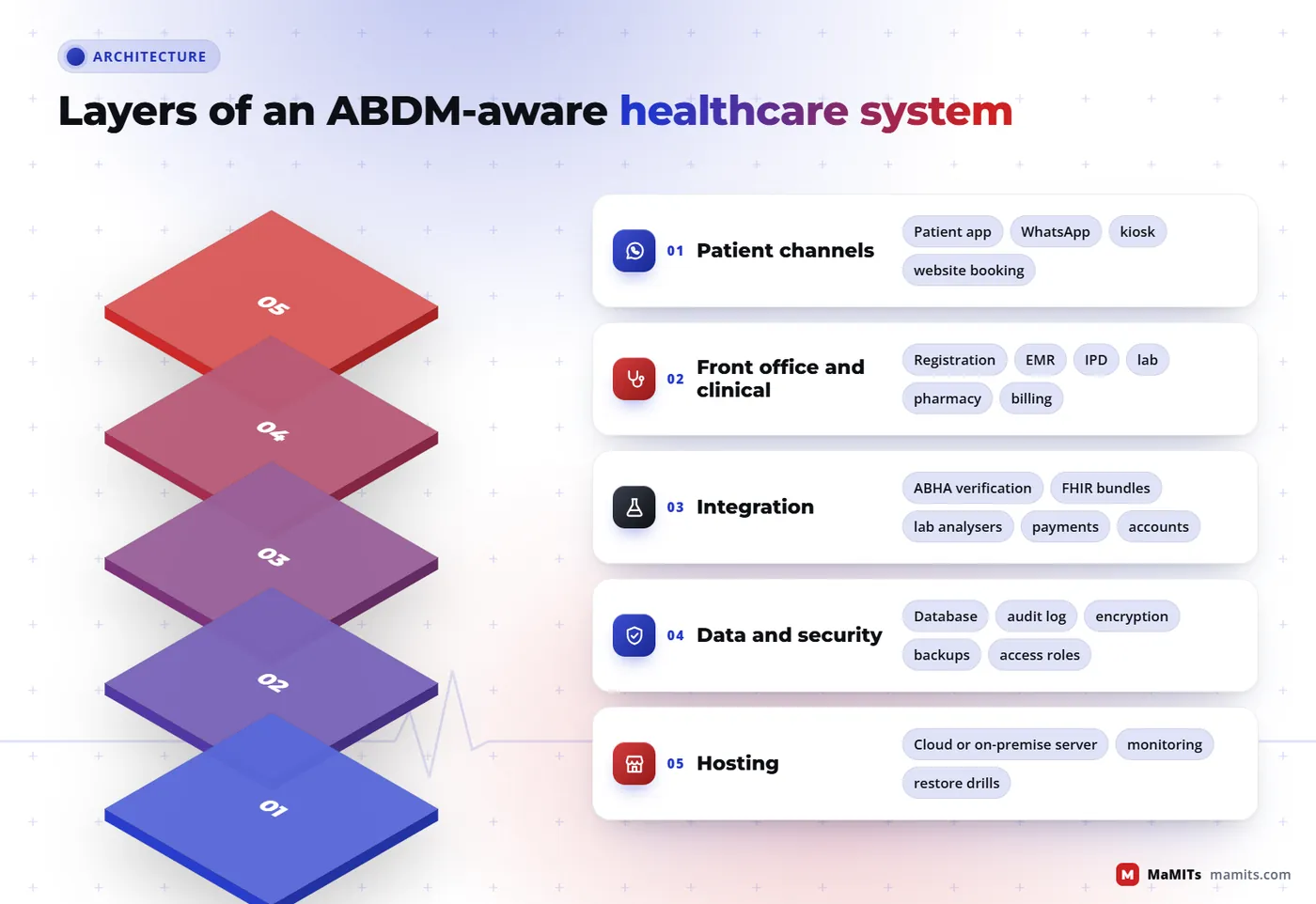
A Health Information Provider (HIP) is a facility whose system creates health records and shares them with the patient through ABDM's consent flow, for example a lab making a report visible in the patient's health records app. A Health Information User (HIU) requests a patient's records from others, again only with consent, for example a doctor viewing last year's discharge summary from another hospital. ABDM integration is done in milestones, starting in the ABDM sandbox and moving to production after NHA's review.
HL7 FHIR is the international standard that describes health data as resources such as Patient, Encounter, Observation and DiagnosticReport, exchanged over web APIs. ABDM uses FHIR R4 profiles published by NRCeS, so a prescription or lab report shared through ABDM is a structured FHIR bundle. If your data is already structured (coded tests, units, dates), producing FHIR is mapping work. If everything is free text, it is a clean-up project first.
MaMITs can integrate your software with ABDM services such as ABHA creation and verification, linking visits to a patient's ABHA and consent-based record sharing, working through the sandbox process with you. We do not claim any government certification on your behalf. Production access is granted by NHA after its own checks, and the APIs change over time, so we budget for updates.
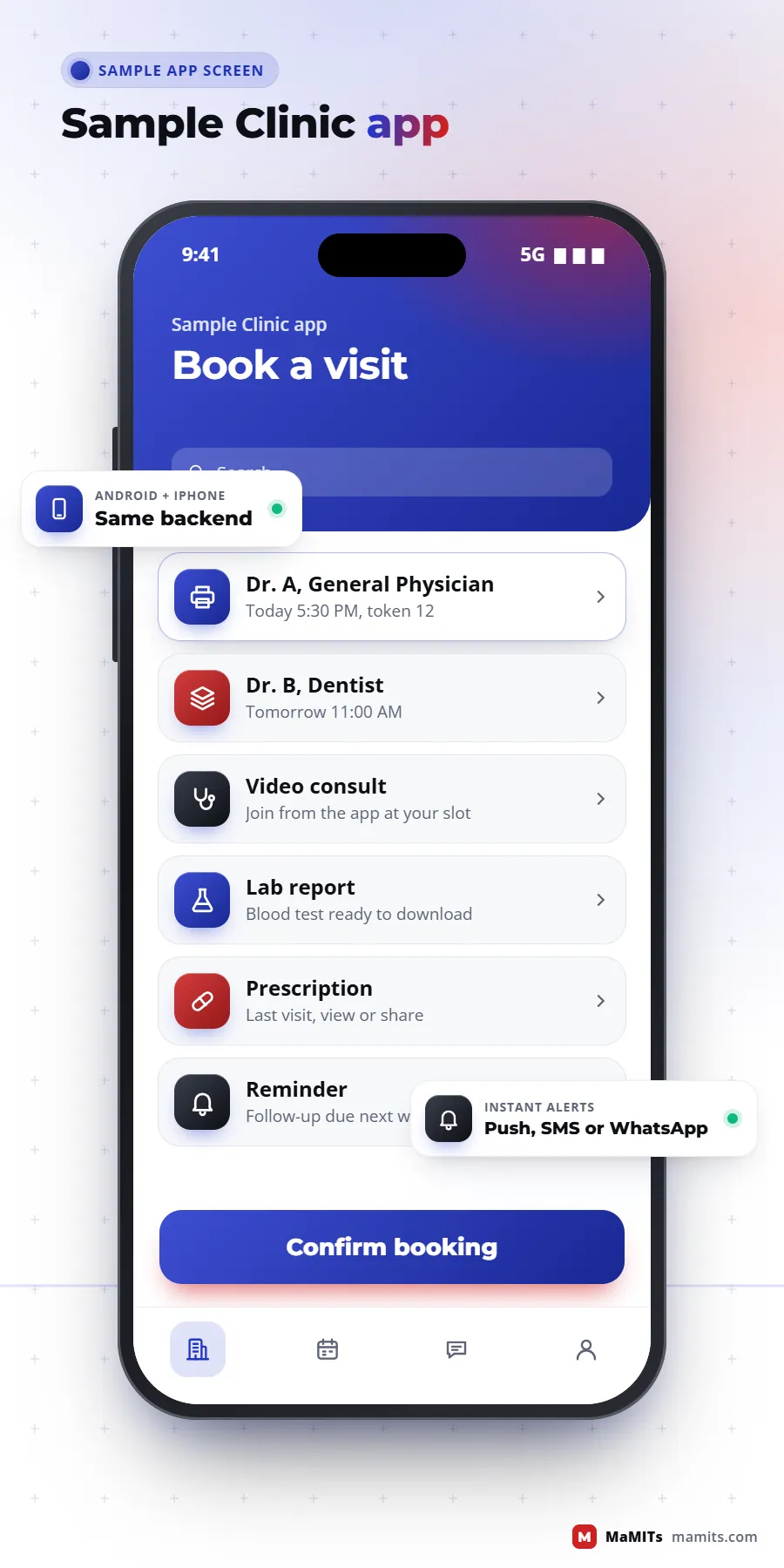
Telemedicine is more than a video call. The app has to confirm who the doctor and the patient are, record the patient’s consent, print the doctor’s registration number on the e-prescription and limit which medicines can be prescribed in which kind of consult, as India’s Telemedicine Practice Guidelines expect. We build these into the screens, so the doctor does not have to remember them.
For the video itself, clinics that want their own branded room can use LiteMeet by MaMITs, our video meeting product, or we embed a video SDK inside the patient app.
Most patient communication is not video, though. It is booking confirmations, token alerts, report-ready messages and follow-up reminders. On WhatsApp these go out as approved templates to patients who have opted in, under Meta's WhatsApp Business Platform rules. A WhatsApp assistant that answers timing and fee questions or rebooks a missed visit is work for our AI development team in Bhopal, with a handover to staff for anything clinical.
Security
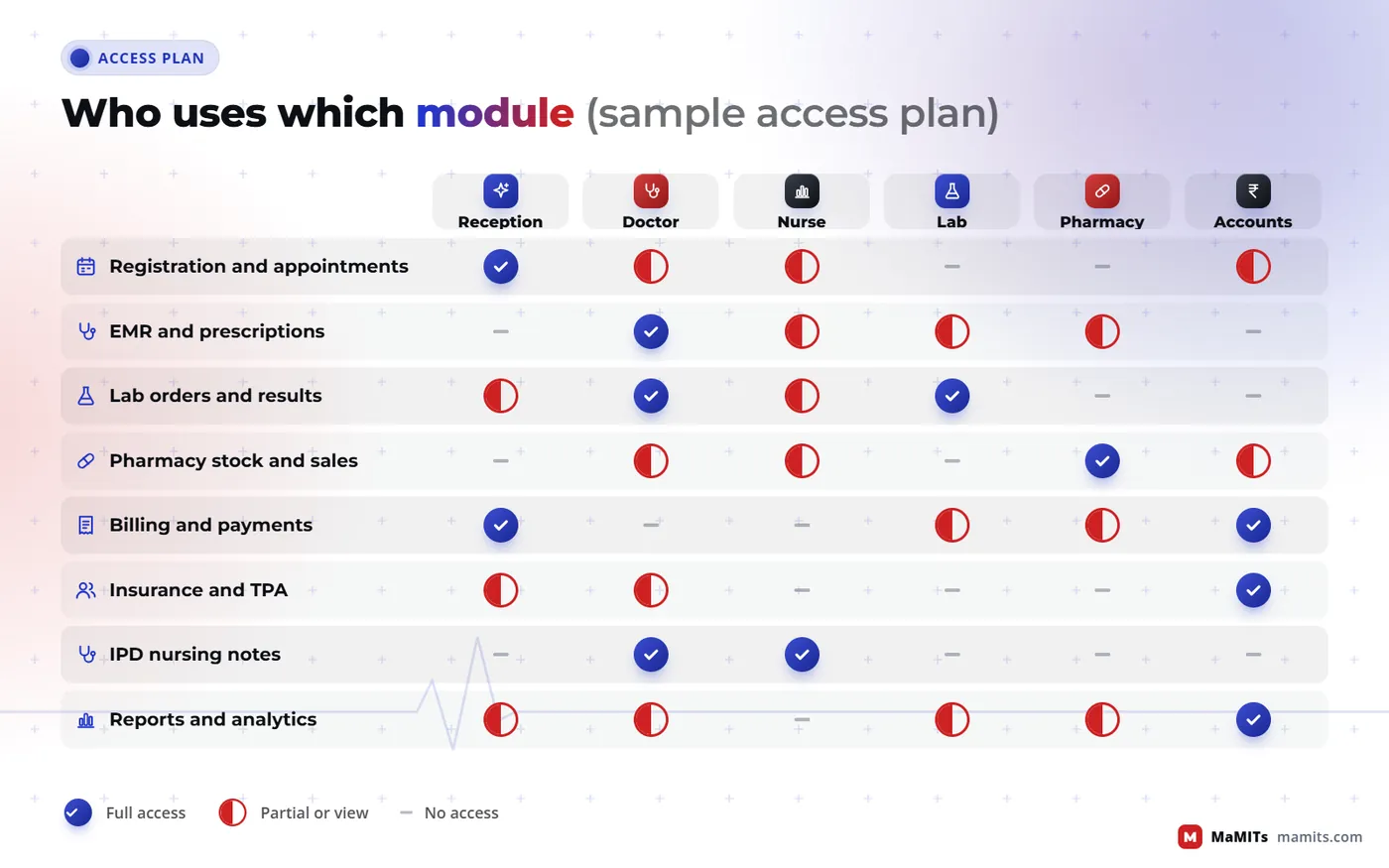
Health records are the most sensitive data most organisations will ever hold. So security is part of the first design, not a feature added at the end. Reception sees what reception needs, a doctor sees the clinical record, and every view or change is logged with a name and a time.
Case study · clinic group, India
MaMITs built a clinic lead, costing and appointment system for a hair transplant clinic group in India. Enquiries arrive as leads, counsellors record follow-ups with the next date, and confirmed patients move onto a surgery calendar. Each case gets a costing with GST that becomes a quotation or an invoice, and staff see only the centres they are assigned to.
The pattern behind that project applies to many clinics. In elective, package-based care (hair, skin, dental, IVF, cosmetic), revenue is usually lost before the patient walks in: slow follow-ups and inconsistent quotes from different counsellors. Such a clinic may need lead and costing software more urgently than a full EMR. Our Lead Management Software is the product version of the same idea.
| Question | Ready-made HMS software | Custom healthcare software | Hybrid (product plus custom modules) |
|---|---|---|---|
| Time to start | Fast, after setup and training | Slower, needs scoping and build | Medium: core first, custom parts later |
| Fit to your workflow | You adapt to the product | Built around your workflow | Standard core, fitted edges |
| Specialty screens (dental, IVF, hair) | Often generic | Designed for the specialty | Added as custom modules |
| Data ownership and export | Check the contract carefully | Yours, with full database access | Agree it in writing |
| Integrations (ABHA, analysers, WhatsApp, accounts) | Only what the vendor supports | What you need, at build cost | A mix of both |
| Running cost | Subscription per user or branch | Hosting plus a support plan | Both, usually smaller |
| Best for | Standard workflows, tight budget | Chains, startups, unusual workflows | Growing clinics and hospitals |
There is no single right answer. If a ready-made product already covers nearly all of your workflow, buy it, and ask us only for the missing integration.
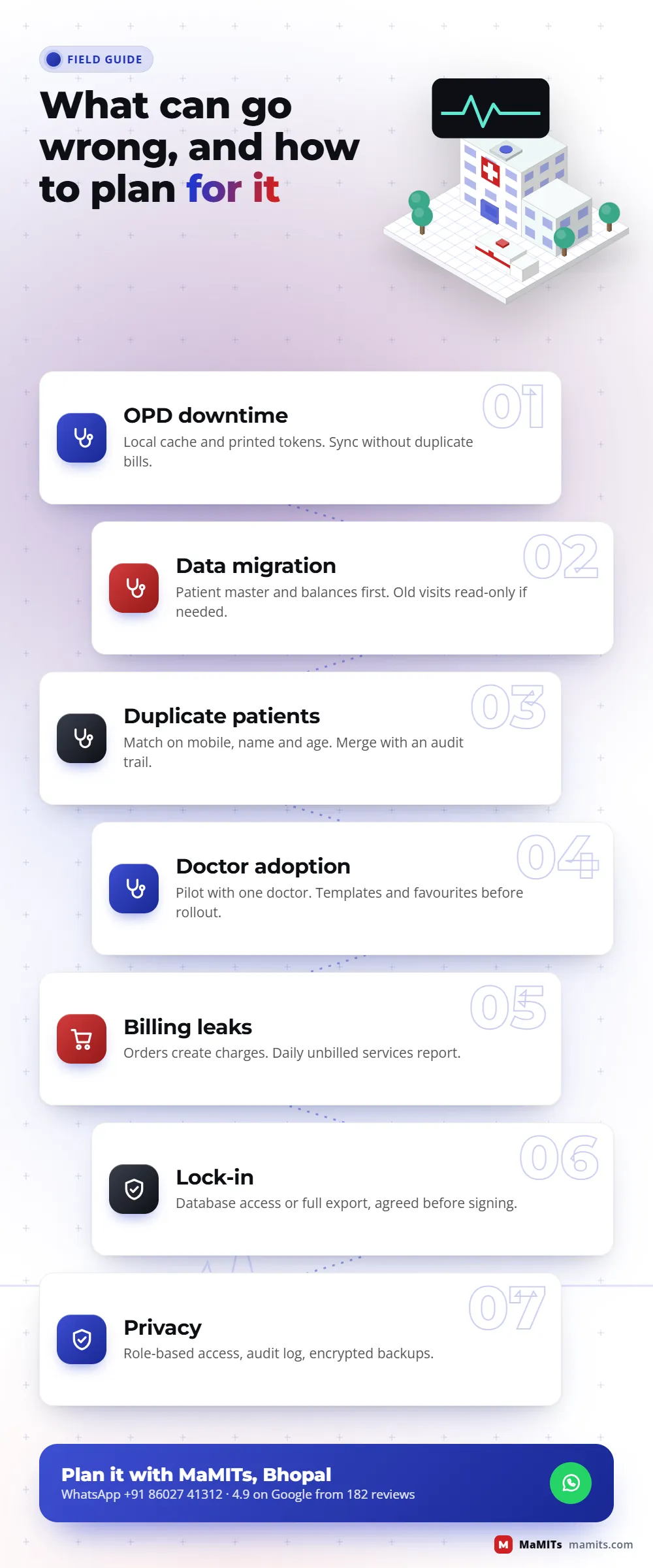
If the server or internet drops at 11 in the morning, the queue does not stop. Plan a fallback: printed token rolls, a local cache for registration, and a sync that does not create duplicate bills when the line returns.
Old software often holds years of patients with duplicate names, missing phone numbers and free-text diagnoses. Move the patient master and balances first, keep old visits read-only if mapping is poor, and run both systems side by side for a short, defined period.
Doctors forced into slow screens drift back to paper. Pilot with one doctor and one counter, fix the screens, then roll out.
Services given but never charged, such as an extra dressing or a repeat test, are common when ward and billing are not linked. Orders should create charges automatically.
Insist on database access or a full export in a documented format before you sign.
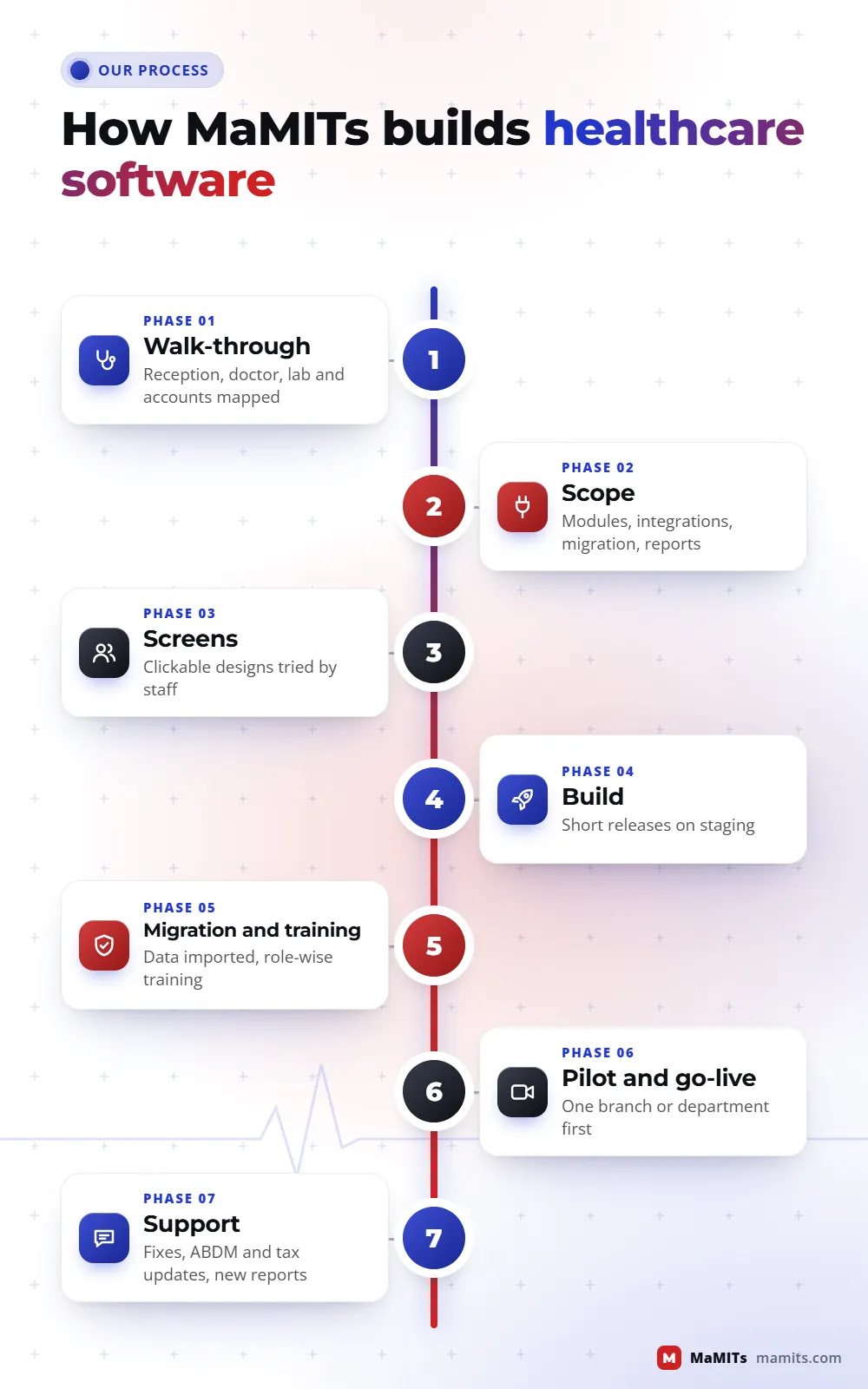
We sit with reception, a doctor, the lab and accounts (in person in Madhya Pradesh, online elsewhere) and map the patient journey and every paper register you still use.
A written module list: what goes live first, integrations, data to migrate and the reports the owner wants.
Registration, doctor and billing screens as designs your staff can try before code is written.
Modules arrive on a staging system at regular intervals for testing with realistic sample data.
Patient master and balances imported, role-wise training and a one-page quick guide for each counter.
One branch or department first, with support on site or on call through the first OPD days.
Fixes, updates for ABDM or tax changes and new reports, under an agreed support plan.
We do not publish a fixed price, because two clinics asking for 'clinic software' can need very different things. MaMITs quotes after a scoping call, and a small module, such as appointments with WhatsApp reminders, can start after a short scoping session.
A sensible way to control cost is to launch the module that hurts most, use it for a month, then fund the next one. Apps follow the same thinking as our mobile app development work: one shared backend, then the screens. For pharma or device plants, batch traceability belongs on our manufacturing software page instead.
The main cost factors
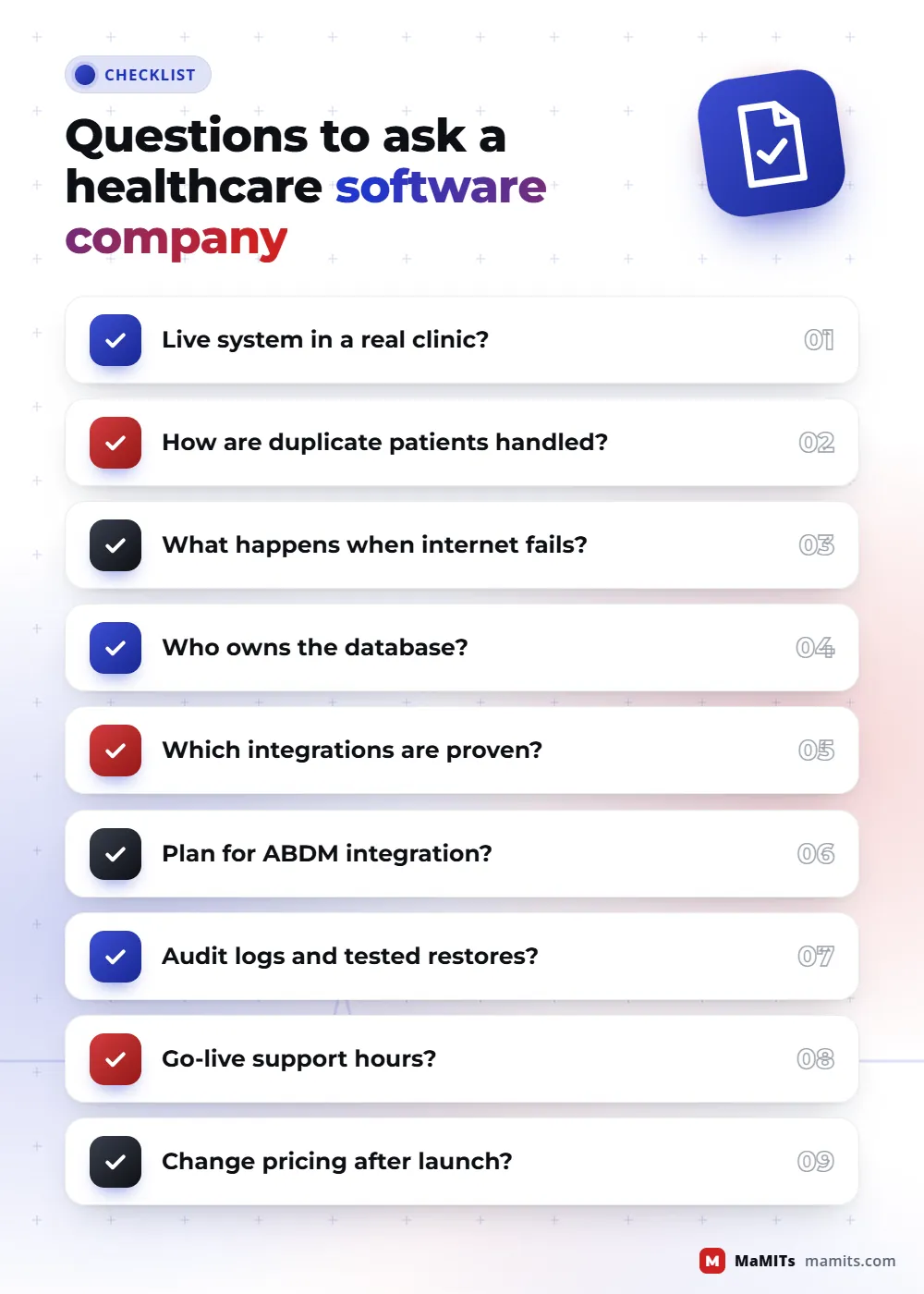
People searching for the best or No. 1 hospital software company usually compare demos. Demos hide the hard parts. Ask these questions instead.
A vendor that answers clearly, including 'we have not done that yet', is safer than one that says yes to everything.
MaMITs is a software company in Bhopal that works with healthcare businesses across India and abroad. Meetings follow a simple rule, so that we arrive prepared.
Madhya PradeshIn person with 3 days notice
Our office is in Ayodhya Nagar. Clinics and hospitals in Bhopal can meet us in person with 3 days notice, and we can watch your OPD during the morning rush.
Clinics, diagnostic centres and hospitals in Indore get in-person meetings with 3 days notice, so we can watch the reception and lab desk at work.
Hospitals and labs in Gwalior and Jabalpur get in-person visits with 3 days notice, because an OPD flow has to be seen before it is designed.
Nursing homes, eye and dental clinics and diagnostic centres across the state usually start with appointments, billing and reports on WhatsApp in Hindi and English. We visit anywhere in Madhya Pradesh with 3 days notice.
Beyond Madhya PradeshIn person with 7 days notice in India, online abroad
Delhi, Noida and Gurugram in person with 7 days notice, with online reviews in between.
In person with 7 days notice across Maharashtra, and the same for Uttar Pradesh.
Online meetings. Healthtech products for patients abroad are planned with their security needs from the first design.
FAQ
A hospital management system covers the whole facility, including IPD admissions, beds, nursing, OT, pharmacy, lab, insurance and accounts. Clinic management software focuses on appointments, consultation notes, prescriptions, billing and follow-ups for one or a few doctors. Many growing clinics start with clinic software and add IPD or lab modules later, so the data model should allow that from the start.
It depends on modules, number of branches and users, integrations such as ABHA or lab analysers, apps, data migration and the support level. Ready-made products usually charge a subscription, while custom software is quoted on scope. MaMITs gives a written quote after a scoping call, and a small module such as appointments with reminders can start after a short session.
Yes, MaMITs can integrate hospital, clinic or lab software with ABDM services such as ABHA creation and verification, linking visits to a patient's ABHA, and consent-based sharing of records as FHIR bundles. The work starts in the ABDM sandbox. Production access is granted by the National Health Authority after its review, so we do not claim certification on your behalf.
Yes. The Telemedicine Practice Guidelines of March 2020 allow registered medical practitioners to consult by video, audio or text. Doctor and patient identity must be established, consent recorded where the doctor starts the consult, and prescriptions follow medicine lists that depend on the type of consultation. Some drug categories cannot be prescribed through telemedicine at all.
EMR software development means building the electronic medical record a facility uses for its own patients: history, vitals, diagnosis, orders, results, prescriptions and notes. The hard part is speed for doctors, so good EMRs use specialty templates, favourites and previous-visit views instead of long forms. Structured data also makes FHIR sharing and analytics much easier later.
Usually yes, if the old system allows a database export or reports in Excel or CSV. We first move the patient master, outstanding balances and stock, then decide whether old visits can be mapped or should stay as read-only history. Expect duplicate patients and inconsistent names; cleaning them is part of the migration plan, not an afterthought.
It can, if it is designed for it. Options include an on-premise server for the main hospital, a local cache that lets registration and token issue continue, and printed fallback forms. When the connection returns, records sync with checks that prevent duplicate bills. Which option fits depends on your size, your internet reliability and your budget.
Yes. A patient app usually covers booking, payment, live token status, reports, prescriptions and reminders, and a doctor app covers the day's list, history and e-prescriptions. Both share one backend with the hospital or clinic software. MaMITs has delivered 30+ mobile apps, and we decide native or cross-platform after looking at the features you need.
Yes. After the pathologist approves a report, the lab management software can send a WhatsApp message with a secure download link or the PDF, using an approved template sent to patients who have opted in. We avoid sending reports without approval, and we keep a delivery log so the lab can show when each report went out.
Yes. A multi-branch design keeps one patient record across branches, so a patient seen in one centre can be found in another, while billing, stock, doctors and reports stay branch-wise. Staff can be limited to their own centre, and the owner sees combined and branch-wise numbers on one dashboard.
Yes. MaMITs works from Bhopal with clients across India and abroad. Clients in Madhya Pradesh can meet us in person with 3 days notice, and Delhi NCR, Mumbai, Pune and Uttar Pradesh with 7 days notice. Clients in the USA, Canada, Australia and the UK work with us through online meetings.
Next step
Send a WhatsApp to +91 86027 41312 with your type of facility, the number of doctors or branches, and the one problem you want solved first. We will reply with questions, then set up a scoping call.
MaMITs, 144, Neerja Nagar, Durgesh Vihar, Ayodhya Nagar, Bhopal 462041 · ★ 4.9 on Google from 182 reviews