×

App Development Company in Bhopal- MaMITs

Website designing in Bhopal 10+ Years dynamic experience in website designing and ecommerce development. App development company Bhopal MaMITs.

1We Support 24x7.
2Call Now - +91-860-2741312
3 Address -

144, Durgesh Vihar, Ayodhya Nagar, Bhopal, Madhya Pradesh ,India : 462022

If you still have problems, please let us know, by sending an email to info@mamits.comThank you!

GET A FREE QUOTE

Please fill this for and we'll get back to you as soon as possible!

Retail, wholesale and distribution software

Retail Software Development Company in Bhopal for Stores, Distributors and Dealer Networks

MaMITs is a retail software development company in Bhopal that builds the software between your goods and your money: store operations, distributor management, salesman order booking, B2B dealer ordering and loyalty. We design it around how your trade actually runs, including schemes, credit and returns, instead of forcing you into a generic billing screen.

  • Rated 4.9 on Google from 182 reviews
  • 100+ software deployed, 30+ mobile apps
  • Built for India first: GST touch points, WhatsApp, offline field use
4.9Google rating, 182 reviews
100+Software deployed
30+Mobile apps
180+Live websites

Quick summary

What does a retail software development company build?

A retail software development company builds software for selling and moving goods: multi-store operations, pricing and schemes, distributor management, salesman order booking apps, B2B ordering portals for dealers, loyalty, and online store sync. Good builds connect these to billing, stock and accounts, so one order is entered once and seen correctly everywhere.

  • CoversStores, wholesale, distributors, dealers, field sales
  • Typical usersOwners, store staff, salesmen, distributors, retailers
  • Works withBilling, GST, stock, accounts, WhatsApp, e-commerce
  • Meet usBhopal office, MP in person with 3 days notice

Start with the map

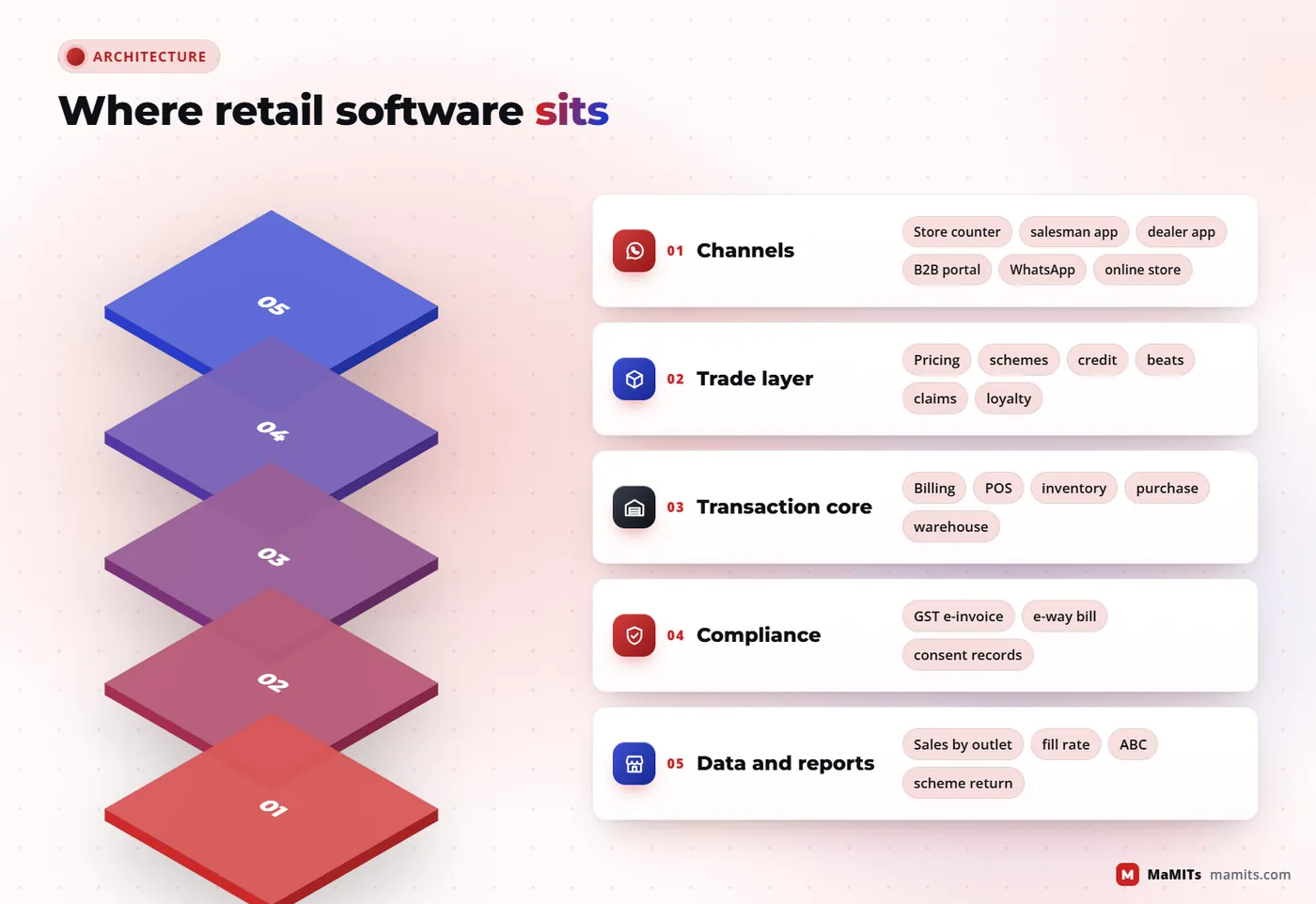
Retail software is not one product: what sits where

Most buyers arrive asking for billing software and leave with a list of six problems billing never touched. Naming the layers first saves months.

A shop counter, a distributor godown and a brand's sales office all sell goods, yet their pain is different. The counter needs speed and correct prices. The godown needs to know which retailer owes how much and which scheme was promised. The brand needs to see what actually sold on the shelf, not just what it pushed to the distributor. Retail management software that handles only the counter leaves the other two working in spreadsheets and WhatsApp screenshots.

We split the work into two families. The transaction core is billing, POS, inventory, purchase and warehouse. That depth lives on our ERP, CRM and inventory software page, because it is shared by factories, traders and service firms alike. The trade layer is what this page is about: store-wise pricing, schemes, distributor and dealer relationships, field sales, B2B ordering, loyalty and channel sync. The trade layer is where Indian retail and wholesale businesses differ most from each other, and where off-the-shelf tools usually bend the least.

Why the split matters when you buy

If a vendor quotes you a full suite, ask which part is their product and which part they will customise. A strong core with a weak trade layer is the most common reason distributors run two systems side by side. As a retail software development company we often keep a client's existing billing or Tally setup and build the trade layer on top, which is cheaper than replacing everything.

Trade layer this page

  • Store-wise pricing
  • Schemes
  • Distributor and dealer
  • Field sales
  • B2B ordering
  • Loyalty
  • Channel sync

Transaction core ERP page

  • Billing and POS
  • Inventory
  • Purchase
  • Warehouse
  • Accounts
Layered diagram of retail software with trade layer above ERP core billing inventory and warehouse
The trade layer sits on top of the billing, stock and accounts core.

Who this is for

Which retail and wholesale businesses need custom software?

Not every shop needs custom work. These are the businesses where we usually see ready software run out of road.

A1

Retail chains and single stores scaling up

NeedsSame product priced differently by store, stock transfers, staff shifts, one view across branches

We buildMulti-store control panel, store-wise price lists, transfer and returns workflow, shift close reports

A2

Supermarkets and kirana networks

NeedsThousands of SKUs, loose and packed goods, home delivery orders from regular customers

We buildBarcode and weighed-item pricing, WhatsApp and app ordering, customer credit and loyalty

A3

Fashion, footwear and electronics retailers

NeedsSize and colour variants, serial or IMEI tracking, exchange and warranty rules

We buildVariant-aware catalogue, serial capture at sale, exchange and warranty claim flows

A4

Pharma and FMCG distributors, stockists, wholesalers

NeedsBatch and expiry, schemes, credit limits, salesman beats, claims with the company

We buildDistributor management system, salesman app, scheme engine, expiry returns and claim tracker

A5

Brands with dealer networks

NeedsDealers ordering by phone, unclear secondary sales, scheme payouts disputed every quarter

We buildDealer management software, B2B ordering portal and dealer app, target and scheme dashboards

A6

D2C brands and franchise businesses

NeedsOwn website plus marketplaces plus franchise outlets, all drawing from one stock

We buildOmnichannel retail software with channel sync, franchise ordering and royalty reports

Multi-store retail

Running several stores without running several businesses

The second store is where most retailers lose control. The owner can no longer stand at the counter, so prices drift, a staff member gives an unapproved discount, and stock that shows in one branch is actually sitting in the other's back room. Retail management software for multiple stores has to enforce rules centrally while still letting each store act quickly.

In a typical setup the head office owns the master catalogue and price lists, then assigns them by store or by region. A mall store can carry a different price from a high-street store, and a clearance price can run in one branch only. Schemes such as buy two get one, slab discounts or bank-card offers are defined once with dates and store scope, so the counter staff cannot invent their own. Returns follow a policy: within how many days, with or without a bill, cash refund or credit note, and who approves.

Inter-store transfers deserve their own workflow. Goods leave one store as an outward transfer, sit in transit, and are received with a count at the other end. Differences are flagged instead of silently disappearing. Staff management closes the loop: shift open and close, cash declared versus system cash, sales by staff member, and incentive calculation where you pay one.

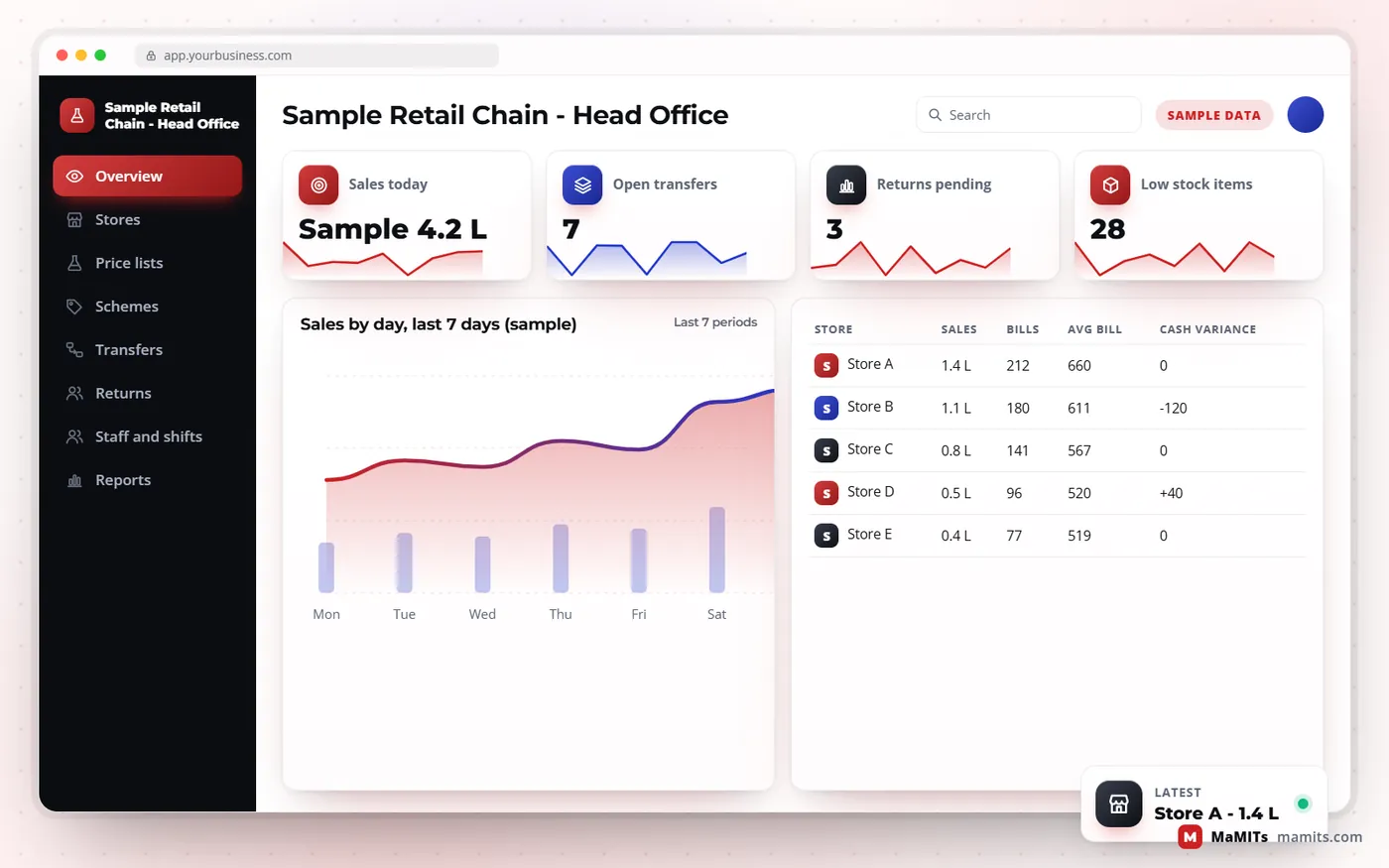
Multi-store retail management software dashboard with store sales, transfers and stock alerts using sample data
Sample multi-store dashboard: sales, transfers and returns by store.

One SKU, three store prices (sample)

Store AMallRs 499
Store BHigh streetRs 479
Store CClearanceRs 399
  • Store-wise and region-wise price lists with start and end dates
  • Scheme rules defined centrally, applied automatically at the counter
  • Transfers with dispatch, in-transit and receipt counts
  • Return and exchange policy with approval levels
  • Shift close, cash variance and staff-wise sales

Distributor management system

Primary, secondary and tertiary sales, explained in plain words

  1. 01
    Brand pushes a scheme

    A quarter-end scheme makes distributors buy more. Primary sales jump.

  2. 02
    Distributor godown fills

    Stock arrives, but retailers are still selling at the old pace.

  3. 03
    Salesman beats run

    Orders from outlets climb slowly. Secondary sales start to catch up.

  4. 04
    Shelf moves, or does not

    Tertiary sales show what customers really bought. The gap is now visible.

  5. 05
    Expiry comes back

    Unsold stock returns as expiry claims. A brand watching only primary sales sees it months late.

0 points between what the brand sold and what the shelf sold. Sample data.

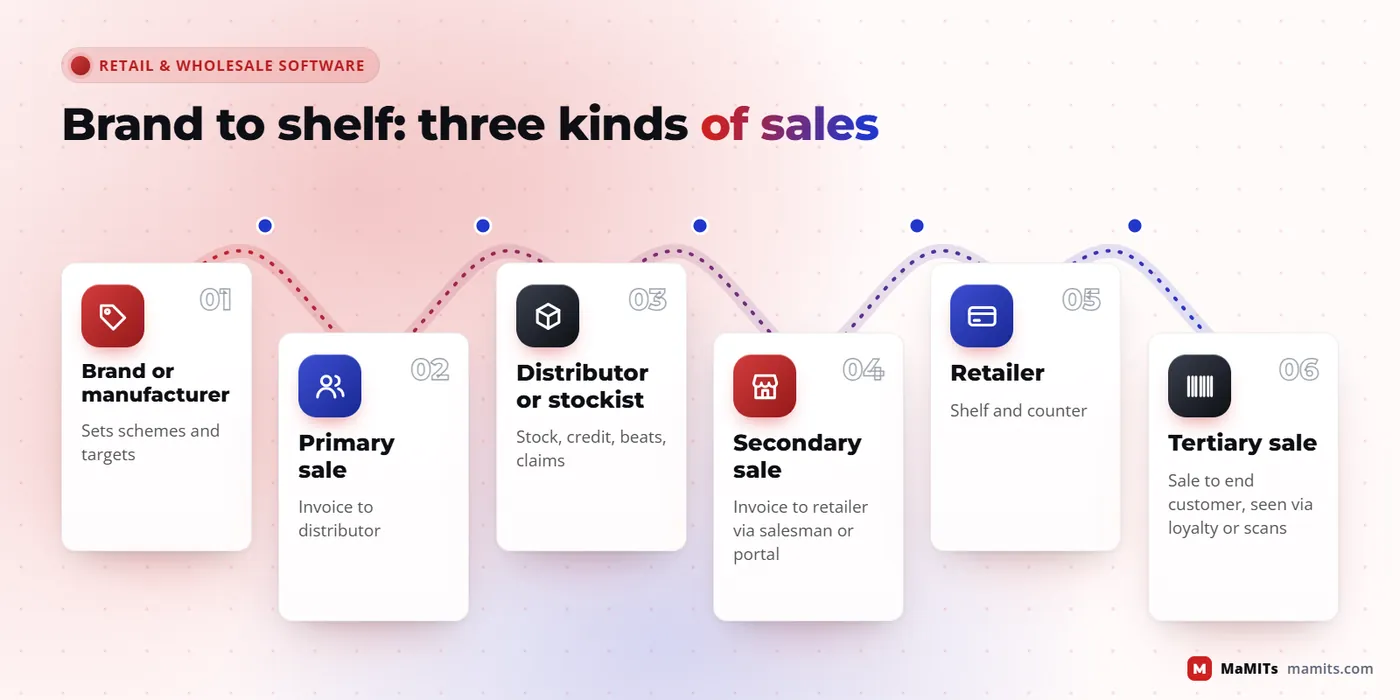
Primary sales are what the brand or manufacturer sells to its distributor or stockist. Secondary sales are what the distributor sells onward to retailers: the kirana, the chemist, the hardware shop. Tertiary sales are what the retailer sells to the end customer. A brand that sees only primary sales can be fooled for months: distributors keep buying because of a scheme, while the shelf is not moving, and the stock comes back later as expiry or as a demand for price support.

A distributor management system sits at the distributor and captures secondary sales as they happen: every invoice to every retailer, with product, scheme and salesman. That data flows up to the brand, giving it real sell-through by town and outlet. Tertiary data is harder, because it lives in the retailer's billing. It is usually gathered through loyalty programmes, retailer apps, scan-based schemes or modern-trade data shares, so plan for partial coverage rather than promising it everywhere.

Flow of goods from brand to distributor to retailer to customer showing primary secondary and tertiary sales
Primary, secondary and tertiary sales, and what each stage records.

What a distributor management system must handle

Distribution management software earns its keep in the details that cause disputes between brand, distributor and retailer.

  • Credit limits and credit days per retailer, with order blocking or approval when crossed
  • Scheme and discount engine: slab, quantity free, value discount, combo, period and territory scope
  • Claims: scheme reimbursements, price drop, damage and expiry claims raised to the company with proof
  • Batch and expiry visibility so near-expiry stock is pushed or returned in time, essential for pharma and FMCG
  • Beat plans and outlet master: which salesman covers which outlets on which day
  • Fill rate: what was ordered versus what was actually supplied
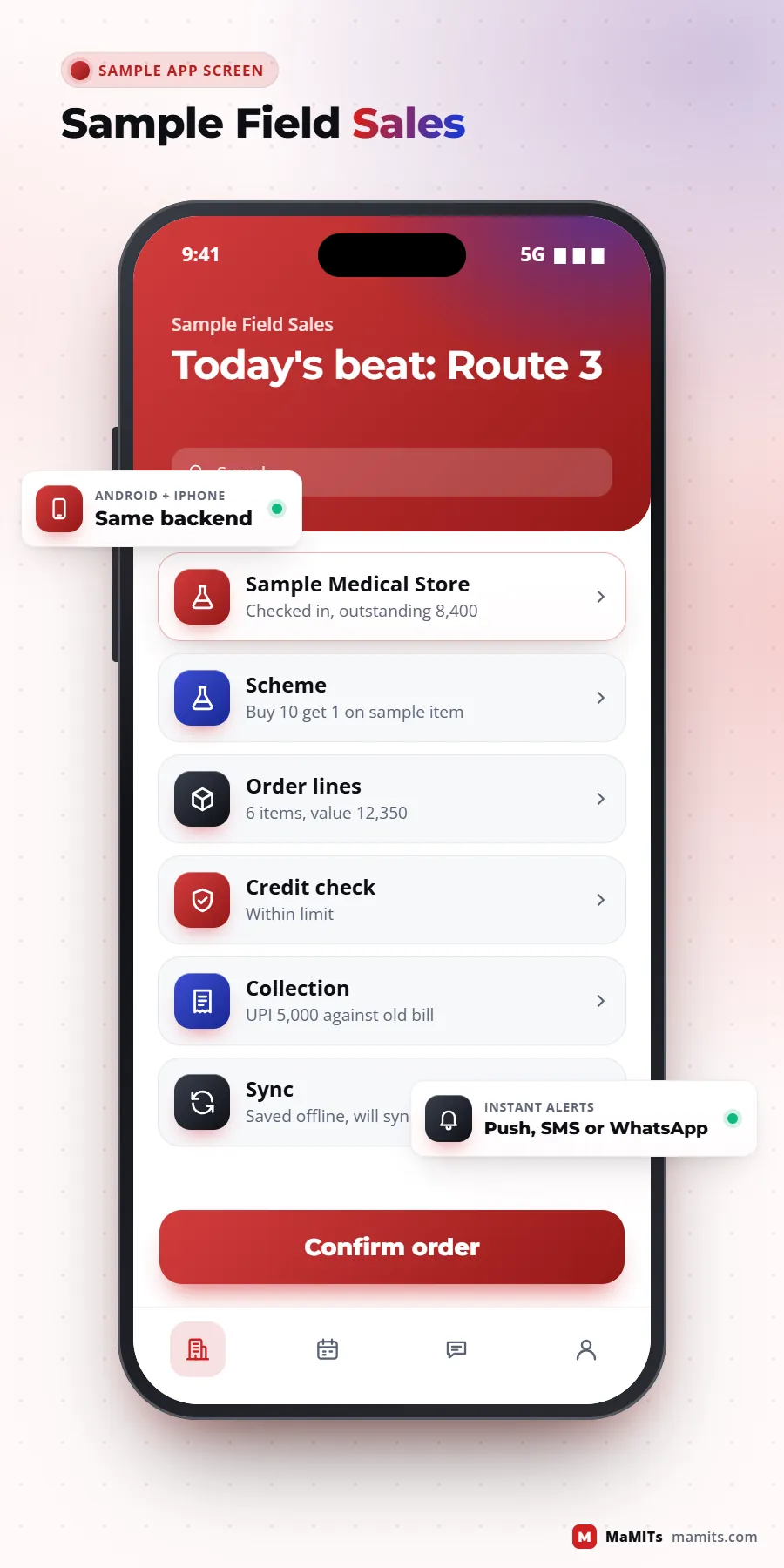
Salesman order booking app screen showing outlet visit, scheme, outstanding and offline order sync status
Sample salesman app screen during an outlet visit.

Field sales

Salesman app and order booking app that work in weak network areas

A salesman app is only useful if salesmen actually use it in the market, and markets in tier 2 and tier 3 towns often have patchy mobile data. So the first design rule is offline first: the day's beat, outlet list, price list, schemes and retailer outstanding are downloaded in the morning, orders are booked without network, and everything syncs when signal returns. An order booking app that shows a spinning loader in a chemist's shop gets abandoned within a week.

GPS check-in at the outlet confirms the visit, and a photo option helps with display or merchandising checks. We are careful with tracking though. Continuous live tracking drains batteries and annoys good salesmen, so most distributors prefer location at check-in, order and day close, which is enough for beat compliance. Collections are part of the same visit: cash, cheque or UPI collected against specific invoices, with a receipt sent to the retailer on WhatsApp so there is no argument later.

Managers see the day as it unfolds: planned versus visited outlets, productive calls, order value, new outlets added and collections. That is where a salesman app pays for itself, by showing which beats are profitable and which outlets have not ordered in a month.

Today’s beat, Route 3 (sample)

Order bookedCollectionNot visited yet
  • Offline order booking with later sync
  • GPS check-in, check-out and visit photos
  • Scheme suggestion and credit-limit warning at order time
  • Collections against invoices with WhatsApp receipt
  • Attendance, beat compliance and expense claims

Wholesale software

Wholesale software modules that stop money leaking

Wholesale margins are thin, so small leaks matter. These are the modules where we most often find the leak.

Credit control

Limit by retailer, ageing of dues, hold on new orders past due days, and a clear override trail when the owner allows an exception.

Scheme engine

Company schemes and your own schemes kept separate, so you know which discount the brand will reimburse and which came out of your margin.

Claims tracker

Every claim raised to a brand with invoices, photos and status. Unsettled claims are often hidden profit that nobody is chasing.

Returns and expiry

Sale returns, damage and expiry tracked by batch, with near-expiry alerts so stock is liquidated or returned within the company's window.

Price and barcode control

MRP, trade price and special rates per customer group, barcode label printing, and controls against selling below cost by mistake. Brands selling through modern trade usually need GS1 India barcodes on their packs.

B2B ordering and dealer apps

B2B ordering portal, dealer app and WhatsApp ordering

Many distributors still take orders by phone call at 9 pm, written on paper and keyed in next morning. A B2B ordering portal lets regular retailers and dealers order themselves, at their own price list, with their own schemes and outstanding visible before they confirm. It does not replace the salesman. It frees him from being an order-taker so he can open new outlets and push new lines.

For brands, dealer management software adds what a portal alone lacks: dealer onboarding and documents, targets, scheme eligibility, ledger and statement downloads, warranty or service requests, and a channel for announcements. The dealer app should feel like a simple shopping app, because the person using it is often a shop owner on a budget phone, not an accountant.

WhatsApp is where retailers already are. The WhatsApp Business Platform catalog features allow catalogue, single-product and multi-product messages, so a retailer can browse and send an order without installing anything. We connect these to the order system and, where it helps, add an AI assistant that reads a typed or voice order and converts it into lines for confirmation. That AI work is covered on our AI development company in Bhopal page.

  • Customer-specific price lists, schemes and minimum order rules
  • Outstanding, ledger and invoice download for each retailer
  • Reorder from previous order in two taps
  • WhatsApp catalogue ordering linked to the same stock
Sample Kirana StoreLast order 6 days ago
  • Sample biscuit 200 gx 24
  • Sample tea 500 gx 12
  • Sample soap 4-packx 36
Outstanding Rs 8,400

Tap Reorder: the same lines, today’s price list and scheme.

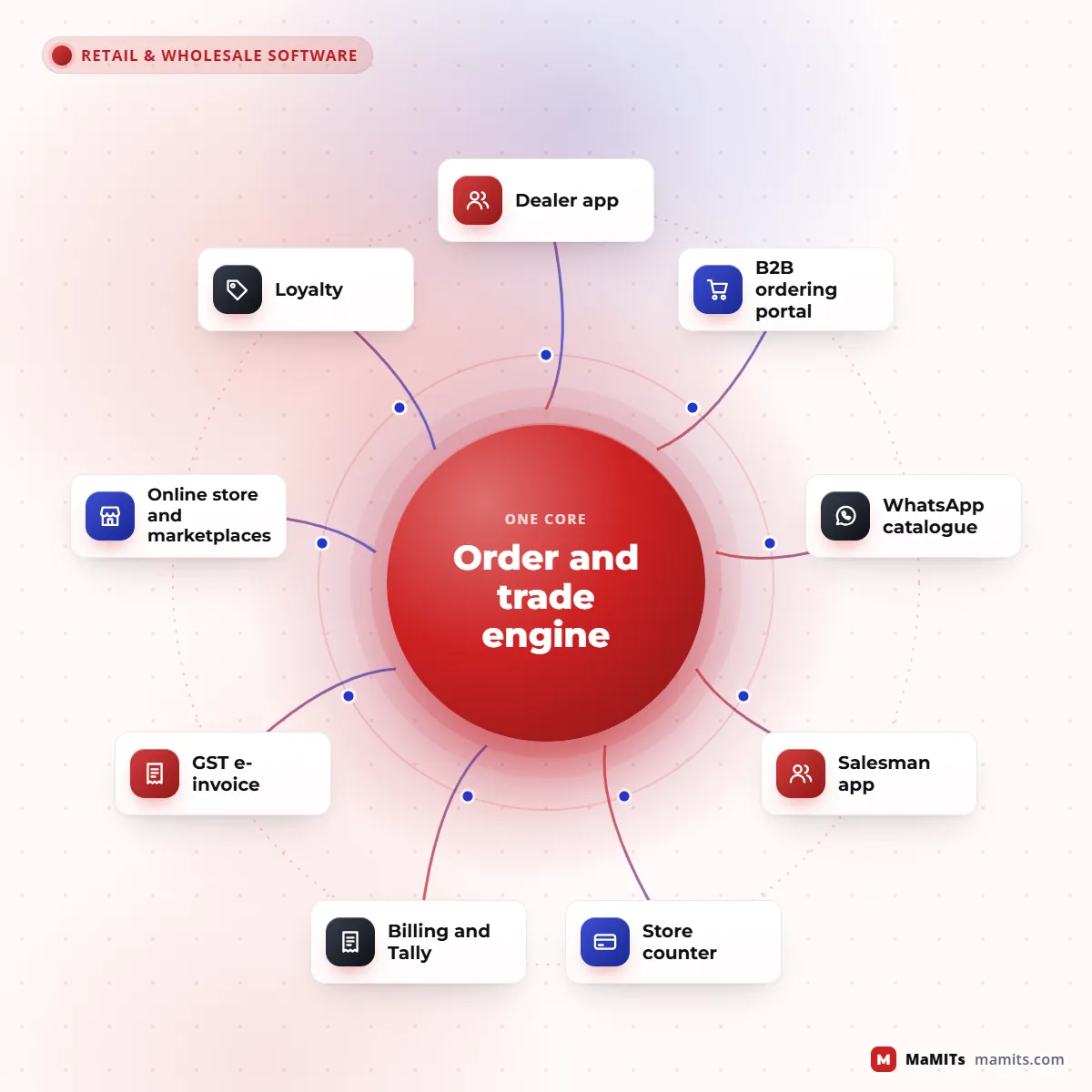
Hub diagram of B2B ordering portal connected to dealer app, WhatsApp, salesman app, billing and Tally
One order system fed by every channel your dealers use.

Loyalty, omnichannel and franchise

Loyalty program software, omnichannel retail and franchise models

Loyalty has two audiences that are often confused. Customer loyalty rewards the end shopper with points, tiers, birthday offers and coupons. Retailer loyalty rewards the shopkeeper who stocks and sells a brand, often through scan-and-earn on product codes or purchase-based slabs. Loyalty program software for retailers doubles as a data source: every scan is a signal of tertiary sales, which brands otherwise struggle to see. Since loyalty stores phone numbers and purchase history, we keep opt-in, purpose and deletion requests inside the same screens, so nothing has to be patched later.

What omnichannel retail software actually means

Omnichannel retail software means one stock, one customer and one order history across the store, your website, marketplaces and social selling. That means stock sync to marketplaces at safe buffers, order pull into one queue, click and collect where the customer orders online and picks up from a chosen store, and returns accepted at any store. We build the online store itself through our ecommerce website development team. Sellers interested in the government-backed ONDC open network usually join through a seller app, and the integration effort depends on that partner.

Franchise businesses

A franchise model needs the brand to see franchise sales without owning the franchisee's books. Typical needs are indent ordering from the franchisor's warehouse, fixed or suggested pricing, royalty and marketing-fee calculation from reported sales, and audit visibility. The trade-off is control versus franchisee freedom, and the software should reflect the agreement, not assume total control.

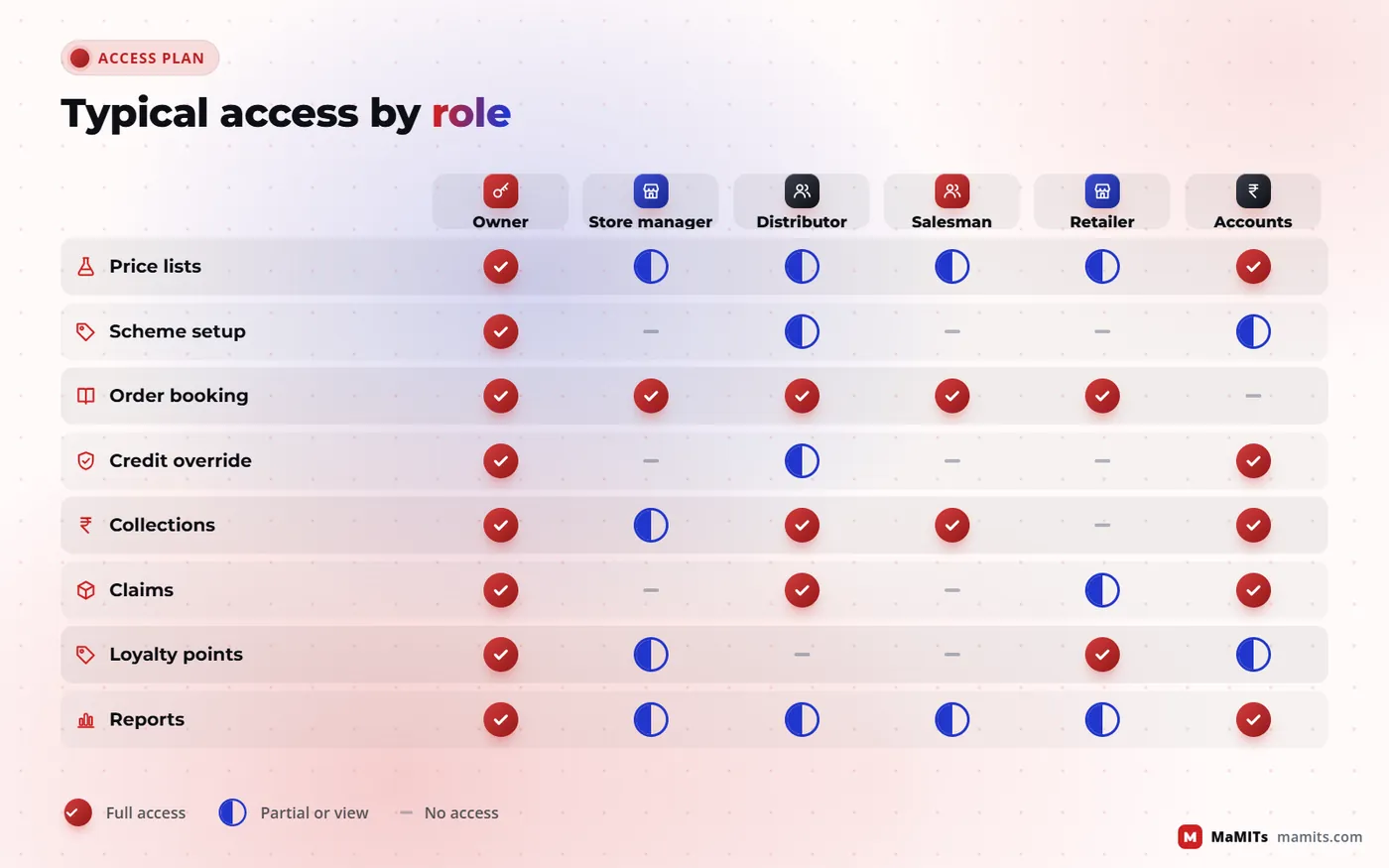
Matrix of retail software features against owner, store manager, distributor, salesman, retailer and accounts roles
Who sees what: a typical access pattern.

Build vs buy

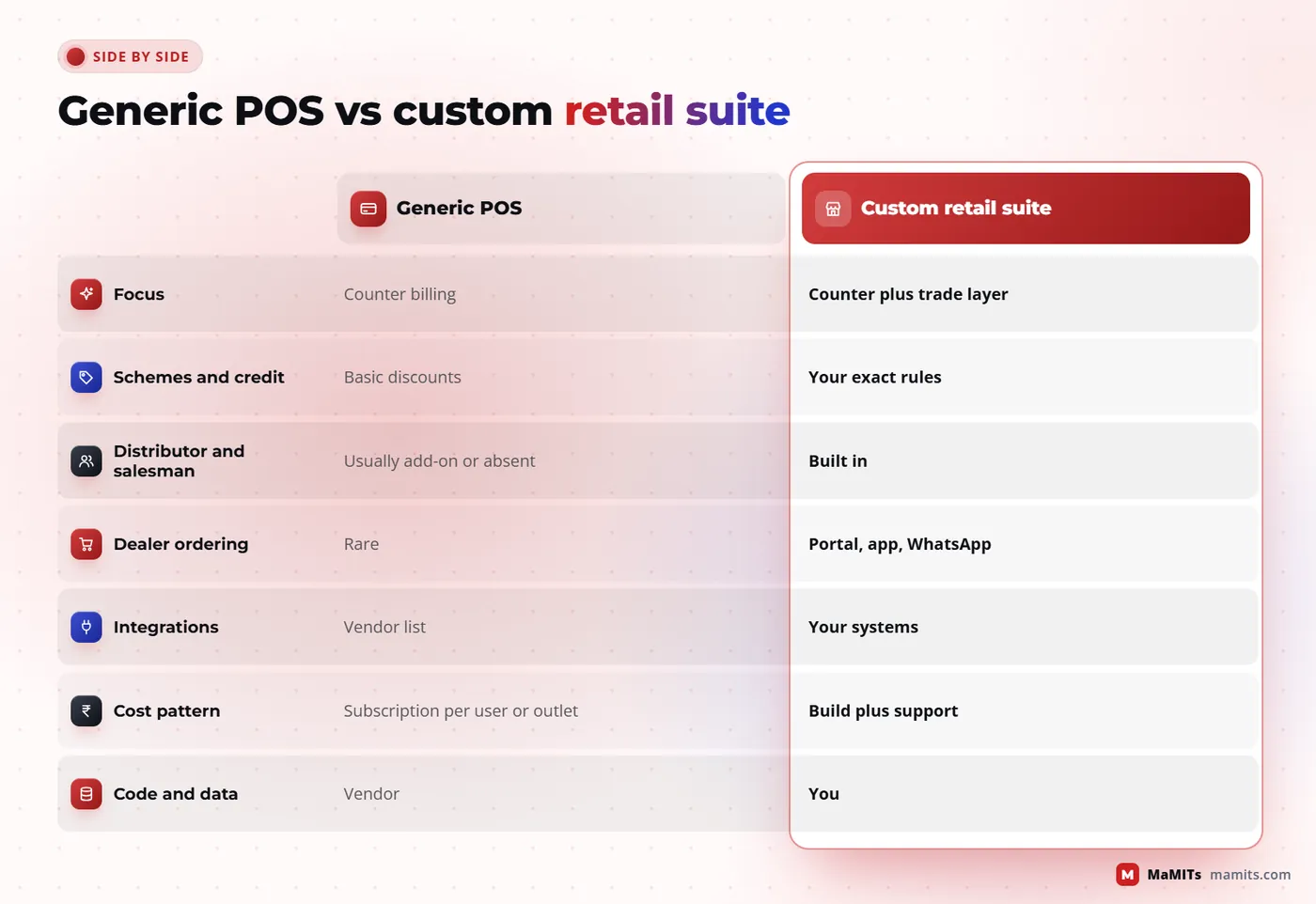
Ready retail software or custom build: a straight comparison

We tell many enquirers to buy a ready product. Custom work makes sense when the trade layer is your advantage or your pain.

QuestionReady POS or DMS productCustom retail suite
Time to startDays to weeksWeeks to months, phased
Your schemes and credit rulesFit the product's optionsModelled exactly as you run them
Cost patternPer user or per outlet subscription, rises with team sizeBuild cost plus hosting and support, you own the code
Integration with your Tally, ERP or brand portalOnly what the vendor supportsBuilt to your systems
Offline field useVaries by productDesigned for your markets
Data ownership and exportsVendor's format and termsYour database
RiskVendor changes pricing or featuresDepends on the developer's quality and handover

A common middle path: keep a proven billing or accounting product and build only the distributor, salesman and dealer layer around it.

Comparison of generic POS software versus custom retail software suite on schemes, cost, integration and data
Generic POS versus a custom retail and distribution suite.

Analytics

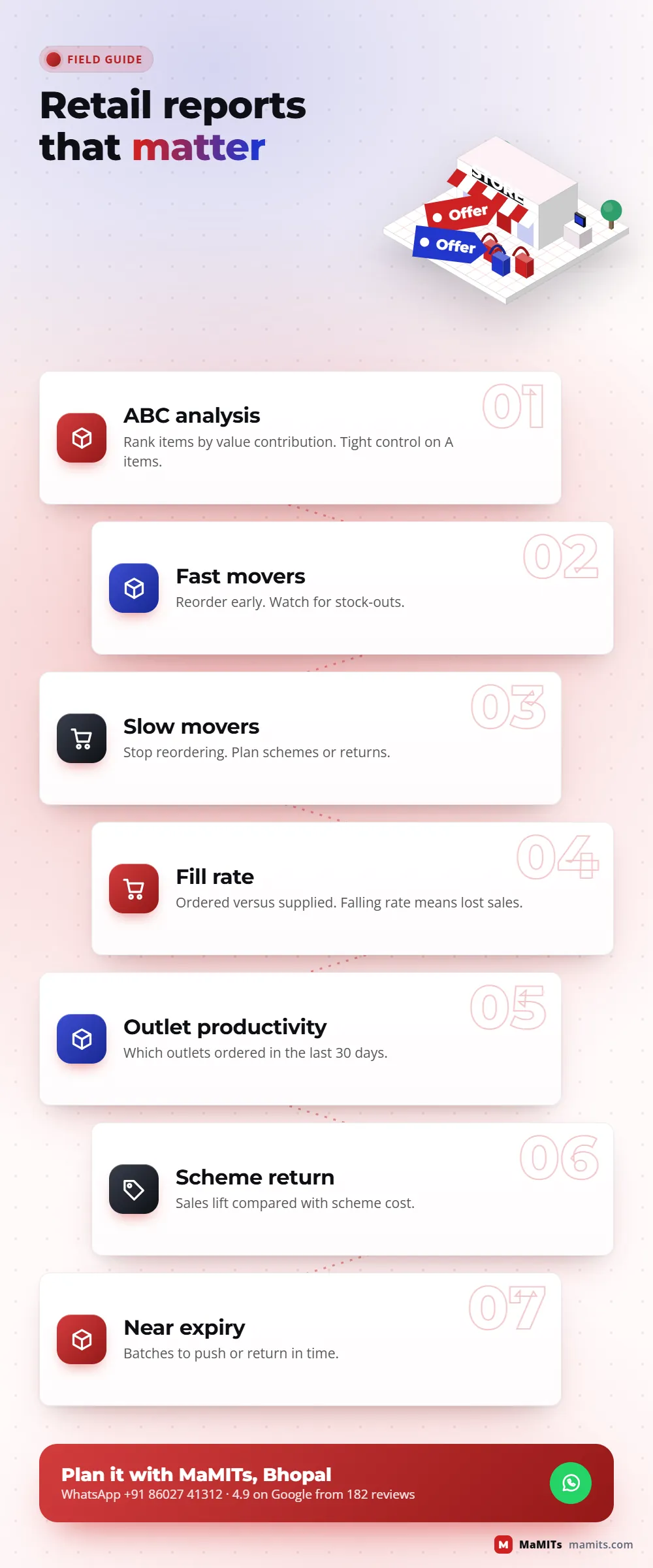
Which retail reports change decisions, not just fill screens?

  • ABC analysis

    ranks items by contribution: the small group of A items that bring most of the value gets tight stock control, while C items get simpler rules.

  • Fast and slow movers

    show what to reorder and what to stop buying.

  • Fill rate

    compares ordered quantity with supplied quantity, and a falling fill rate usually means lost sales before anyone complains.

  • Outlet productivity

    shows which retailers ordered in the last 30 days.

  • Scheme return

    compares sales lift with what the scheme cost.

We keep dashboards short. An owner should see five numbers in the morning on a phone, and drill down only when one looks wrong. Detailed stock valuation and ageing reports sit in the ERP core.

Infographic of retail analytics including ABC analysis, fast and slow movers, fill rate and scheme return
Five retail reports that change decisions.

How we work

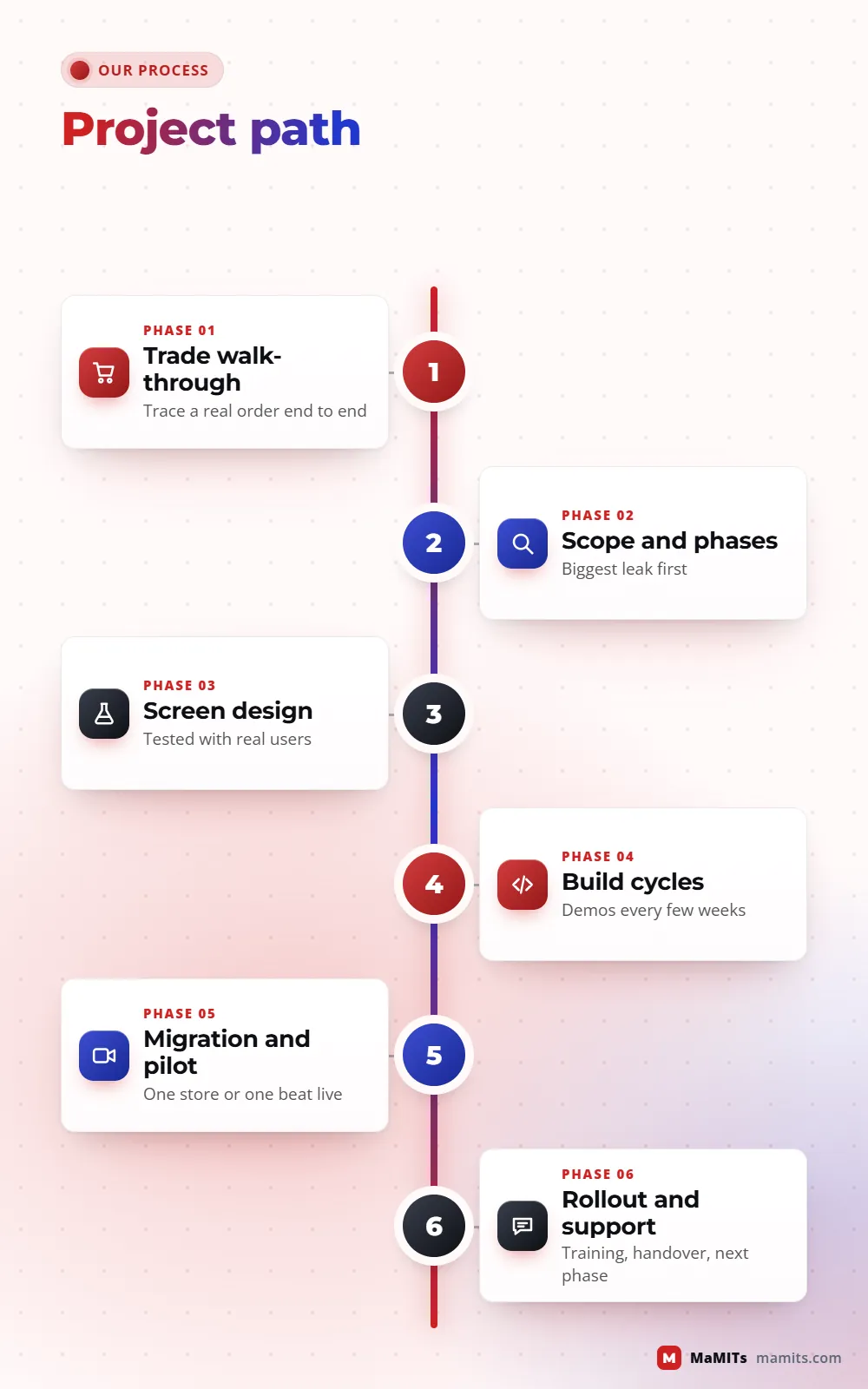
How MaMITs builds retail and distribution software, step by step

  1. 01

    Trade walk-through

    We sit with the owner, accounts and one salesman, and trace a real order from booking to collection, including the exceptions: returns, expiry, disputed schemes.

  2. 02

    Scope and phase plan

    We separate must-have from later, decide what stays in your current billing or Tally, and agree on the first phase that solves the biggest leak.

  3. 03

    Design screens with real users

    Clickable screens for the counter, salesman and retailer are tested with the people who will use them, in Hindi or English as they prefer.

  4. 04

    Build in short cycles

    Modules are shown every few weeks on a test server so feedback arrives early, not at the end.

  5. 05

    Data migration and pilot

    Items, price lists, outlets and opening balances are imported and checked. One store or one beat runs live before everyone moves.

  6. 06

    Rollout, training and support

    Staff training, handover documents and ongoing support. Later phases add loyalty, portals or channel sync on the same base.

Timeline of retail software development process from trade walk-through to rollout and support
How a retail or distribution software project moves from first call to rollout.

Cost and limits

What decides the cost, and what custom retail software cannot do

We do not publish a price list, because two distributor management projects can differ in effort several times over. We quote after a scoping call. Small modules, such as a salesman order booking app on top of existing billing, can start after a short scoping session. Retail patterns repeat in other sectors too: a school book and uniform store runs on the same stock rules (see education software), and a pharmacy chain adds batch, expiry and prescription checks that we handle in healthcare software.

Cost factors

  1. 01Number of user types: owner, store, salesman, distributor, retailer, dealer
  2. 02Scheme and pricing complexity across stores, regions and customer groups
  3. 03Integrations: Tally or ERP, GST e-invoice and e-way bill, payment gateway, marketplaces, WhatsApp
  4. 04Offline mobile apps on Android and iPhone versus web only
  5. 05Data migration quality: clean item masters cost less to move
  6. 06Hosting scale, support hours and how fast changes are needed

Limitations to know before you start

Software will not fix a scheme policy that nobody follows, and it will not make salesmen honest by itself. Tertiary sales data will always be partial. Marketplaces change their APIs, so channel sync needs maintenance. And the first month after go-live is slower, as staff unlearn old habits. A good partner plans for these instead of hiding them.

Choosing a partner

How to choose the best retail software development company

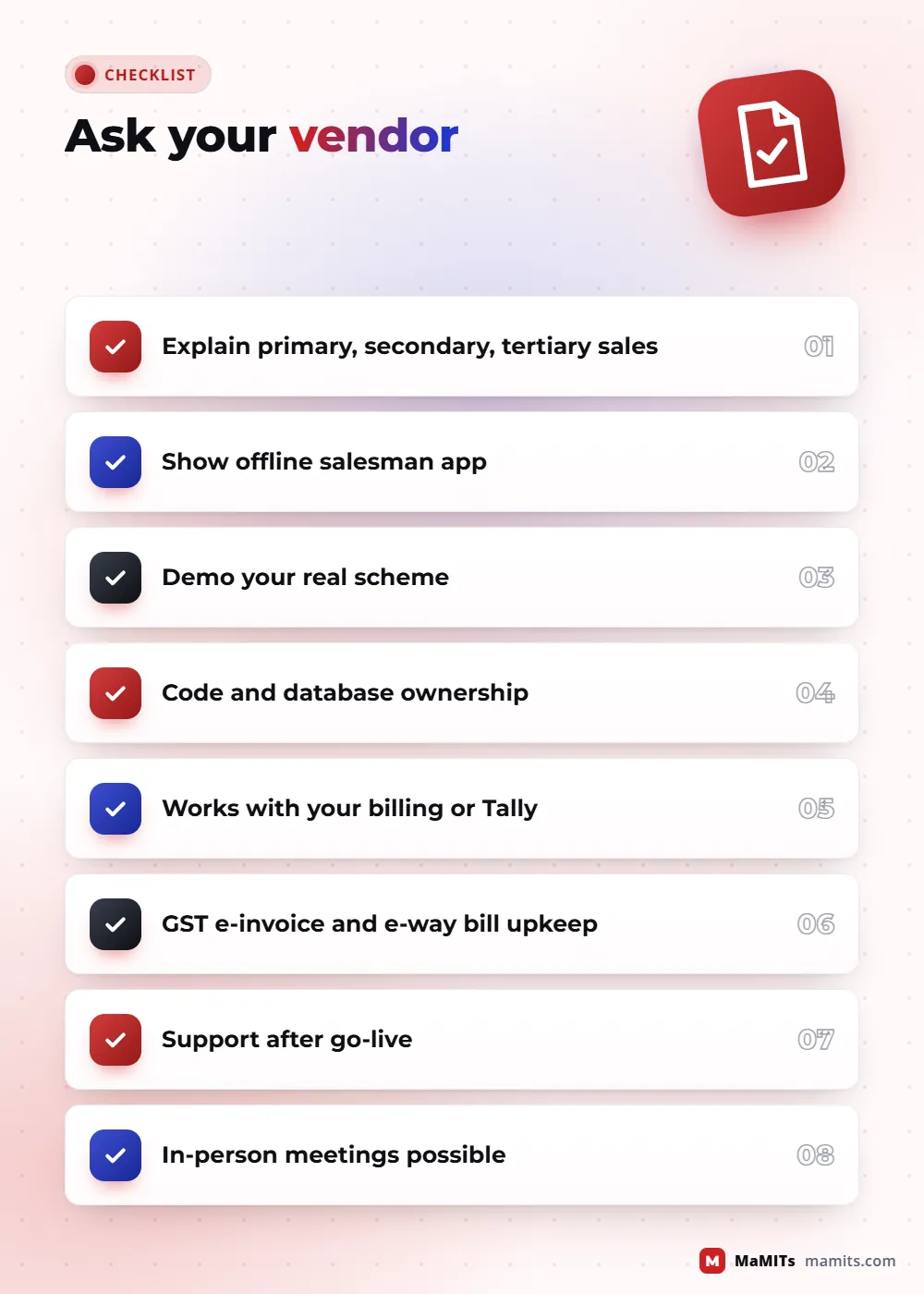
People searching for the best or No. 1 retail software development company usually want a partner who will still answer the phone a year later. Ask these.

Also look at what they have already shipped. You can see our work on the MaMITs portfolio, and read why we build from scratch in our software and app developer in Bhopal guide.

Checklist for choosing the best retail software development company covering offline apps, schemes and code ownership
Questions to ask any retail software vendor.

Where we work

Retail software development company in Bhopal, serving Indore, Delhi and beyond

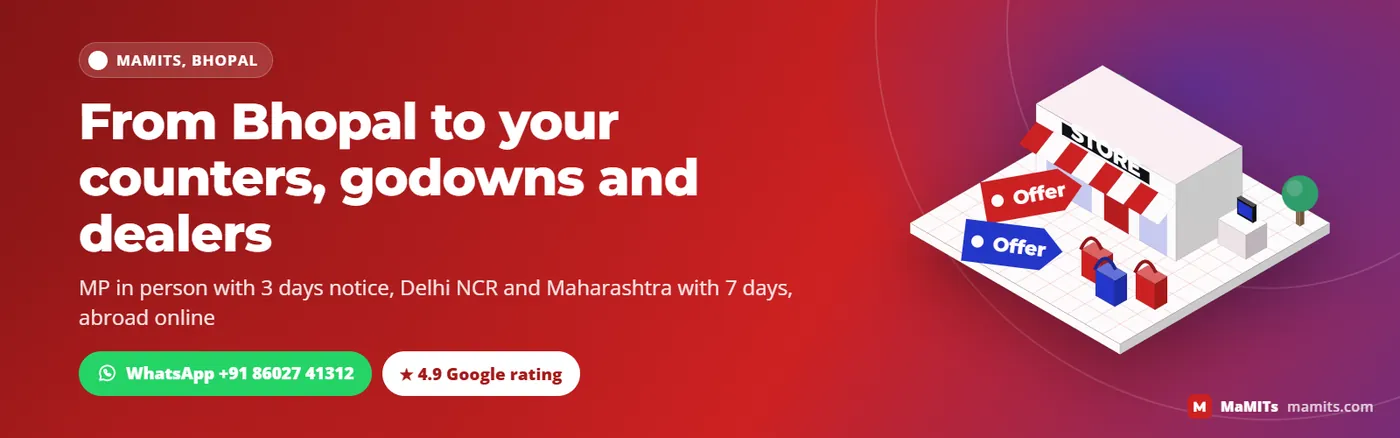
Our office is in Ayodhya Nagar, Bhopal, so Madhya Pradesh clients can meet us in person with 3 days notice. Related businesses also use our logistics software for delivery vans and our manufacturing software where the brand owns a plant. Fully bespoke builds outside retail are covered on our custom software development page.

Madhya PradeshIn person with 3 days notice

Bhopal

Kirana networks, pharma distributors and retail chains in New Market, MP Nagar and Hamidia Road style trade zones can walk us through their counters in person.

Indore

For FMCG stockists and wholesalers around Siyaganj and the city's trading belts, we offer retail software in Indore with in-person meetings on 3 days notice.

Gwalior and Jabalpur

Distributors and stockists in Gwalior and Jabalpur meet us in person with 3 days notice, often to fix salesman order booking and outstanding first.

Ujjain, Dewas, Sagar and the rest of MP

Smaller wholesalers and dealer networks across the state usually start with a salesman app and party-wise rates in Hindi and English. We visit anywhere in Madhya Pradesh with 3 days notice.

Beyond Madhya PradeshIn person with 7 days notice in India, online abroad

Delhi NCR

Brands with dealer networks in Delhi, Noida and Gurugram meet us in person with 7 days notice, with online reviews in between.

Mumbai and Pune

D2C brands and franchise businesses in Maharashtra meet us in person with 7 days notice.

USA, Canada, Australia, UK

Retail and wholesale businesses abroad work with us through online meetings.

Strip banner for retail software company in Bhopal serving Indore, Delhi NCR, Mumbai and international clients
Meet us in Bhopal, or across India and abroad.

FAQ

Retail and distribution software questions, answered

What is retail software development?

Retail software development is designing and building software for businesses that sell goods: stores, wholesalers, distributors and brands. It covers pricing, schemes, store operations, field sales, dealer ordering, loyalty and channel sync, connected to billing and stock. Custom development fits the software to your trade rules instead of adapting your business to a generic product.

What is the difference between primary and secondary sales?

Primary sales are sales from a manufacturer or brand to its distributor or stockist. Secondary sales are sales from that distributor to retailers. Tertiary sales are retailer sales to end customers. Tracking secondary sales shows a brand real market movement, while primary sales alone can hide stock piling up at distributors.

Can a salesman app book orders without internet?

Yes, if it is built offline first. The salesman downloads beats, outlets, prices, schemes and outstanding in the morning, books orders without network during the day, and the app syncs automatically when signal returns. Conflicts such as stock changes are checked at sync time and flagged to the distributor for confirmation.

What is a distributor management system?

A distributor management system is software used at the distributor level to manage secondary sales: retailer invoices, schemes, credit limits, beat plans, returns, expiry, claims and stock. It usually shares data with the brand so the company can see sell-through by town and outlet, and with the salesman app used in the market.

Do I need custom software or is a ready product enough?

A ready product is enough when your pricing, schemes and credit rules are standard and your team is small. Custom software makes sense when schemes are complex, you need integration with your billing or brand portal, you want to own your data and code, or per-user subscription costs keep rising with your field team.

How much does retail or distribution software cost in India?

Cost depends on user types, scheme complexity, mobile apps, offline needs, integrations such as Tally, GST e-invoice and marketplaces, and data migration. MaMITs does not use a fixed price list. We quote after a scoping call, and smaller modules like a salesman order booking app can start after a short scoping session.

Can my retailers order from me on WhatsApp?

Yes. Using the WhatsApp Business Platform, retailers can browse your catalogue and send orders inside WhatsApp. These orders can flow into the same system as salesman and portal orders, with the right price list and credit check. An AI assistant can also convert typed or voice orders into lines for confirmation.

Will the software handle GST e-invoice and e-way bill?

Yes. Retail and distribution builds generate the e-invoice IRN and the e-way bill from the same order-to-invoice flow, so nobody retypes the invoice on a portal. Detailed billing, stock and accounts are built in our ERP and inventory work. If your accountant already uses a GST suvidha provider, we connect to that instead of adding a second route.

How does the software handle expiry for pharma and FMCG?

Stock is tracked by batch and expiry date from purchase to sale. The system suggests the earliest expiry batch first, alerts on near-expiry stock by distributor or store, and records expiry returns with batch details so claims to the company carry proof. Expiry policies and return windows differ by company, so they are configurable.

What is a B2B ordering portal?

A B2B ordering portal is a website or app where your regular retailers and dealers place orders themselves at their own price list and schemes. They can see stock availability, outstanding dues and past invoices. It reduces phone and paper orders and lets salesmen focus on new outlets and product lines.

Can it connect with Tally or my existing ERP?

In most projects, yes. We often keep the client's existing accounting or billing system and build the distributor, salesman and dealer layer around it, syncing masters, orders and invoices. The exact method depends on the system's version and available integration options, which we check during scoping.

Which is the best retail software development company in Bhopal?

The best choice is the company that understands your trade, shows working offline apps, models your real schemes, gives you code ownership and supports you after go-live. MaMITs is a Bhopal retail software development company rated 4.9 on Google from 182 reviews, with 100+ software deployed. Compare a few vendors against the checklist above.

Next step

Talk to a retail software development company that starts with your trade

Send us one real order: who booked it, what scheme applied, how it was billed and collected. We will show you where software saves time and where it does not, then quote after a scoping call.

MaMITs, 144, Neerja Nagar, Durgesh Vihar, Ayodhya Nagar, Bhopal 462041 · ★ 4.9 on Google from 182 reviews

TOP
});