INDLOG 01
Transporters and fleet owners
NeedsLR and bilty, trip sheets, driver advances, freight bills, document expiry
We buildA transport ERP with trip profit per vehicle and a simple driver app

Website Designing and Mobile Apps Development in Bhopal, Digital Marketing, SEO Company - MaMITs
Phone No. +91-860-274-1312
Email: info@mamits.com
MaMITs
MaMITs, 144, Durgesh Vihar, JK Road, Bhopal, Madhya Pradesh, India 462022
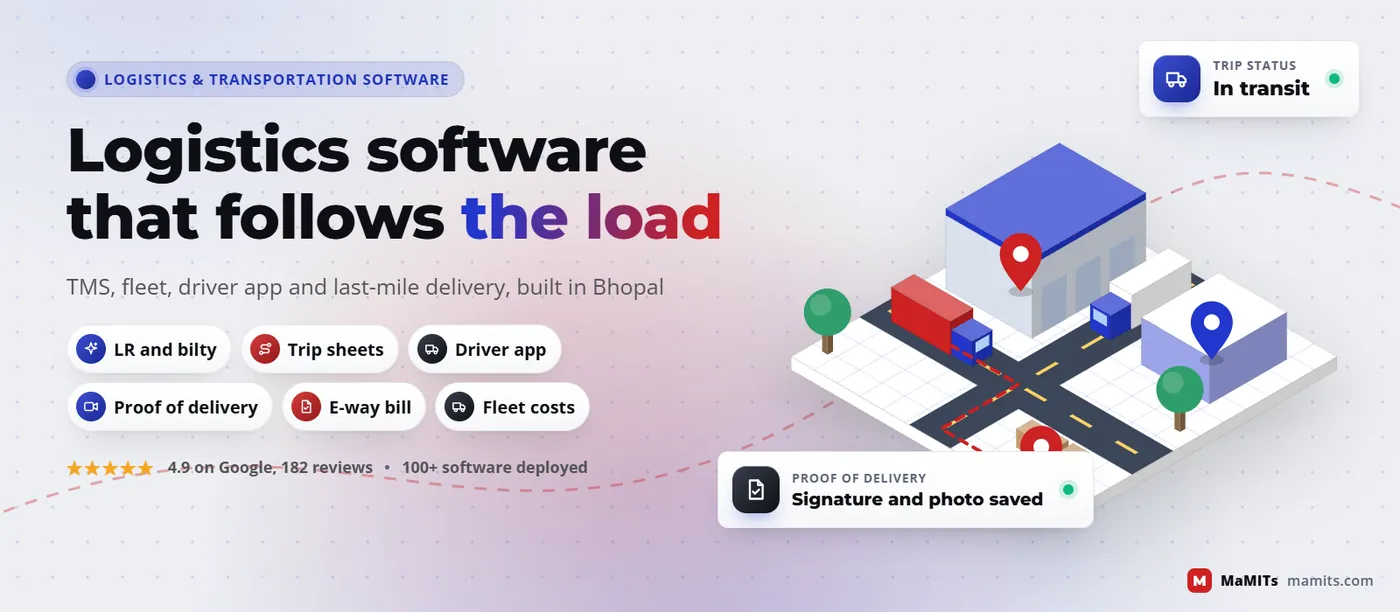
MaMITs is a logistics software development company in Bhopal that builds custom software to follow a load from booking to LR, trip, proof of delivery and invoice, on web and on a driver app that works in weak network. We work with transport and delivery businesses across India and abroad.
Printed in your own layout. One number from booking to bill.
Milestones on the MaMITs road, counted from live work.
Quick summary
A logistics software development company builds the system a transport or delivery business runs on: bookings and consignment notes, trip planning, vehicle and driver records, GPS tracking, proof of delivery, freight billing and collections. The right partner fits it to your lanes, rate cards and paperwork instead of forcing a generic screen on your team.
Start here
Many transport offices still run on three things: a bilty book, a WhatsApp group and an Excel sheet that only one person truly understands. It works at ten trucks. At forty trucks it starts leaking money in places nobody looks: a diesel advance that never got adjusted, a POD that reached the office three weeks late so the bill went out late, a fitness certificate that expired while the truck was loaded in Nagpur.
Where money leaks at forty trucks
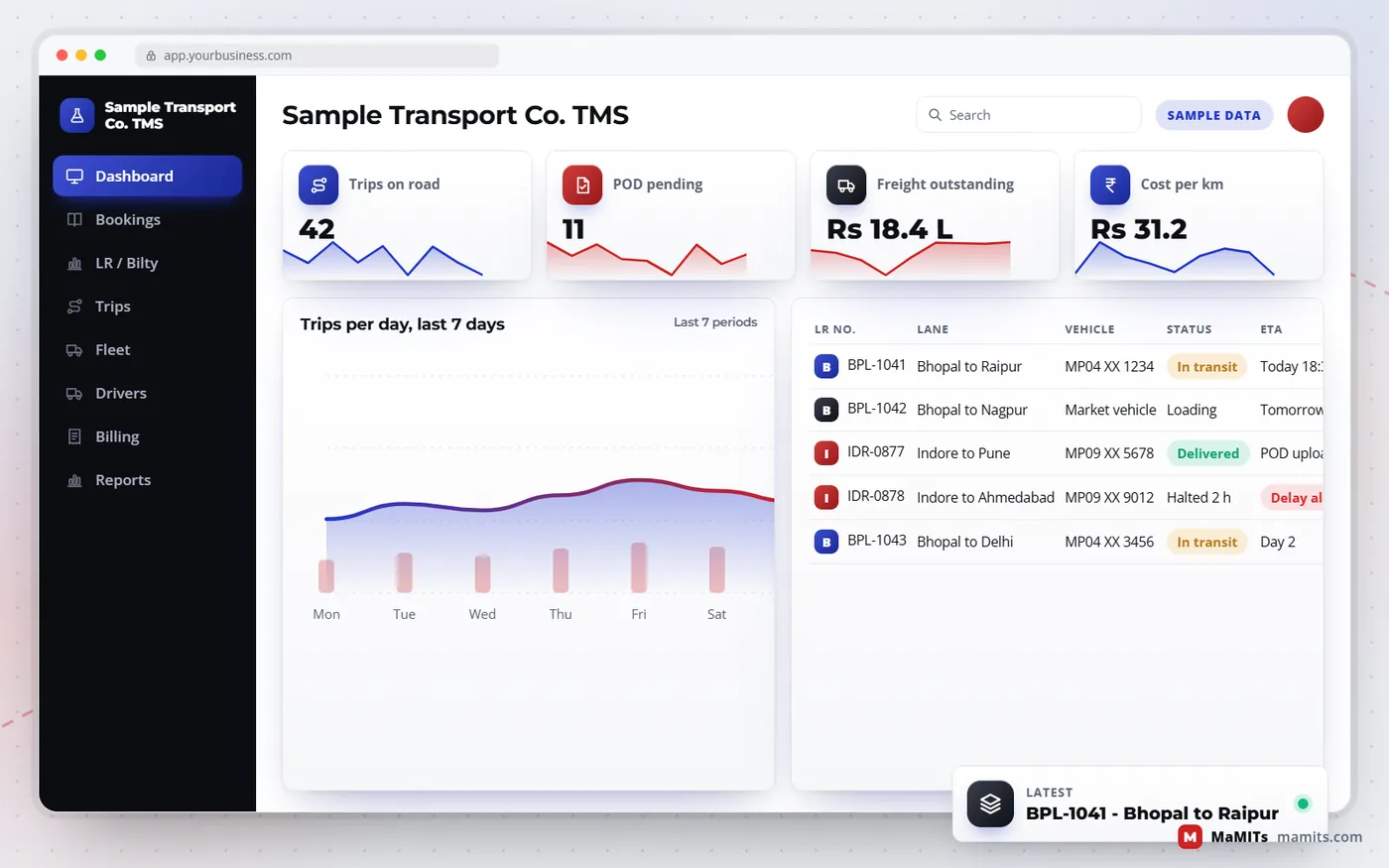
Logistics software is the single record that ties those moments together. One consignment should carry its booking, its LR number, the vehicle and driver, the trip expenses, the delivery photo and the invoice line. When that chain is unbroken, the questions an owner asks every evening (where is it, who owes us, which truck is losing money) get answered from data instead of phone calls.
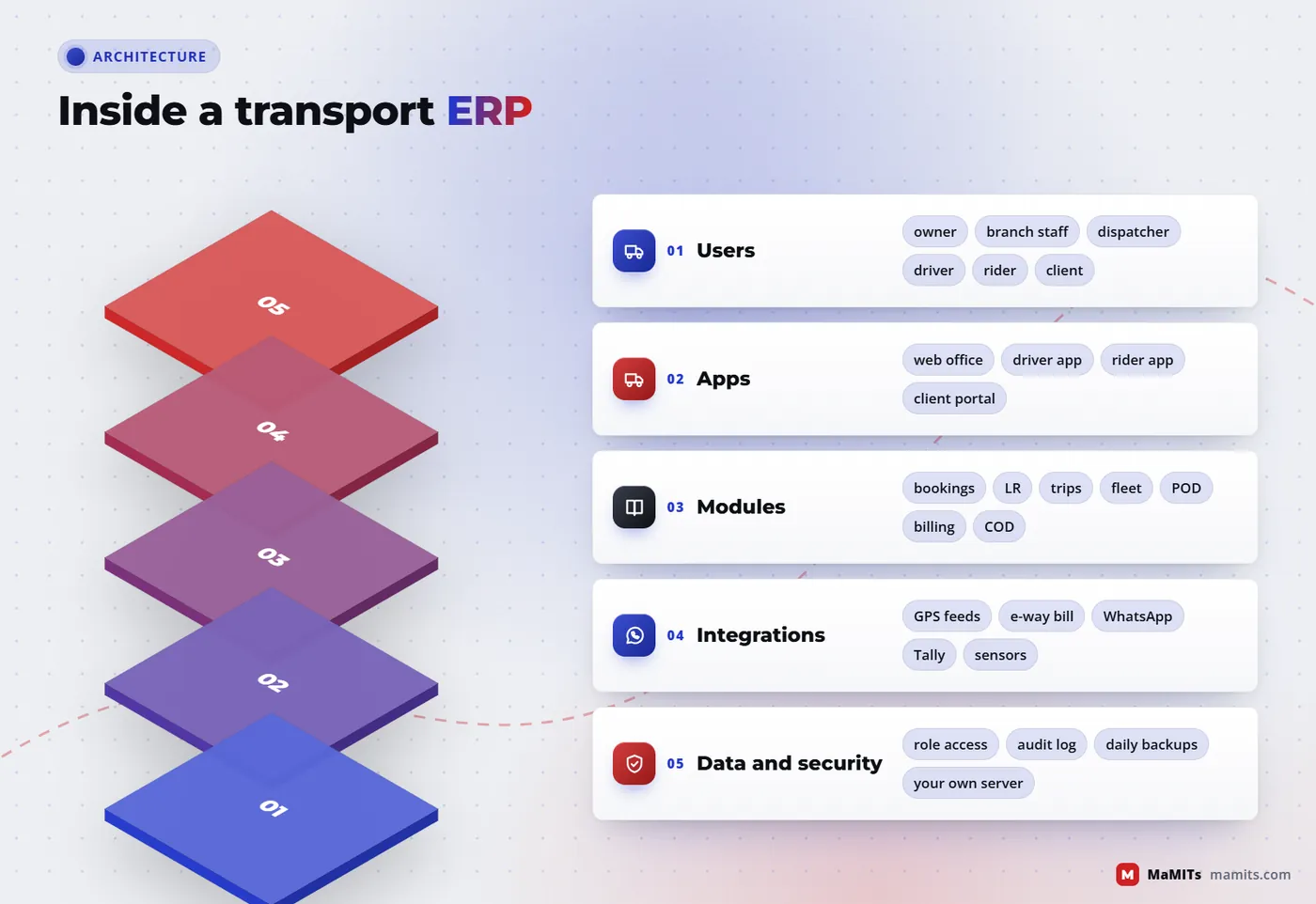
That is why we treat transport management software, fleet records and the driver app as one design problem, not three products stitched together. The screens differ by user, the data does not. Put simply, a logistics software development company should understand the road before it writes code: loading bays, driver phones with weak signal, e-way bills and the accounts team waiting for proof of delivery.
Who we build for
The same word, logistics, hides very different operations. These are the businesses we design for and what changes for each.
NeedsLR and bilty, trip sheets, driver advances, freight bills, document expiry
We buildA transport ERP with trip profit per vehicle and a simple driver app
NeedsMultiple clients, contract rate cards, SLA reports, own and hired vehicles
We buildClient-wise billing, market vehicle hire with broker payments, client tracking portal
NeedsHubs, bagging, barcode scans, franchise settlements
We buildHub-and-spoke scanning flow, manifest, franchise ledger
NeedsFast assignment, rider app, COD control
We buildDispatcher board, rider app, COD reconciliation by rider and day
NeedsOrders from the store, slots, live status to buyers
We buildOrder sync, delivery app development with WhatsApp updates
NeedsBeat-wise van loading, returns, collections
We buildLoad sheets and route delivery tied to the sales side on our retail and distribution software
NeedsSurvey, quotation, inventory list, damage claims
We buildSurvey app with item photos, job costing, customer tracking link
NeedsReefer temperature proof per trip
We buildSensor data on the trip record with alerts and a temperature log for the customer
NeedsRoutes, stops, attendance, parent or HR alerts
We buildRoute and stop master, boarding scan, live bus location for parents or HR
NeedsBookings, duty slips, driver payouts
We buildOur cab and taxi booking software, extended where needed
Transport management
In Indian road transport the lorry receipt (LR, also called bilty or consignment note) is the legal and commercial heart of a load. Good TMS software prints it in your format, numbers it per branch without gaps, and links it to everything that follows. Bad software makes the LR an afterthought and the office ends up writing it by hand again.
A typical scenario: a Bhopal transporter books 18 tonnes of cement for Raipur, hires a market truck because own trucks are busy, pays an advance to the broker, and bills the consignor on a per-tonne rate with a detention clause. The system has to handle the hired vehicle, the broker ledger, the shortage deduction on delivery and the final freight bill without anyone retyping figures.
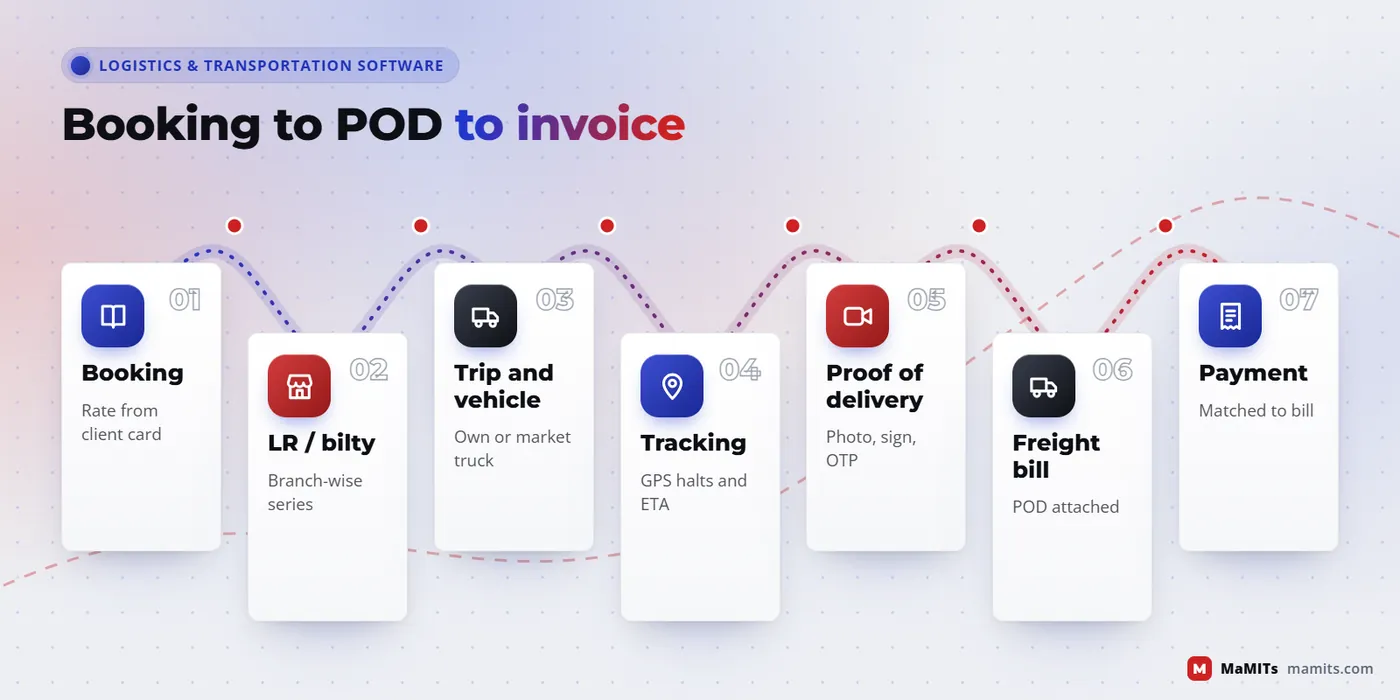
One load, end to end
18 t cement for Raipur. The rate comes from the client rate card, per tonne.
Branch series BPL. Own trucks busy, so a market truck is hired and the broker advance is recorded.
Driver taps Start in the app. Odometer photo, diesel advance against the trip.
Vehicle number updated. Expiry worked out from distance, with an alert before it lapses.
Tracker shows a 50 minute halt. Toll and tea stop logged with bill photos.
App keeps working offline. Entries wait on the phone and sync when the signal returns.
Geofence hit at the consignee gate. Consignee gets a WhatsApp update.
Photo, signature and a 2 bag shortage note. The freight bill goes out the same day and reaches Tally.
Sample trip. Distances and amounts are illustrative.
Fleet management
Fuel and tyres together are usually the largest running costs of a heavy vehicle. Fleet records exist to make those costs visible per vehicle, per driver and per km.
RC, insurance, permit, fitness, PUC, road tax and national permit authorisation with expiry dates. Reminders go to the fleet manager on WhatsApp 30, 15 and 7 days ahead, and a truck with an expired document can be blocked from new trips.
Fuel entries from pump slips or fuel cards, average km per litre per vehicle, and a flag when a trip burns more than that vehicle's own average on the same lane. Theft shows up as a pattern, not a guess.
Service schedules by km or days, job cards, spare parts used, workshop bills, and downtime days. You see which old vehicle is costing more than it earns.
Every tyre by serial number: fitted on which vehicle and position, rotations, retreads, km run and scrap reason. Cost per km per tyre brand becomes a real comparison.
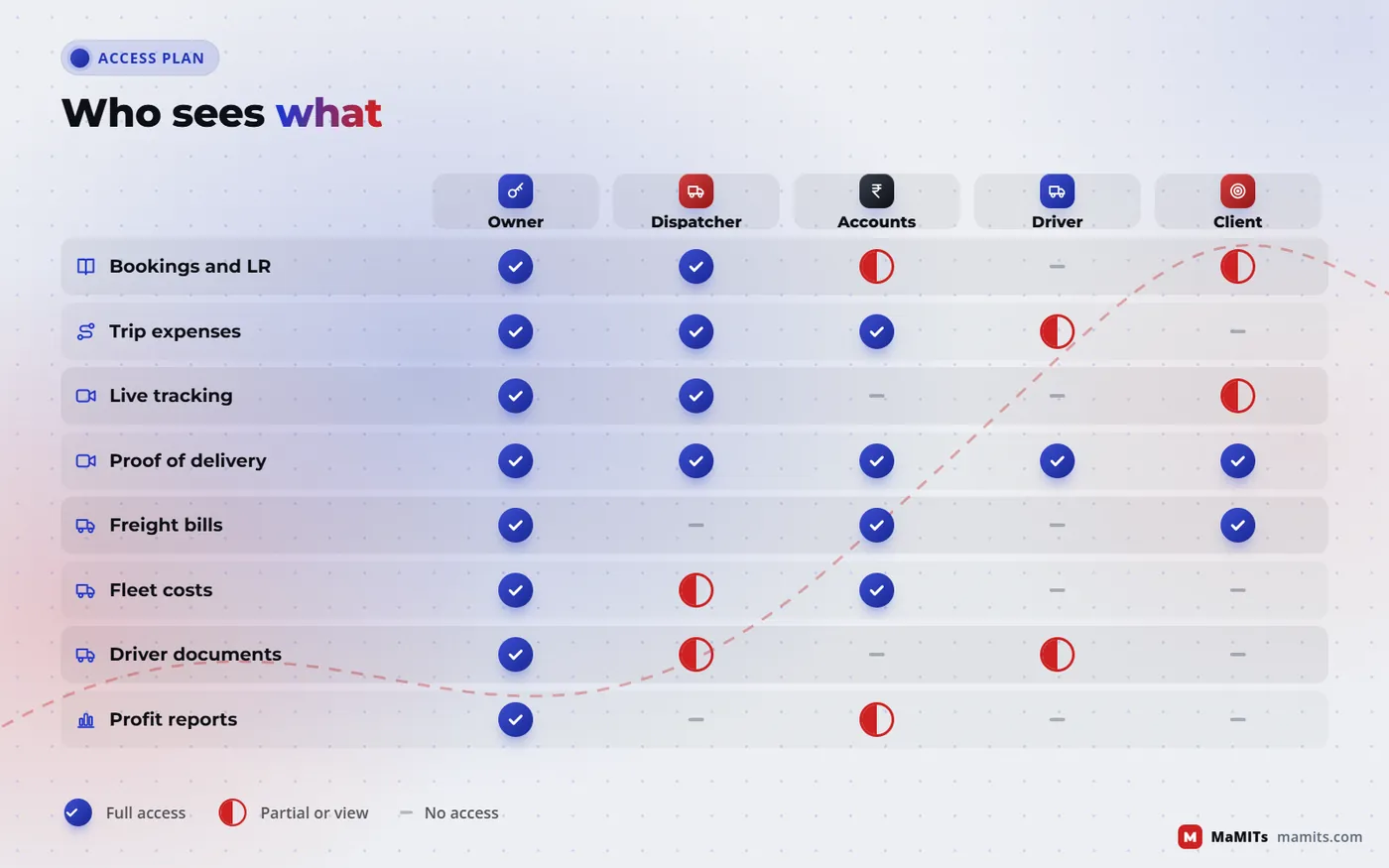
Licence and its expiry, badge, advances, salary or per-trip payment, incidents and documents. Driver data is personal data, so access is limited by role.
Toll, parking, police and RTO challans and repair on the road, captured against the trip so the trip profit is real.
GPS and telematics
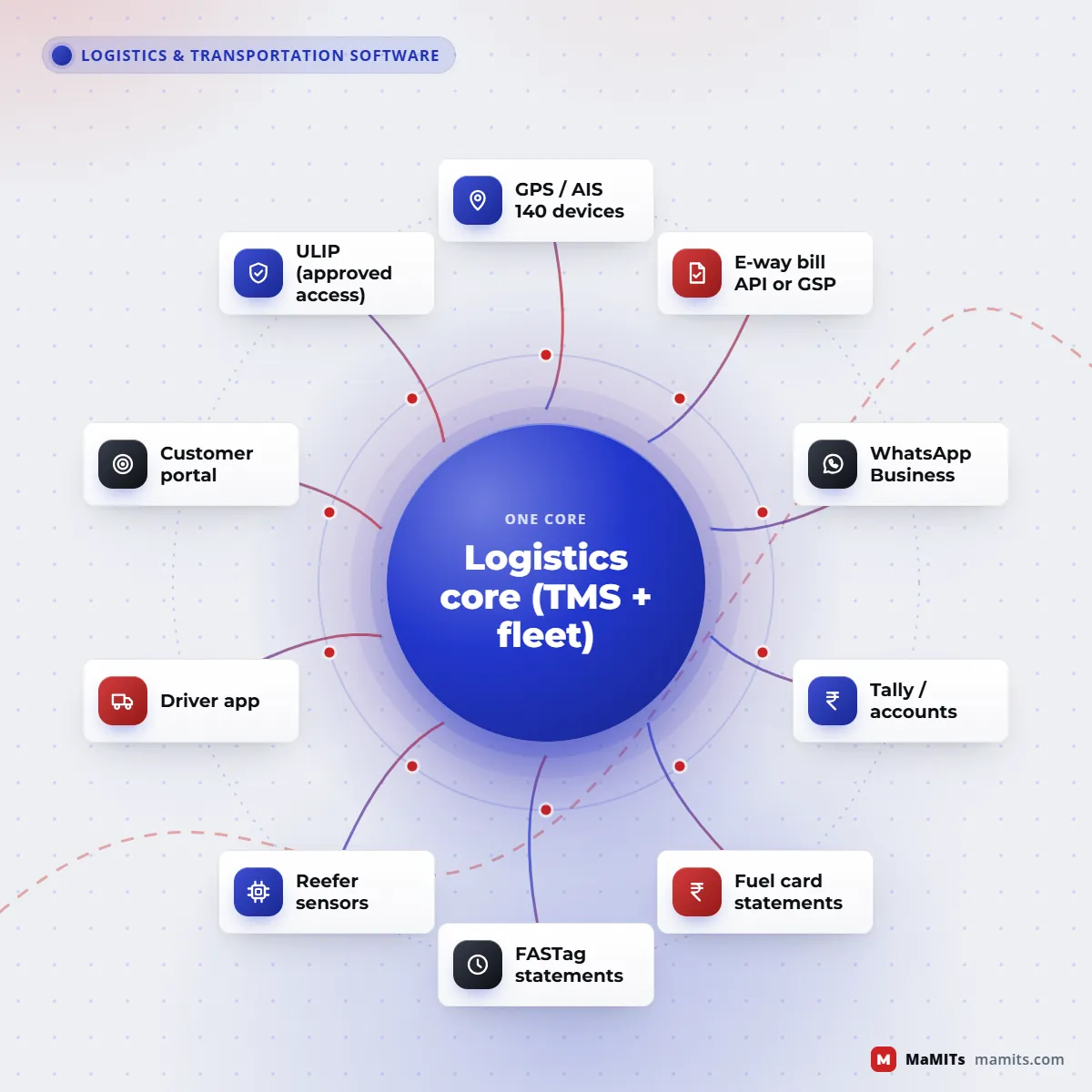
Vehicle tracking software does not need its own hardware from us. Most fleets already have GPS devices from one or more vendors, so we integrate their data feeds (usually an API or a device server that accepts the device protocol) and show location, ignition, halts and overspeed inside the trip, where it means something. A dot on a map is a commodity; a trip that knows it is 40 minutes behind its unloading slot is useful.
Buses, taxis and other public service vehicles usually carry AIS 140 trackers with an emergency button, and those devices report to a state system as well. Goods vehicles vary by permit and state. Either way, the device you already own is the one we connect to; we never ask you to buy hardware from us, and we tell you up front when a cheap tracker gives no usable data.
Driver app and POD
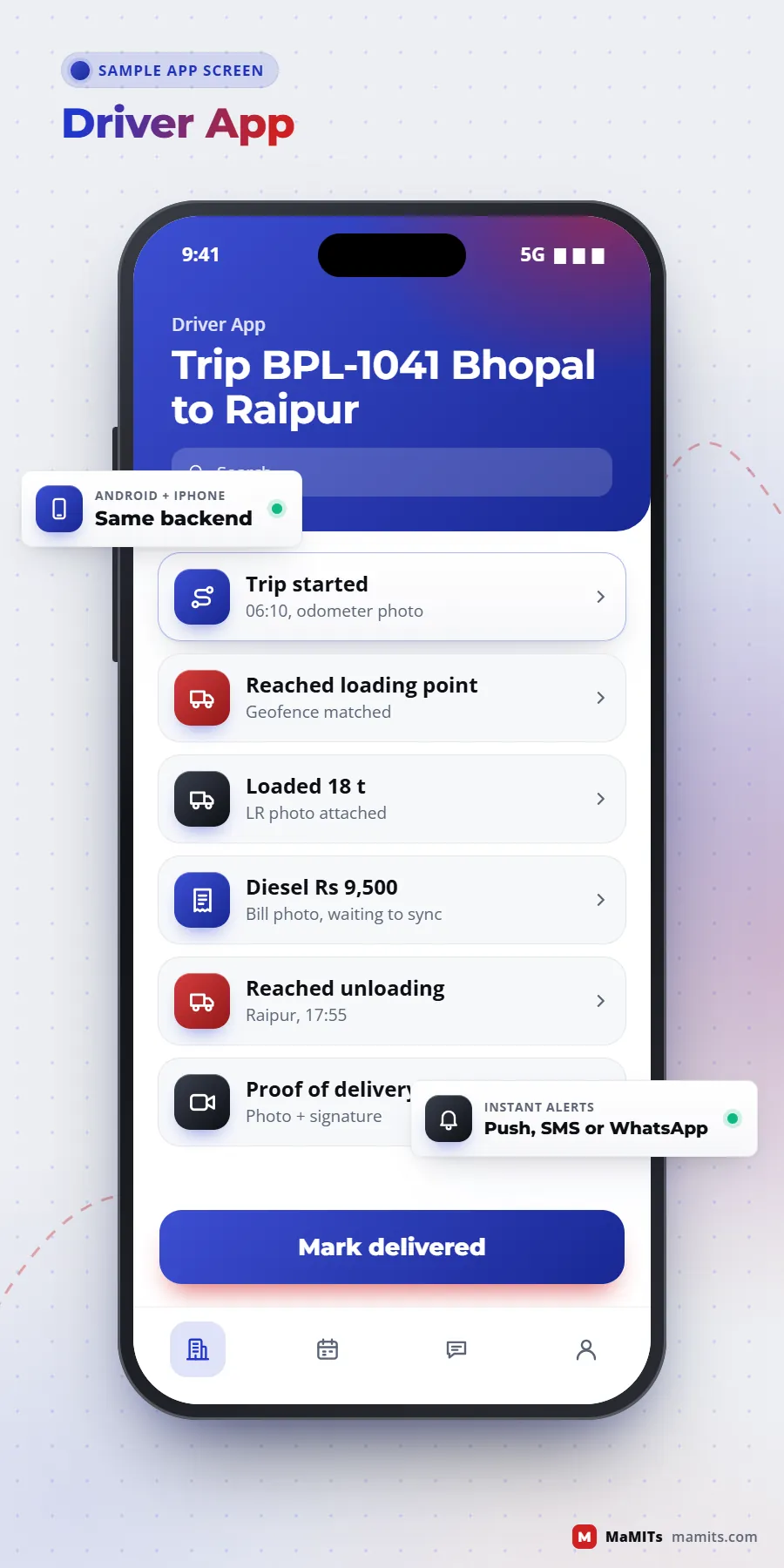
A driver app fails for human reasons more often than technical ones. Drivers will not type. So the app opens on today's trip, has large buttons, works in Hindi as well as English, and asks for the minimum: start trip, reached loading point, loaded, reached, delivered. Each step can carry a photo.
Proof of delivery is where money is decided. The app captures the signed LR copy or the receiver's signature on screen, a photo of the unloaded goods, GPS location and time. It stores everything on the phone first and uploads when the network returns, so a dead zone on a ghat road does not lose a POD. The office sees the POD minutes after delivery, and the freight bill can go out the same day instead of waiting for the paper copy.
One record
The flow looks simple on paper. The value is in what each step hands to the next: the booking passes the rate to the LR, the LR passes weight and consignee to the trip, the trip passes actual expenses and the POD to billing, and billing passes the invoice to accounts. If any step is outside the system, someone retypes it and errors start.
We usually push finished invoices and payments to Tally or your existing accounts software instead of rebuilding accounting. If you want full accounts, inventory and GST billing in the same platform, that depth sits on our ERP, CRM and inventory software page.
Courier, parcel, last-mile
Parcel networks are a scanning problem. Every shipment gets a barcode or QR label at pickup, and every handover (pickup to origin hub, hub to line haul, destination hub to rider, rider to customer) is a scan. If a scan is missed, the parcel is invisible for that leg and customer service is blind. Our courier software development work starts by mapping those handovers before a single screen is drawn.
Last-mile adds cash. With cash on delivery, the rider collects money all day, deposits some at the branch, and some goes by UPI straight to the company. COD reconciliation matches each delivered COD shipment to a collection and each collection to a deposit, rider by rider, day by day. Shortfalls show on the same evening instead of at month end.
Sample COD close, one evening
| Rider | COD drops | Due | Deposited | Status |
|---|---|---|---|---|
| Rider A | 14 | Rs 21,400 | Rs 21,400 | Matched |
| Rider B | 11 | Rs 16,950 | Rs 15,950 | Rs 1,000 short |
| Rider C | 9 | Rs 12,300 | Rs 12,300 | Matched |
Route optimisation sequences stops to cut distance and time, respecting delivery windows, vehicle capacity and rider shifts. It helps most when a rider has 25 or more stops a day. Be sceptical of anyone promising the perfect route: the vehicle routing problem is mathematically hard, so every tool uses heuristics, and the result is only as good as the addresses. Indian addresses with landmarks instead of house numbers need a geocoding clean-up step, and riders' local knowledge should be able to override the plan. For full truckload lanes, route planning is mostly about fixed lanes, tolls and halts, not stop sequencing.
If you run an online store or a kitchen with your own delivery staff, orders arrive from the store, get assigned by area or slot, and the customer gets a live link. Our food and grocery delivery system already covers the restaurant and grocery case.
Government systems
These are the questions every transporter asks. Access routes change, so we check them again at the start of every project.
| System | What it is | What software can do | Limits to know |
|---|---|---|---|
| E-way bill (ewaybillgst.gov.in) | GST document for moving goods, generally above Rs 50,000 consignment value | Generate e-way bills, update Part B vehicle number, extend validity and cancel, through the official API directly or through a GST Suvidha Provider | API access needs registration, sandbox testing and IP whitelisting as per the e-way bill API onboarding process |
| FASTag (NETC) | Electronic toll payment | Import toll transactions from your issuer bank statement or portal export and match them to trips | Live toll data for a fleet is not a public API; banks and ULIP are the routes |
| Vahan and Sarathi (Parivahan) | National vehicle registration and driving licence records | Store RC and licence details, check them through permitted channels | Scraping government portals is not acceptable; use ULIP access or manual verification |
| ULIP (goulip.in) | Unified Logistics Interface Platform under the National Logistics Policy | Fetch vehicle, licence, FASTag and e-way bill data through approved APIs | Company must register, get its use case approved and sign an NDA before data access |
Around the core
Two sectors overlap with transport more than people expect: school bus routing, which we cover with education software, and sample pickup and pharmacy delivery, which sits next to our healthcare software development work.
Consignors log in to see their LRs, live status and PODs, and download bills. WhatsApp messages go out at dispatch, delay and delivery through the official WhatsApp Business Platform. An AI assistant that answers 'where is my load' from the TMS is possible; see our AI development company in Bhopal page.
Some clients want their own load board: shippers post loads, verified truck owners bid, the winning bid becomes a booking. This is freight management software with a marketplace layer, and the hard part is trust (KYC, ratings, payment terms), not the bidding screen.
Goods often wait in a godown between legs. We connect gate-in, gate-out and stock per consignment. Full warehouse management (bins, picking, multi-warehouse stock) is covered on the ERP and WMS page.
Temperature and humidity sensors in reefers send readings to the trip. Excursions above your limit raise an alert, and the customer gets a temperature log for the whole journey. Sensor choice and calibration stay with your hardware vendor.
Freight bills grouped by client and period, POD attached, outstanding by age, reminders, and part payments matched to bills. Most transport cash problems are collection problems.
Cost per km, revenue per km, empty miles (km run without load), trip profit by vehicle, client and lane, days from delivery to POD to bill. Three or four numbers checked every week beat forty charts nobody opens.
Build or buy
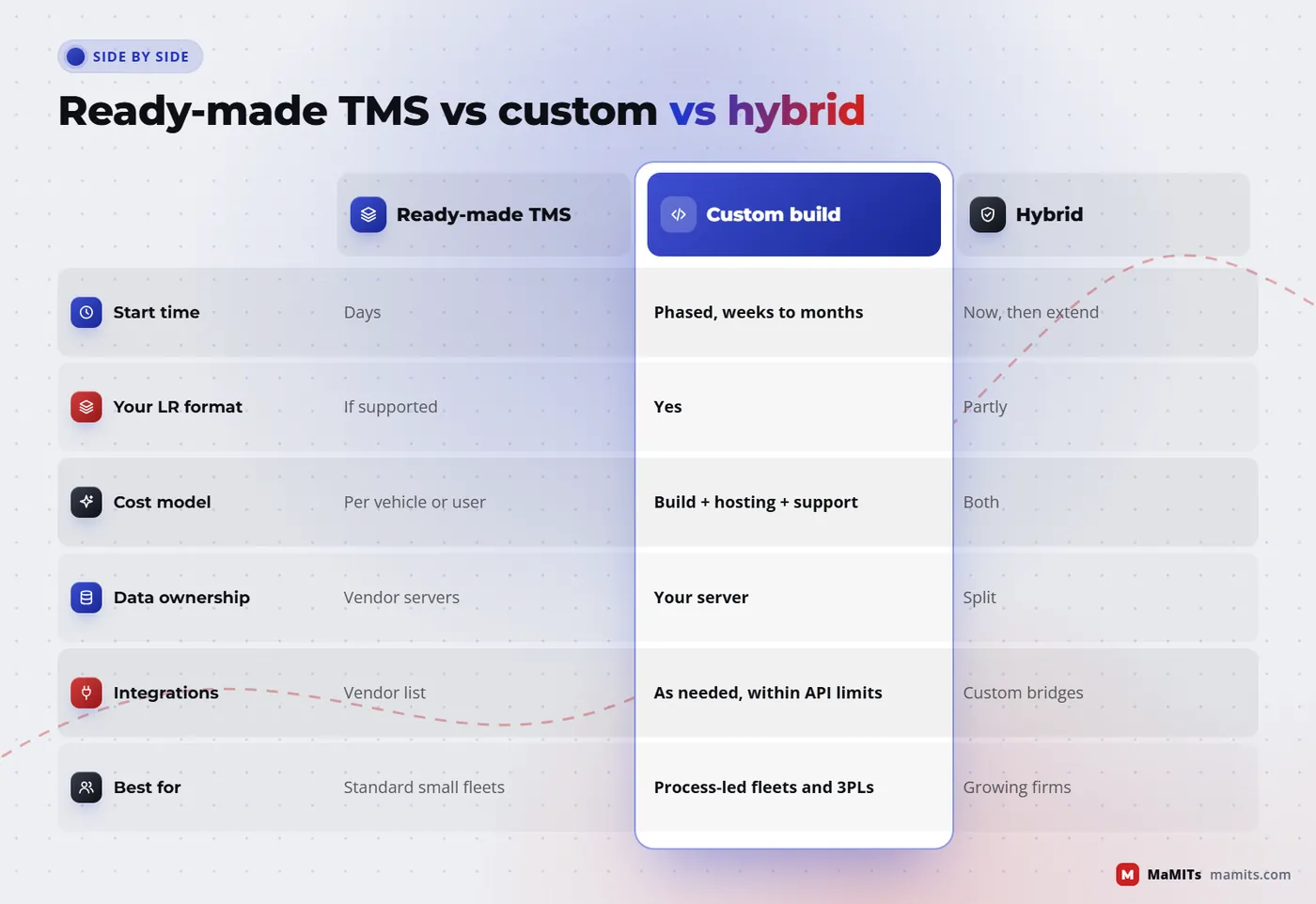
| Question | Ready-made TMS subscription | Custom build by MaMITs | Hybrid |
|---|---|---|---|
| Time to start | Days | Weeks to months, phase by phase | Ready tool now, custom pieces later |
| Fits your LR format and rate rules | Only if the vendor already supports them | Built to your process | Partly |
| Monthly cost | Per vehicle or per user, rises with fleet | Development cost plus hosting and support | Both |
| Data ownership | On vendor servers, export varies | Your server and database | Split |
| Integrations with your GPS, Tally, client portals | What the vendor offers | What you need, within API limits | Custom bridges |
| Best for | Small fleets with standard work | Fleets, 3PLs and couriers whose process is their edge | Growing firms testing the water |
If a ready product fits 90 percent of your work, use it. Custom pays off when the missing 10 percent is where you make or lose money. For broader context see our guide to custom software development.
How we work
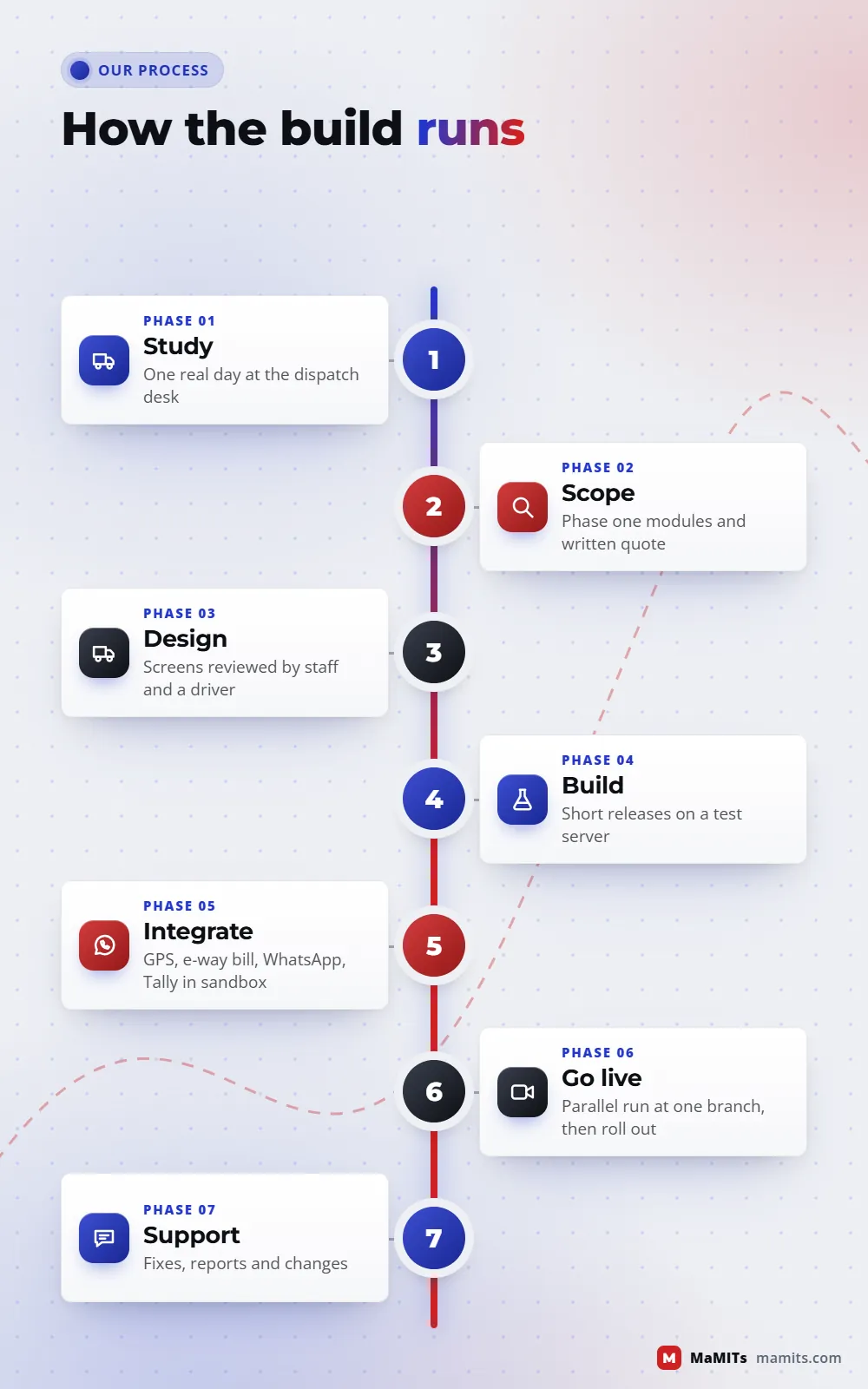
We map one real day: how bookings come in, how LRs are written, how trips are settled and how bills are made. Papers and Excel files are the best requirement documents.
Usually bookings, LR, trips and billing first, because that is where money moves. Fleet, tracking and apps follow. You get a written scope and a quote after this call.
Clickable screens reviewed by the people who will type into them, including a driver for the app.
Working modules every couple of weeks on a test server, with your real masters (clients, vehicles, lanes) loaded.
GPS feeds, e-way bill API or GSP, WhatsApp, Tally export, each tested in sandbox before live.
Run alongside the old method for a short period at one branch, then roll out branch by branch.
Bug fixes, new reports and changes as your lanes and clients change.
Cost and limits
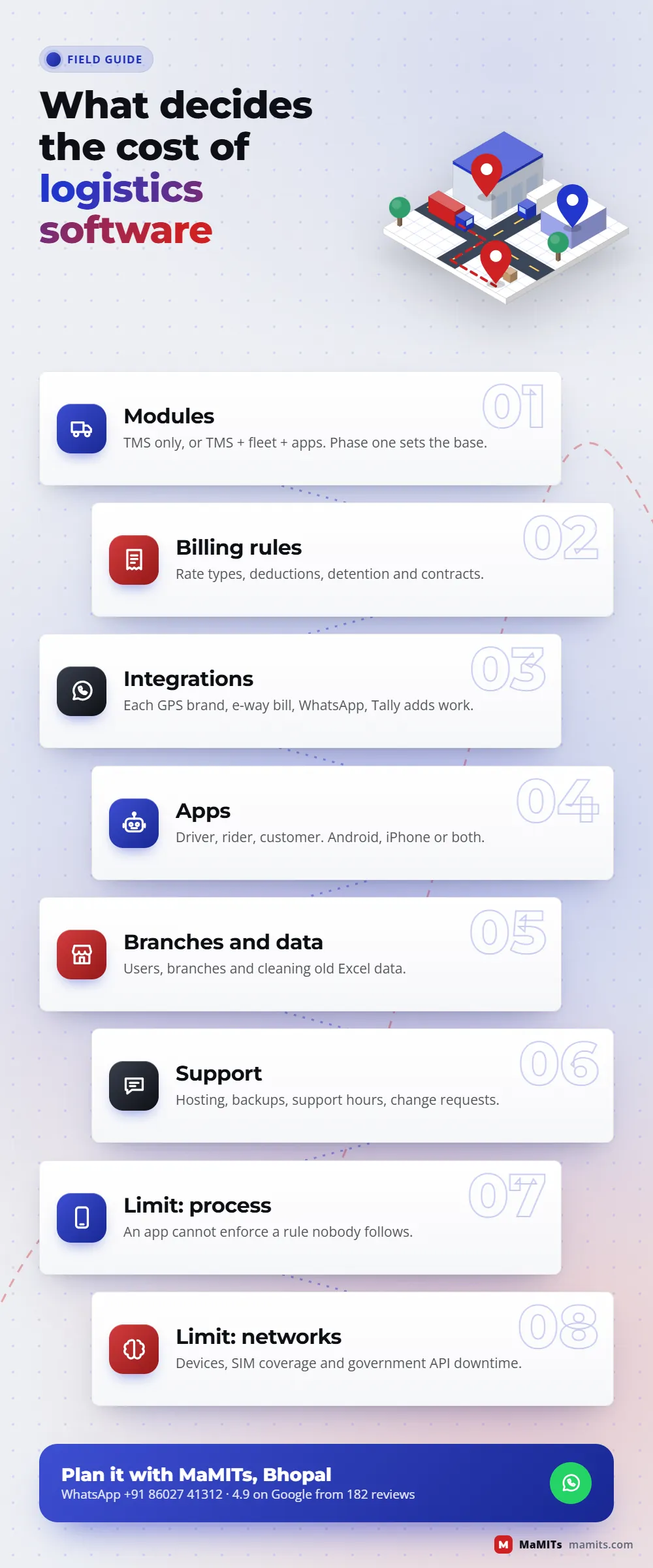
We do not publish a fixed price because two transport ERP projects with the same name can differ tenfold in effort. MaMITs quotes after a scoping call, and a small first module can start after a short one. These are the factors that move the number: When you compare quotes, ask each logistics software development company how it handles offline driver apps and failed e-way bill calls; the answer tells you more than the price.
Cost factors
Software does not fix a process nobody follows. If drivers are not asked for PODs today, an app alone will not make them do it; a rule such as 'trip settlement only after POD upload' will. Tracking depends on device quality and SIM coverage. Government APIs have downtime and changing rules, so the system must let staff continue manually and catch up later. Data from old Excel sheets is usually messy and cleaning it takes real time. Plan for these and the project lands; ignore them and any vendor will look bad.
Choosing a partner
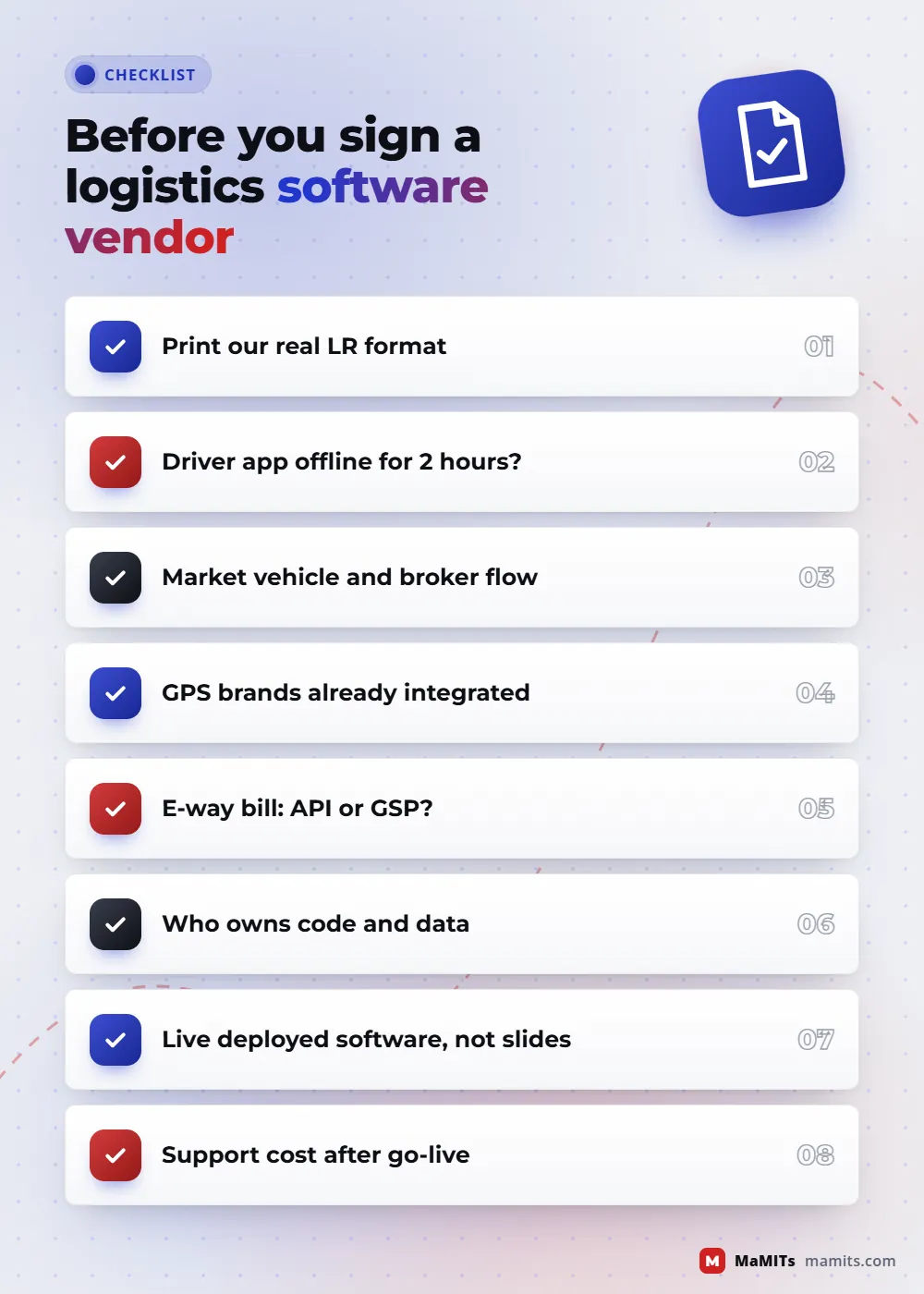
People searching for the top logistics software company usually compare demos. Compare these instead:
MaMITs is rated 4.9 on Google from 182 reviews and has deployed 100+ software and 30+ mobile apps. See the portfolio or read how to pick a software company in Bhopal. Factory plants that run their own dispatch often need production planning too; that is on our manufacturing software page.
Where we work
Bhopal sits close to the centre of India's road network, and a large share of India's long-haul lanes cross Madhya Pradesh. We meet clients in person across Madhya Pradesh with 3 days notice, and in Delhi NCR, Mumbai, Pune, Maharashtra and Uttar Pradesh with 7 days notice. Clients in the USA, Canada, Australia, the UK and France meet us online. If you are shortlisting a logistics software development company in Bhopal, Indore or Delhi NCR, ask to see a driver app working on a low-cost Android phone.
Madhya PradeshIn person with 3 days notice
Our office is at Ayodhya Nagar. Transporters on the Bhopal bypass and Mandideep belt can sit with us and walk through their trip sheets in person.
Indore's transport and parcel trade around the city's logistics hubs needs multi-branch LR series and strong collections; we visit with 3 days notice.
Fleet owners with mixed own and market vehicles; in person within Madhya Pradesh with 3 days notice.
Fleet owners and parcel operators across the state usually start with trip sheets, LR series and driver payments. We visit anywhere in Madhya Pradesh with 3 days notice.
Beyond Madhya PradeshIn person with 7 days notice in India, online abroad
Delhi, Noida and Gurugram 3PLs and courier operators often need client portals and hub scanning; in-person meetings with 7 days notice.
Last-mile and e-commerce delivery operations; in-person meetings with 7 days notice.
FAQ
Straight answers to what transporters, couriers and fleet owners ask us most.
Transport management software (TMS) records and controls the movement of goods: bookings, lorry receipts, vehicle and driver assignment, trip expenses, proof of delivery and freight billing. It replaces bilty books and Excel sheets with one record per consignment, so an owner can see status, outstanding payments and profit per trip without calling the branch.
It depends on modules, billing rules, number of integrations, apps and branches. A focused TMS with LR, trips and billing costs far less than a full platform with fleet, driver app, customer portal and e-way bill integration. MaMITs gives a written quote after a scoping call where we see your real documents and process.
Yes, through the official e-way bill API or a GST Suvidha Provider. The software can create the bill from invoice and LR data, update the vehicle number in Part B when a truck changes, extend validity and cancel. API access needs registration, sandbox testing and whitelisting, so plan a few weeks for approvals.
Yes. AIS 140 trackers, which buses and taxis usually carry, and ordinary goods-vehicle trackers can both feed the software through the vendor’s API or device server. Location, ignition, halts and overspeed then show inside each trip. The device’s own link to the state system stays as it is.
A well-built driver app should. Ours saves trip steps, expenses, photos and signatures on the phone and uploads them when the network returns, with automatic retries. The driver sees what is still waiting to sync. This matters on highways and in rural delivery areas where signal drops for long stretches.
At delivery the driver or rider captures the signed LR or an on-screen signature, the receiver's name and mobile, a photo of the goods, and optionally an OTP sent to the receiver. Time and GPS location are recorded automatically. The office can attach that POD to the freight bill the same day.
Usually yes, if the device vendor provides an API or a data feed in a documented protocol. Many fleets have two or three brands, so each needs its own connector. Some low-cost trackers give no usable data access, and in that case we tell you before you spend on the integration.
Each delivered COD shipment is matched to a collection entry, cash or UPI, and each rider's cash is matched to a branch deposit at day end. The dispatcher sees short or pending amounts per rider the same evening. Reports by rider, hub and date make month-end settlement a check, not an investigation.
If a ready product fits nearly all of your work and the per-vehicle fee is acceptable, buy it. Choose custom when your rate rules, LR format, client reports or integrations are your advantage and ready tools force workarounds. A hybrid, ready tool now and custom modules later, is also a sensible route.
Toll transactions can be imported from your FASTag issuer's statements or portal exports and matched to trips by vehicle and time. Live, automated FASTag data for a fleet is not an open public API; approved access routes include your issuing bank and the government's ULIP platform after registration and approval.
Yes. Route and stop masters, vehicle and driver assignment, boarding scans by card or app, and live bus location for parents or the HR team. Document expiry alerts and tracking device compliance for public service vehicles are part of the same system.
This is agreed in the contract before work starts. For custom builds, clients typically own their database and the software built for them, hosted on their own server or cloud account. Always confirm ownership, export format and handover terms in writing with any vendor you choose.
Next step
Send photos of an LR, a trip sheet and a freight bill on WhatsApp. We will tell you what to build first, what to buy instead, and what it would take, before you commit to anything.
MaMITs, 144, Neerja Nagar, Durgesh Vihar, Ayodhya Nagar, Bhopal 462041 · ★ 4.9 on Google from 182 reviews