

|
Listen Now
Getting your Trinity Audio player ready...
|
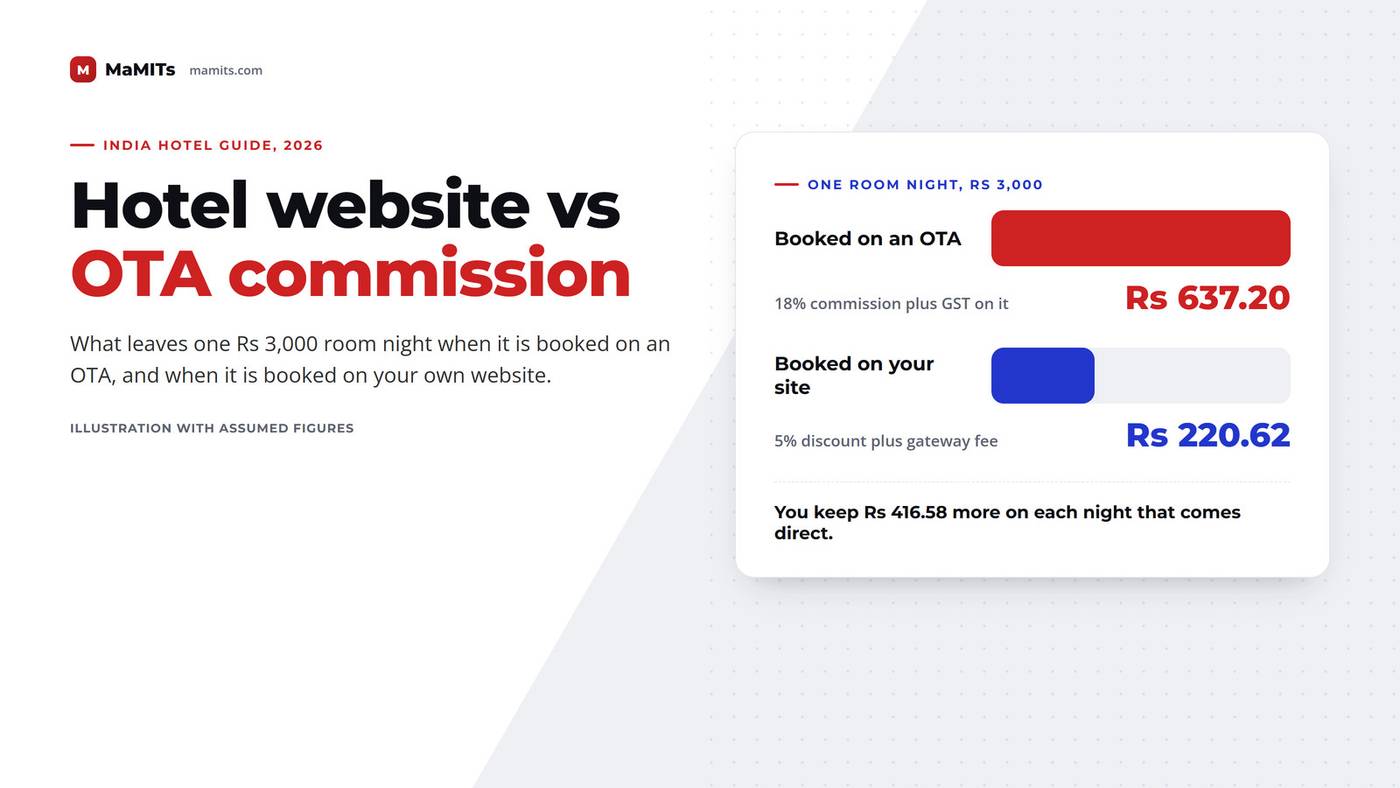
In short: hotel website development pays for itself only when the site takes bookings that would otherwise have come through an OTA and paid commission on them. In the worked example further down, a 20-room hotel that moves one room night a day from OTAs to its own website saves about Rs 1 lakh a year once it has paid for the payment gateway, a booking engine and the upkeep of the site (only about Rs 26,000 in the first year, when the site is built), and it needs about 123 direct room nights a year to cover those running costs. Most OTAs do not publish their commission; your contract sets it. A website will not replace MakeMyTrip or Booking.com for you. It lowers the part of your room revenue that goes to them.
How much commission do OTAs charge hotels in India?
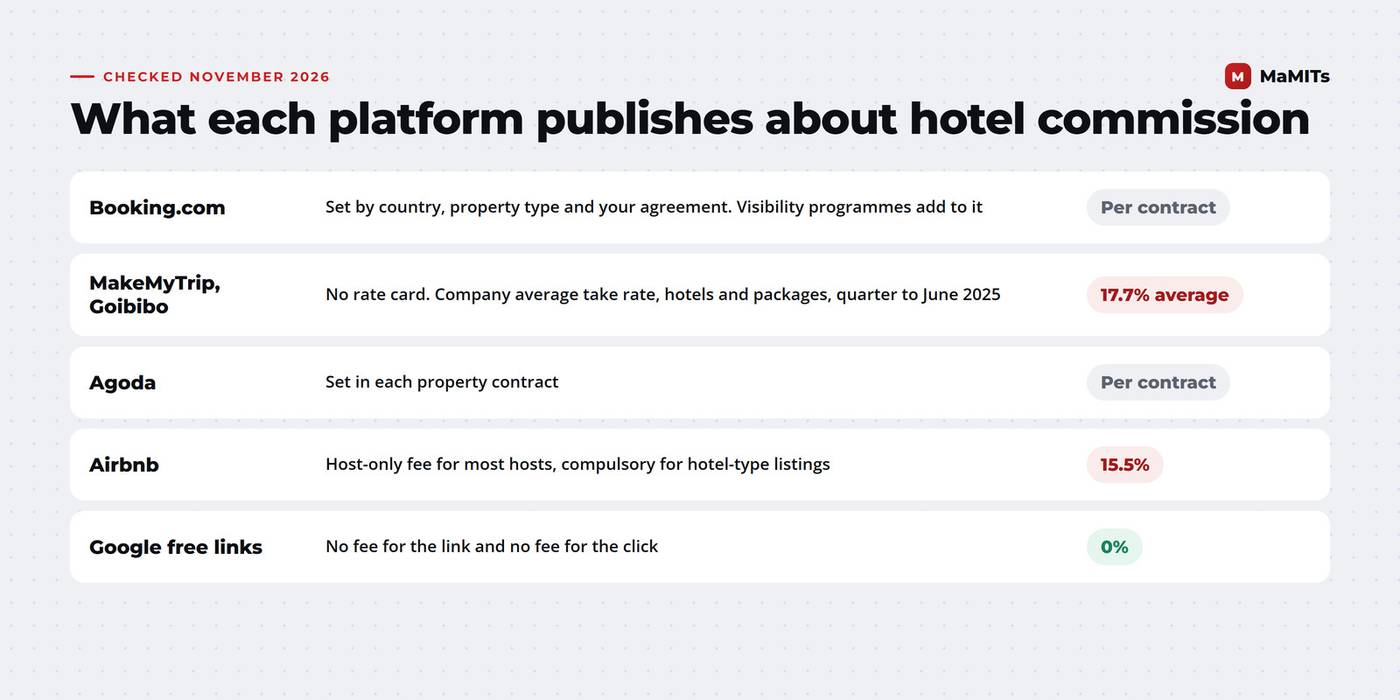
Most OTAs take a percentage of every booking, fixed in each hotel’s own contract, and only Airbnb puts a rate on a public page: 15.5% for most hosts under its single-fee structure.
OTA: an online travel agency, the site or app that sells your rooms and keeps a cut. For an Indian hotel that usually means MakeMyTrip and Goibibo (one company), Booking.com, Agoda and Airbnb. Here is what each of them says in public.
| Platform | What the platform itself publishes | A figure you can rely on | Where your real rate sits |
|---|---|---|---|
| Booking.com | Its partner help says the percentage depends on your country, your property type and the agreement you signed, and that programmes such as Preferred Partner add to it | Not published for India | Your agreement and the extranet |
| MakeMyTrip and Goibibo | No public rate card for hotels | 17.7%: the company’s average take rate across hotels and packages for the quarter ended June 2025, given on its earnings call of 22 July 2025. An average, not your rate | Your contract and the monthly statement |
| Agoda | Commission is set per property contract | Not published | Your contract and the Agoda extranet |
| Airbnb | 15.5% for most hosts on the host-only fee, which is compulsory for hotel-type listings; the older split fee is 3% for the host plus 14.1% to 16.5% for the guest | 15.5% | Your Airbnb payout report |
| Google free booking links | No fee for the link and no fee for the click | 0% | Google Hotel Center, or ask your booking engine vendor |
You will find “OTAs charge 15% to 25%” repeated on dozens of sites. We do not print it, because the ones we read give no source for it. The only commission that matters is the one on your own statement, and it hides in three places: the base percentage in the contract, the extra you pay for “preferred” or other visibility programmes, and the discounts and coupons that the hotel funds out of its own rate.
The MakeMyTrip number is a company-wide margin on hotels and holiday packages together. Nobody should read it as the rate a 20-room hotel in Shimla signs for.
What does an OTA booking cost after GST and TCS?
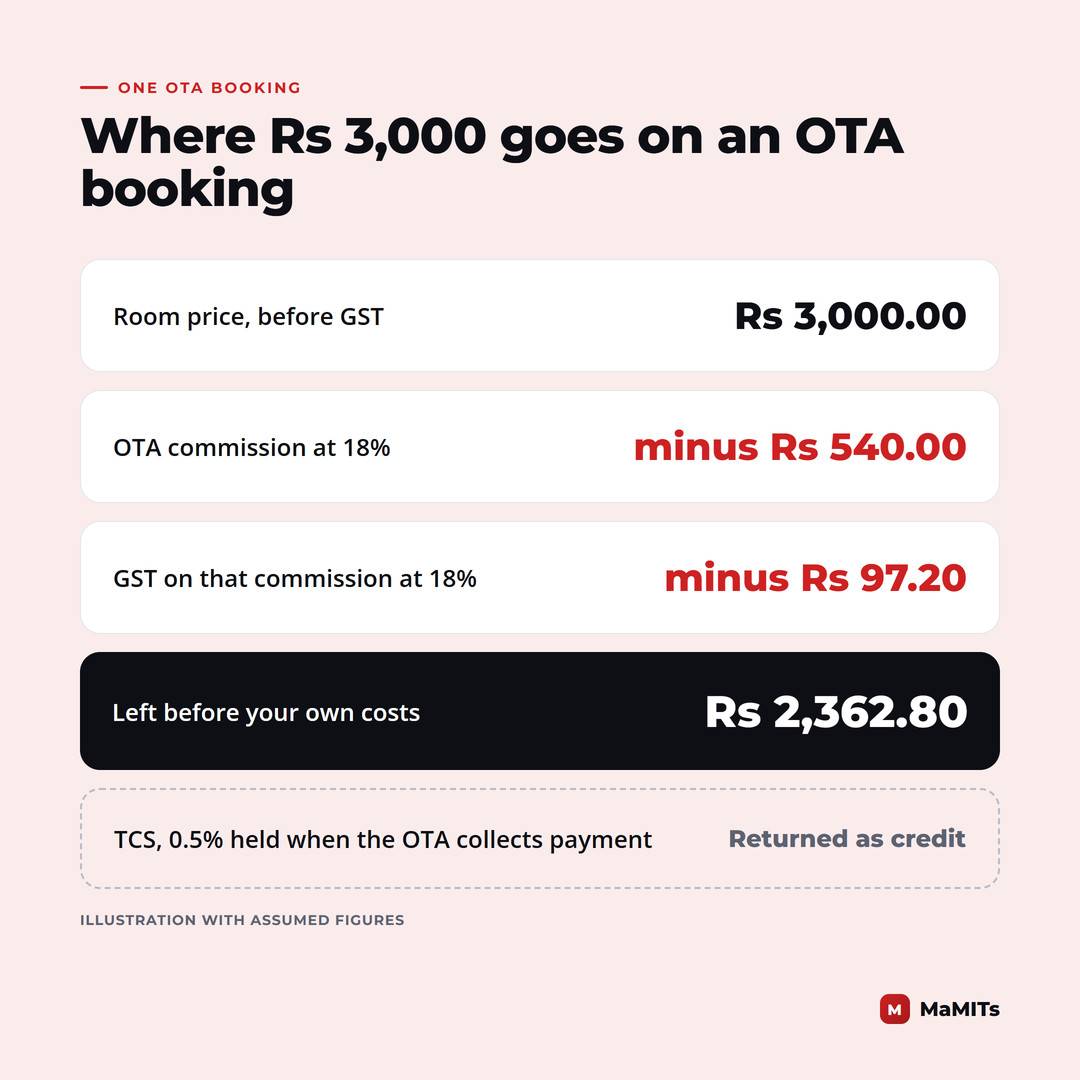
The commission is not the whole deduction. The OTA bills GST on its commission, and when it collects the guest’s money it also holds back a small tax collected at source, which you get back as credit.
Check the GST line on your own commission invoice; our example assumes 18%. On a Rs 3,000 room night at an assumed 18% commission, the commission is Rs 540 and GST on it is Rs 97.20, so Rs 637.20 leaves that one booking (assumed figures). Whether you can set that Rs 97.20 off against your own GST depends on your room tariff slab and on rules that changed in September 2025 and were being revised again in October 2026. Confirm with your CA. We build websites; we are not tax advisers.
Since 22 September 2025, hotel rooms up to Rs 7,500 a night carry 5% GST without input tax credit, as set out in the GST Council’s September 2025 press release. In October 2026 the Council recommended loosening the credit rule for this slab, so ask for the current position before you plan around it.
TCS (tax collected at source): when an OTA takes the guest’s payment, Section 52 of the CGST Act makes it hold back a small part, 0.5% in total since July 2024 (0.25% central plus 0.25% state). You do not lose it. It lands in your electronic cash ledger and your accountant uses it against your own GST, as the official FAQ on TCS under GST (PDF) explains. The real work is matching the OTA statement with the ledger every month.
What does a direct booking on your own website cost?
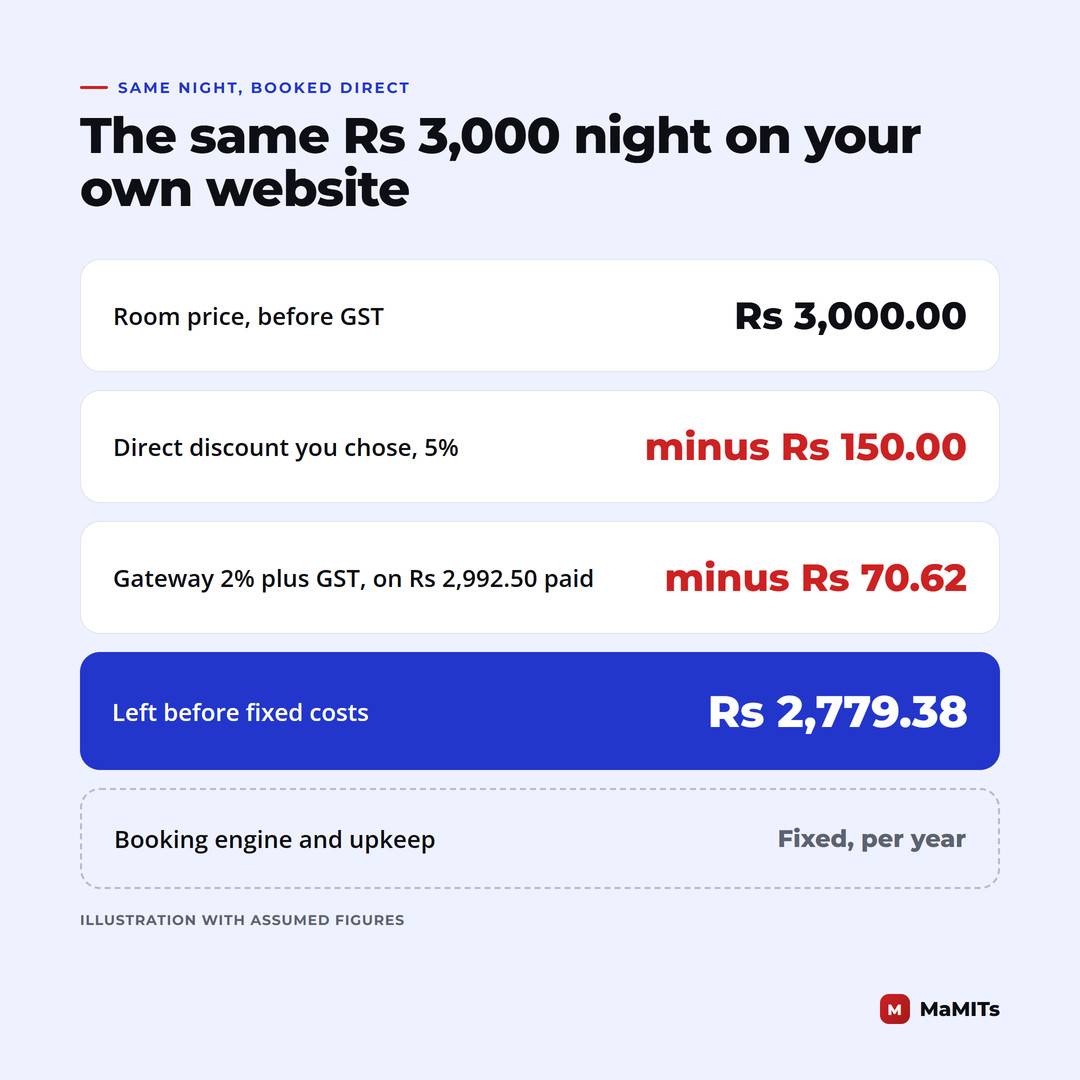
A direct online booking costs you the payment gateway fee, about 2.36% of what the guest pays on Razorpay’s standard plan, plus your share of what it costs to run the site. A direct booking has four costs in all:
- The payment gateway. Razorpay’s public pricing page lists 2% per successful domestic payment plus 18% GST on that fee, which works out to 2.36%. Corporate cards cost 2.15% and international cards up to 3%, each plus GST. Other Indian gateways publish similar price lists; compare them before you sign.
- Any direct discount you choose to give. That is your decision, not a fee. Before you show a lower public price on your own site, read the parity clause in your OTA agreement or ask your account manager in writing.
- A booking engine, if you want online payment and live availability. A booking engine is the software on your site that shows which rooms are free, takes the dates and the payment, and confirms the room. Most Indian vendors quote on request: some charge a flat monthly fee, some a percentage of each direct booking. Get two written quotes. If you also sell on OTAs, the vendor will talk about a channel manager, the software that updates your room count on every OTA and on your site at once so one room is not sold twice.
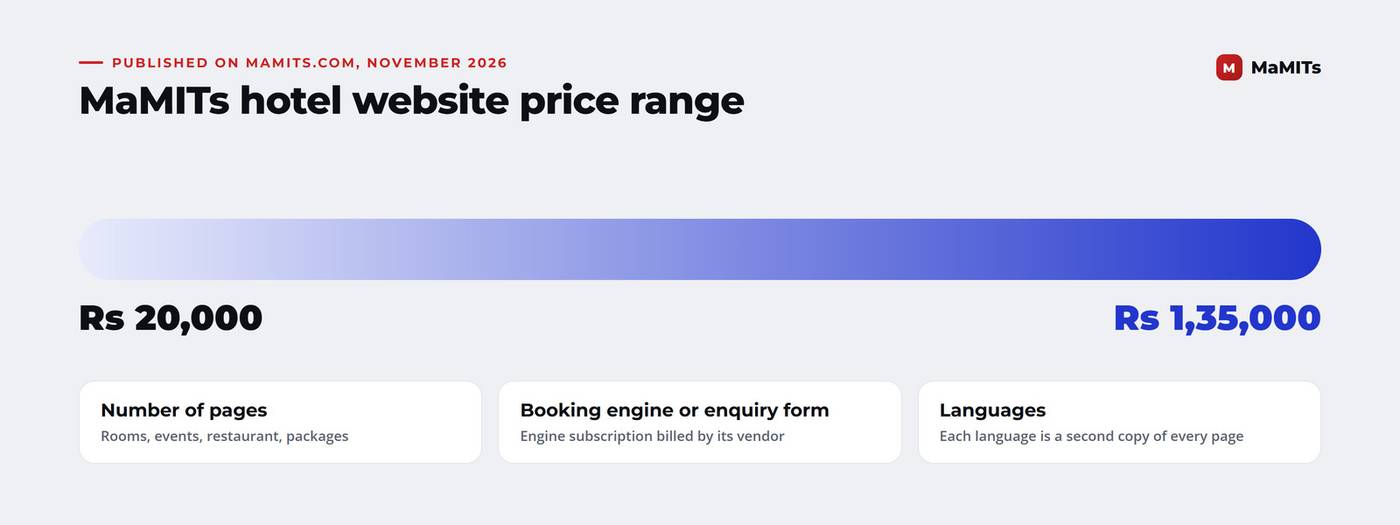
- The website itself: hotel website development is paid for once, then domain, hosting and upkeep come every year. MaMITs quotes hotel websites between Rs 20,000 and Rs 1,35,000, and our hotel website design and development page shows what moves the price.
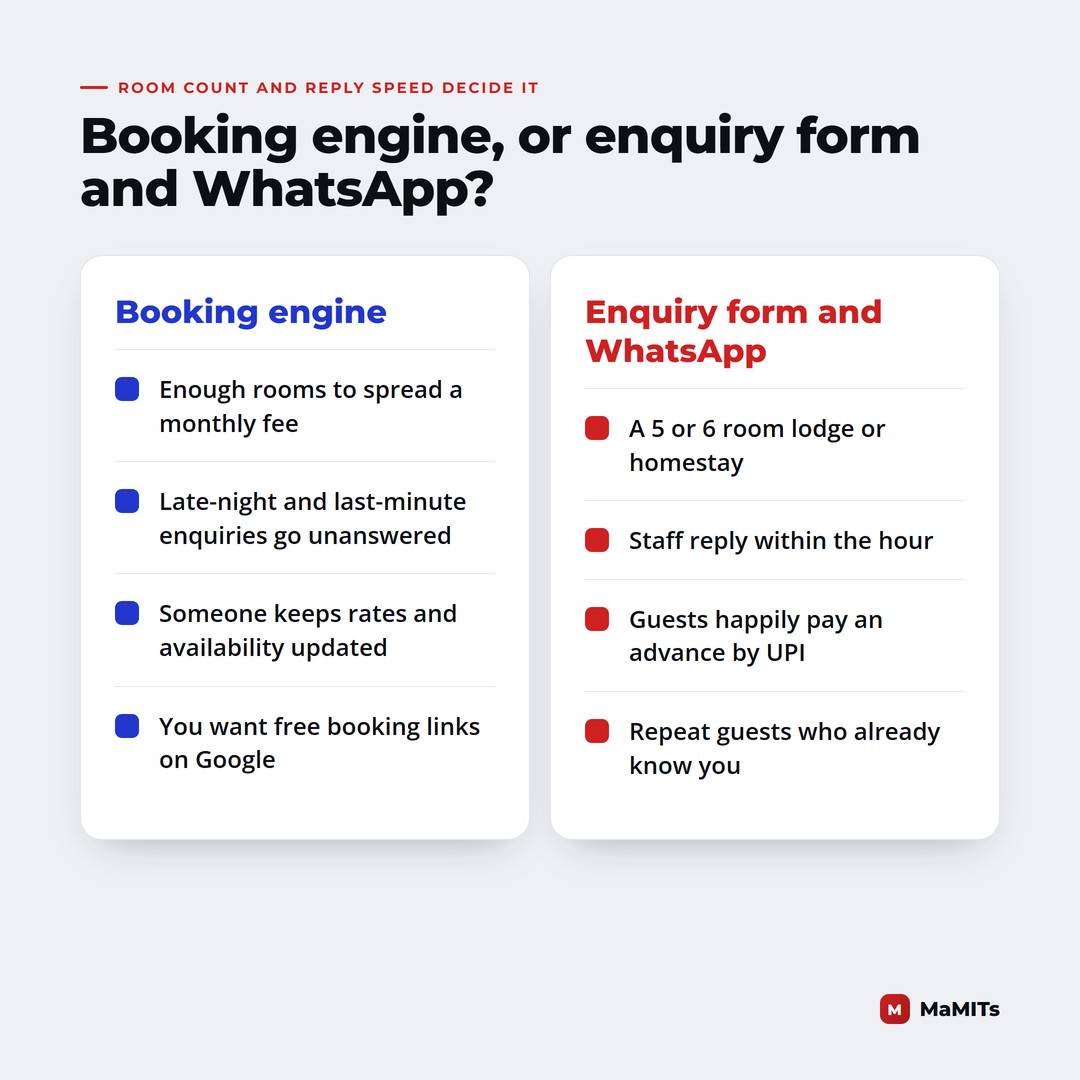
A small property may not need a gateway at all. A guest sees the site, sends a WhatsApp message with dates, and pays an advance by UPI or bank transfer straight into the hotel’s account. That payment goes from the guest to you with no gateway in between, and for a 6-room homestay in Coorg it is often all the “booking system” the business needs.
Worked example: a 20-room hotel over three years, OTA only or with its own website
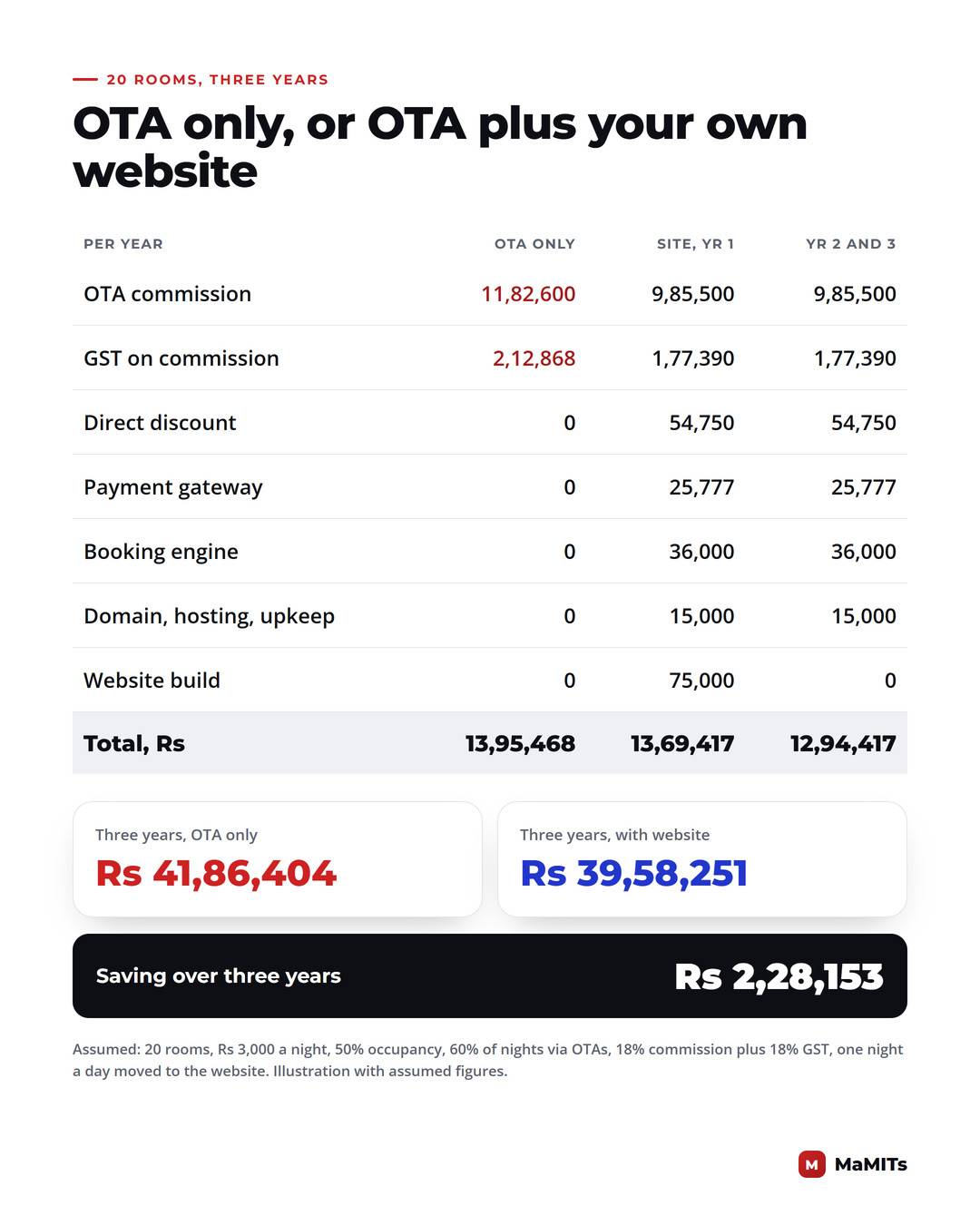
On the assumed figures below, the hotel pays about Rs 41.86 lakh to OTAs over three years if it sells only through them, and about Rs 39.58 lakh in total if it also runs its own website and moves one room night a day to it. The difference is about Rs 2.28 lakh.
This is an illustration with assumed figures. It is not a client of ours and not an average for India. Take a 20-room hotel in a hill town or a temple town, and then redo the sums with your own rate, occupancy and contract.
| Assumption | Value |
|---|---|
| Rooms | 20 |
| ADR (average daily rate: what one sold room earns per night, before GST) | Rs 3,000 |
| Occupancy across the year | 50% |
| Share of room nights that come through OTAs today | 60% |
| OTA commission on the room price before GST | 18% (assumed, close to the 17.7% MakeMyTrip average; your contract will differ, and Booking.com’s help page says that in most countries it charges commission on the tax as well) |
| GST on the commission invoice | 18% (assumed) |
| Room GST | 5% (tariff under Rs 7,500) |
| Room nights moved from OTAs to the website | 365 a year, one a day (OTA share falls from 60% to 50%) |
| Direct discount on the website | 5%, so the direct rate is Rs 2,850 |
| Payment gateway | 2% plus 18% GST on the fee, charged on the amount the guest pays including room GST |
| Website build, paid once | Rs 75,000 (assumed, inside the MaMITs published range, not a quote) |
| Booking engine | Rs 3,000 a month, Rs 36,000 a year (assumed; get vendor quotes) |
| Domain, hosting and upkeep | Rs 15,000 a year (assumed) |
| Advertising for the website | Rs 0 (assumed; add yours) |
The sums
Rooms sold in a year: 20 rooms x 365 nights x 50% = 3,650 room nights. Of those, 60% come through OTAs: 2,190 nights, or Rs 65,70,000 of room revenue at Rs 3,000.
OTA only: commission is Rs 65,70,000 x 18% = Rs 11,82,600. GST on it is Rs 11,82,600 x 18% = Rs 2,12,868. The OTA cost for the year is Rs 13,95,468, and over three years Rs 41,86,404. Per OTA room night that is Rs 540 + Rs 97.20 = Rs 637.20.
With its own website: OTA nights fall to 2,190 minus 365 = 1,825, which is Rs 54,75,000 of room revenue. Commission is Rs 54,75,000 x 18% = Rs 9,85,500 and GST on it Rs 1,77,390. The 365 direct nights sell at Rs 2,850, which costs Rs 54,750 in discount. Guests pay Rs 10,40,250 plus 5% room GST = Rs 10,92,262.50 through the gateway, and the fee on that is 2% plus GST = Rs 25,777. Add the booking engine (Rs 36,000) and upkeep (Rs 15,000), and in year one the Rs 75,000 build.
| Cost line | OTA only, per year | With website, year 1 | Year 2 | Year 3 |
|---|---|---|---|---|
| OTA commission | Rs 11,82,600 | Rs 9,85,500 | Rs 9,85,500 | Rs 9,85,500 |
| GST on commission (18%) | Rs 2,12,868 | Rs 1,77,390 | Rs 1,77,390 | Rs 1,77,390 |
| Direct discount (5% on 365 nights) | 0 | Rs 54,750 | Rs 54,750 | Rs 54,750 |
| Payment gateway (2% plus GST) | 0 | Rs 25,777 | Rs 25,777 | Rs 25,777 |
| Booking engine | 0 | Rs 36,000 | Rs 36,000 | Rs 36,000 |
| Domain, hosting, upkeep | 0 | Rs 15,000 | Rs 15,000 | Rs 15,000 |
| Website build (once) | 0 | Rs 75,000 | 0 | 0 |
| Total for the year | Rs 13,95,468 | Rs 13,69,417 | Rs 12,94,417 | Rs 12,94,417 |
| Saving against OTA only | Rs 26,051 | Rs 1,01,051 | Rs 1,01,051 |
The first year barely pays: the hotel is ahead by Rs 26,051. At this size the case for hotel website development is modest, because only one night a day moved, the hotel gave a 5% discount and it pays for a booking engine. The website loses on two lines of the table, too: it adds fixed costs every year, and it costs more up front. On the same assumptions, if two nights a day move instead of one, the three-year saving rises to about Rs 6.84 lakh.
Break-even in room nights
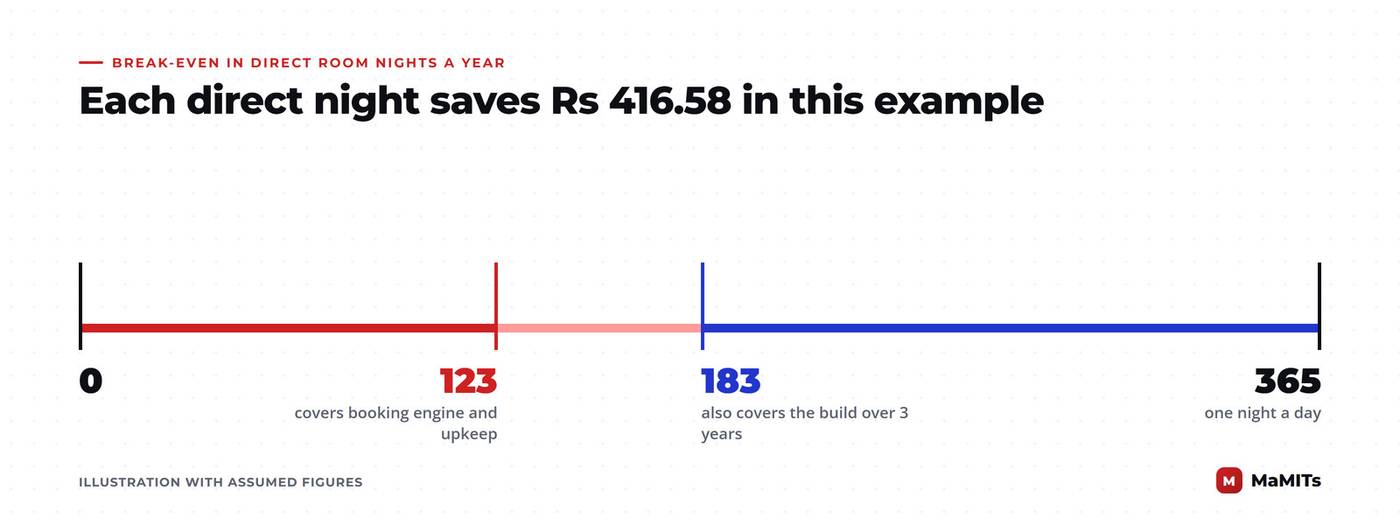
Each night moved from an OTA to the website saves Rs 637.20 in commission and GST, less the Rs 150 discount and Rs 70.62 in gateway fee (Rs 2,850 x 1.05 = Rs 2,992.50, of which 2% is Rs 59.85, plus Rs 10.77 GST). That leaves Rs 416.58 a night. The running costs are Rs 51,000 a year, and Rs 51,000 / Rs 416.58 = 122.4, so the example needs 123 direct room nights a year, about one every three days. Spread the Rs 75,000 build over three years and the target becomes Rs 76,000 / Rs 416.58 = 182.4, so 183 nights, about one every two days. Give no direct discount and the gateway takes Rs 74.34 of the full Rs 3,150, the saving is Rs 637.20 minus Rs 74.34 = Rs 562.86 a night, and the running costs are covered in 91 nights (Rs 51,000 / Rs 562.86 = 90.6).
What the example leaves out
It leaves out the things that are hard to put a price on: any advertising you run to bring guests to the site, the staff time to answer enquiries, and the guests who find you on an OTA and then search your name. If a family sees your hotel on MakeMyTrip and then types its name into Google, a hotel with no website sends them straight back to the OTA. We have not put a number on that, because nobody has measured it for your hotel.
When is a hotel website worth the money, and when is it not?
It is worth it when guests already look for you by name, and it is not worth a booking engine when nearly every room goes to a first-time guest who has never heard of you. Owners who get value from it usually have:
- repeat and referral guests: the families who come back to Mussoorie or Munnar every summer, corporate accounts, wedding parties and tour groups
- something an OTA listing cannot sell properly, such as a wedding lawn, a banquet hall, packages, treks, or a restaurant with its own local customers
- pilgrim trade that books by phone, the way devotees call ahead to lodges in Tirupati, Shirdi, Varanasi and Puri
- a “preferred” or visibility programme on an OTA that they pay for on top of the base commission
Hold back, or buy a cheaper site, in four cases. If you run a 5 or 6 room lodge or homestay, lodge website development on a small budget means a five-page site, an enquiry form and a WhatsApp button; we would not build a booking engine for a 6-room lodge. If nobody at the property can answer an enquiry within the hour, fix that first. The same goes for photos, GST registration and a cancellation policy that are not sorted yet. And if nobody will keep rates and availability updated on the site, do not take online payment on it.
Money spent on hotel website development will not replace MakeMyTrip or Booking.com. New guests will keep finding you there. The aim is a smaller OTA share of your room revenue, not zero.
Can you get direct bookings from Google without paying commission?
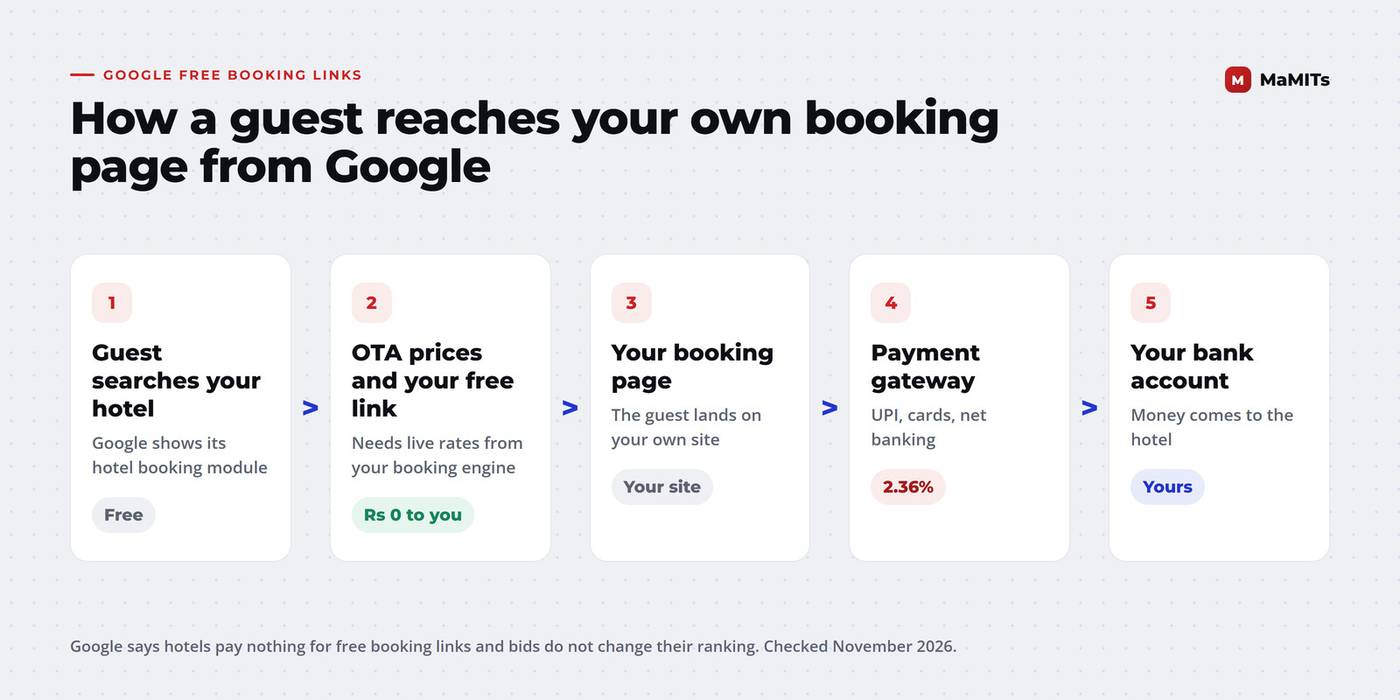
Yes. Google shows free booking links to a hotel’s own website in its hotel search results and charges nothing for the link or the click, but it needs live rates and availability from your booking system before it can show one.
The free link sits in Google’s hotel booking module next to the OTA prices and any paid ads. According to Google’s help page on free booking links, hotels pay no fee for these links, the ranking depends on price accuracy, the landing page and what the guest is likely to prefer, and bids have no effect on it. Paid Hotel Ads are a separate product that you can ignore.
To appear there you need three things:
- a complete Google Business Profile for the hotel, with the same name, address and phone as your website
- a booking engine that sends your rates and availability to Google. Ask the vendor in writing whether it is connected to Google Hotel Center; Google’s page says a connected provider can set up the links for you
- a booking page on your own site where the guest lands and pays
Our reading of Google’s requirements: a site with only an enquiry form still gets the “Website” button on your Business Profile, but it has no live rates to send, so it will not get a priced free booking link.
What should a direct-booking hotel website have?
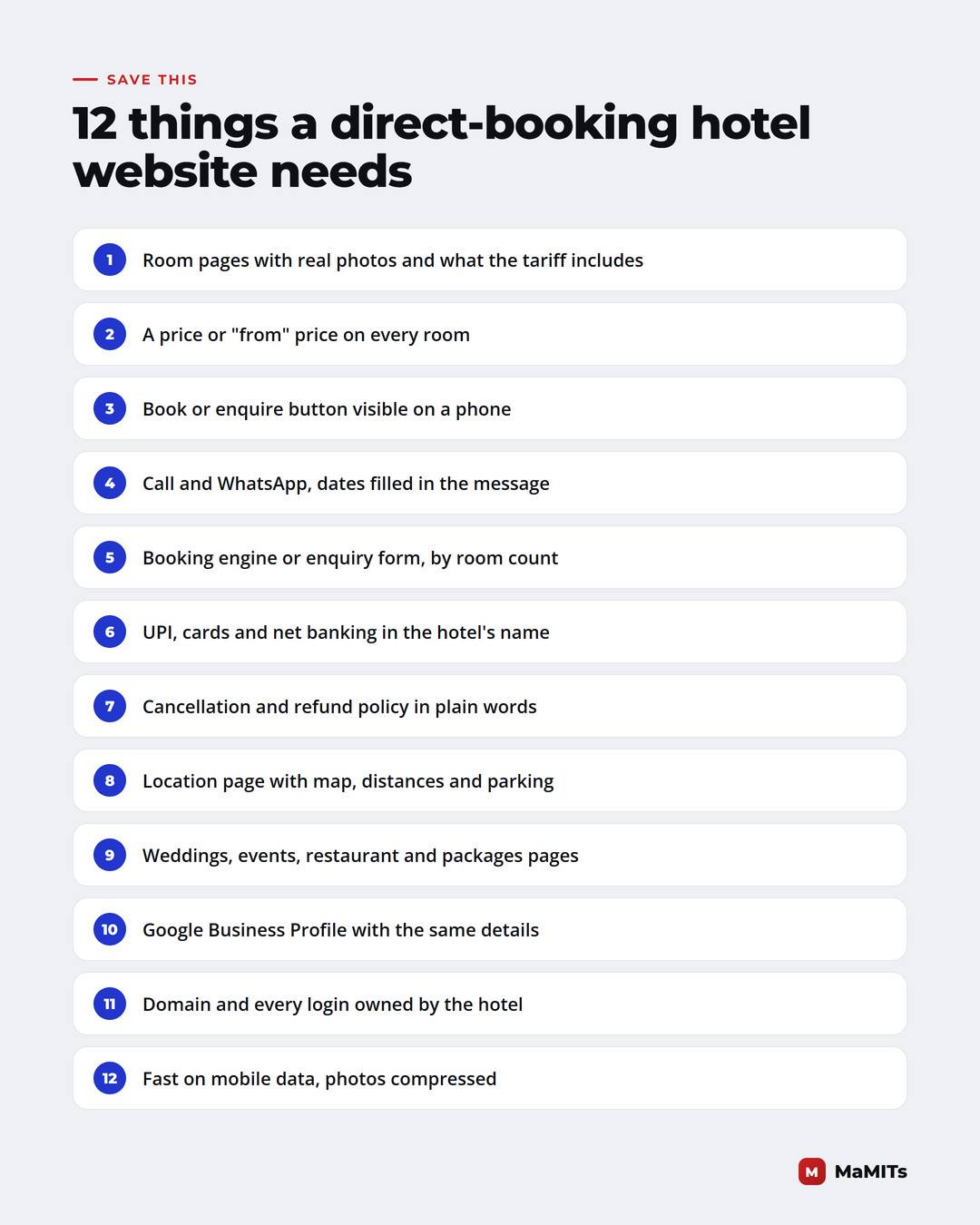
It needs the few things that let a guest on a phone check a room, trust the price, and book or message you in under a minute. Run your current site, or the one you are about to pay for, against this list:
- Room pages with real photos, bed type, room size, what the tariff includes, and whether taxes are extra or included.
- A price or a “from” price on every room page, or live rates from the booking engine.
- A booking or enquiry button that shows on a phone without scrolling.
- Call and WhatsApp buttons, with the WhatsApp message opening with the dates already filled in.
- A booking engine or an enquiry form, chosen by room count and how fast your staff reply.
- UPI, cards and net banking through a gateway account in the hotel’s own name.
- The cancellation and refund policy in plain words on the booking page.
- A location page with a map, the distance from the station, airport, bus stand or temple, and parking.
- Pages an OTA cannot give you: weddings and events, the restaurant, packages, group and corporate enquiries.
- Your Google Business Profile linked to the site, with the same name, address and phone everywhere.
- Domain, hosting, gateway and booking engine logins owned by the hotel, not by the agency or a freelancer.
- Pages that load quickly on mobile data, with compressed photos.
Hotel website design templates are fine for a five-page site if the photos and the words are your own. They fall short when the booking engine has to sit inside the design, when you need two or three languages, or when weddings and events need pages of their own. If your tariffs and offers change every season, a dynamic website with an admin panel lets your staff change them without calling anyone. For design ideas, see the hotel website designs and templates we reviewed.
What should you ask a hotel website design company before you sign?
Ask who will own the domain and the logins, which booking engine they will connect and what it costs every month, and what the price includes, in writing. Whether you hire a hotel website development company, a freelance hotel website designer or a general agency, put these six questions to them in writing:
- Who registers the domain, and in whose name? Who will hold the hosting, gateway and booking engine logins?
- Which booking engine will you connect, is the fee monthly or a percentage of each booking, and is it connected to Google for free booking links?
- How many pages and how many languages does the quote cover? Who writes the text and who shoots the photos?
- What happens after launch: updates, backups, and what it costs each year?
- Which hotel sites have you built that I can open on my phone right now?
- How long will it take with a booking engine, and how long without one?
A good hotel website design company answers all six on one page without being chased. The 15 points to settle before a hotel site is designed go into more detail.
What does hotel website development cost with MaMITs?
MaMITs quotes hotel website projects between Rs 20,000 and Rs 1,35,000, depending on the number of pages, whether you need a booking engine or an enquiry form, and how many languages the site carries. This is the one section of this article that sells something, so read it as that.
The same range covers resort website design, where the extra pages are usually weddings, activities and packages. The booking engine subscription is billed by its own vendor, so ask us to show it as a separate line in the quote. A simple site with an enquiry form can go live in 23 to 96 hours once your content is ready (terms apply); hotel website development with a booking engine takes longer.
Our team works from Ayodhya Nagar, Bhopal, has been building websites since 2015, and works with hotels across India online. At the time of writing that comes to 180+ live websites, 195+ companies and clients, and a 4.9 Google rating from 182 reviews. Hotel sites built by MaMITs include Rajhans Hotels, ZENSAS Denzong Glory in Gangtok, Reva Regency, Pegasus, Jharipani and Country Lodge. For the hotel in Gangtok, the booking engine itself is Djubo’s; what we built is the date search bar on its pages that sends guests into it, styled to match the rest of the site.
You can see the hotel websites we have built and what is included. Our earlier post explains how website development cost is made up, line by line.
Frequently asked questions
What to do this week
Pull last month’s OTA statements and add up the commission plus the GST on it, then divide by the room nights the OTAs sent you. That is your real cost per OTA night. Take off the gateway fee and any discount you would give, and divide a year of booking engine and upkeep costs by what is left. That is the number of direct room nights you need; in our example it was 123. If your repeat guests and phone enquiries already come to more than that, hotel website development has a case for you. If you have six rooms, start with an enquiry form. Send us the two numbers on WhatsApp at +91 86027 41312 or through the contact page, and we will tell you which side of that line you are on.
Figures checked November 2026: Airbnb and Google help pages, Razorpay pricing, the GST Council press release of September 2025 and the official TCS FAQ. Platform fees and tax rules change; check the linked pages for the current numbers.


