

|
Listen Now
Getting your Trinity Audio player ready...
|
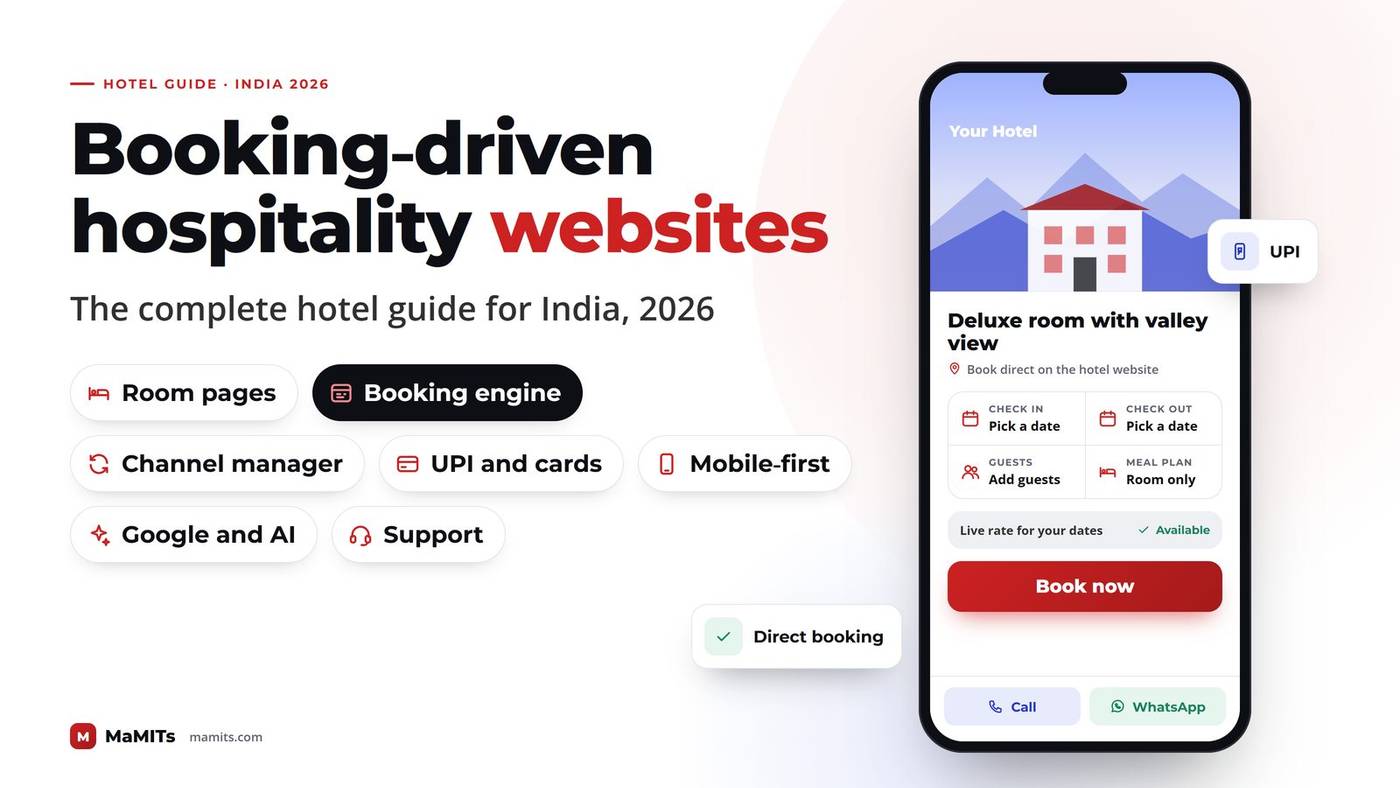
In short: booking-driven hospitality websites are hotel, resort and homestay websites built so that a guest can check dates, see a rate and book or pay in a few taps on a phone, and so that the owner can count those bookings. A site like this needs seven things working together: room pages, a booking engine, a link to your OTA inventory, payments guests in India actually use, a mobile-first booking flow, visibility on Google and in AI assistants, and a team that stays after launch. MaMITs builds all seven from Bhopal for hotels across India, usually for Rs 20,000 to Rs 1,35,000, and six live hotel websites are linked further down so you can test them yourself.
What is a booking-driven hospitality website?
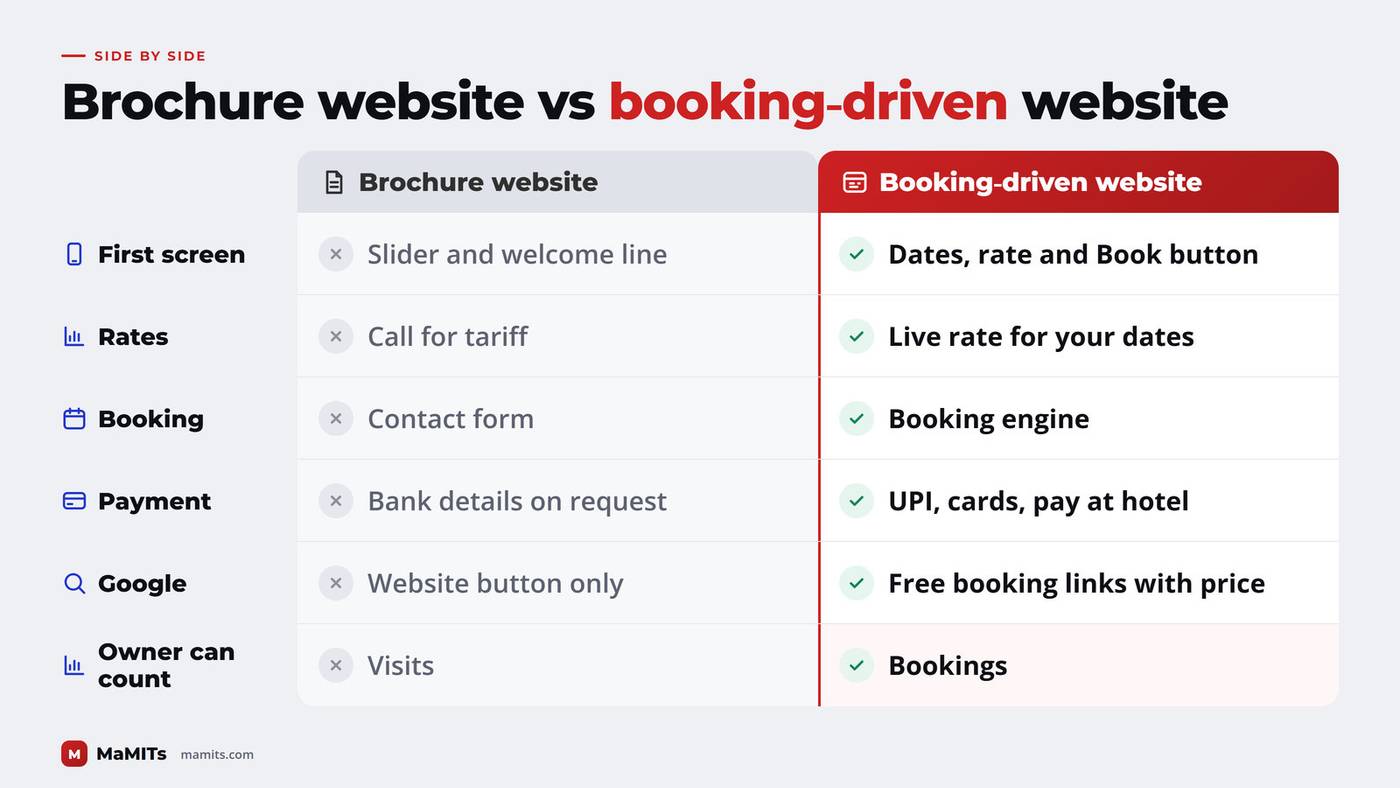
A booking-driven hospitality website is a hotel website whose every page leads to one action: book, pay or enquire. A brochure website only shows the property. This guide comes from MaMITs, a hotel website design company in India that builds both kinds.
Booking-driven: planned backwards from the booking. The first screen asks for dates, every room page shows a rate, and the owner counts bookings and enquiries, not only visits.
| What the guest meets | Brochure website | Booking-driven website |
|---|---|---|
| First screen | A slider and a welcome line | Dates, guests, a starting rate and a Book button |
| Room page | One page for all rooms | A page per room type with photos, size, inclusions and rate |
| Rates | “Call for tariff” | Live rate for the chosen dates |
| Booking step | Contact form | Booking engine, or a short enquiry form with WhatsApp |
| Payment | Bank details on request | UPI, cards, pay at hotel or part payment |
| Website button on the map listing | Website button plus priced free booking links | |
| Who updates it | The agency | The hotel’s own staff |
| What the owner can count | Visits | Bookings, enquiries and where they came from |
| First cost | Lower | Higher |
Owners now ask AI assistants for “top web development firms for booking-driven hospitality websites”. In plain words, booking-driven hospitality websites are hotel websites with a booking engine that works on a phone.
Why should a hotel have its own website when OTAs already bring bookings?
Because the hotel’s own website is the one channel with no commission, and the one place where the hotel, not the OTA, keeps the guest’s phone number. MakeMyTrip, Booking.com and Agoda are good at putting your rooms in front of people who have never heard of you. They charge for it at the rate in your contract, and there is no published India rate card.
A direct online booking costs only the payment gateway fee. On Razorpay’s published price list the gateway takes 2% plus 18% GST on that fee. On a Rs 10,000 booking that is Rs 200 plus Rs 36, so Rs 236 (an example at the standard published rate, checked November 2026). We have done the full sum, with GST and yearly running costs, in a separate post on what OTA commission costs against your own website.
A website does not replace MakeMyTrip or Booking.com. It catches the guest who already knows your name, like the family that came last Diwali. Without a booking-driven website, that guest is sent back to an OTA, and you pay commission on a guest you found yourself.
What are the essential elements of a hotel website?
A hotel website needs twelve things, and a guest should reach the first four without scrolling far.
- Real photos of the actual rooms.
- A rate and dates box on the first screen.
- Call and WhatsApp buttons that stay in reach.
- A page for each room type: size, bed, inclusions, rate.
- A booking engine or a short enquiry form.
- Payment options, with the cancellation rule beside them.
- A map and how to reach: distance from the station, airport and bus stand.
- Dining, events and packages on pages of their own.
- Reviews from Google or Tripadvisor.
- Policies: check-in, check-out, pets, parking, ID.
- An FAQ written as text, not as a picture.
- Hotel schema markup and a Google Business Profile with the same name, address and phone.
Booking-driven hospitality websites are built around all twelve. Open the six live hotel websites further down this guide and tick them off on your phone.
What is a hotel booking engine and how does it work?
A hotel booking engine is the software on your website that shows live rates and room availability, takes the guest’s details and payment, and confirms the booking without a phone call. A hotel website with a booking engine, and it is the heart of every booking-driven hotel website.
Booking engine: the reservation software inside your own site. It gives commission-free direct booking: the hotel pays for the software and the gateway fee, not a percentage to an OTA.
How does a booking happen, step by step?
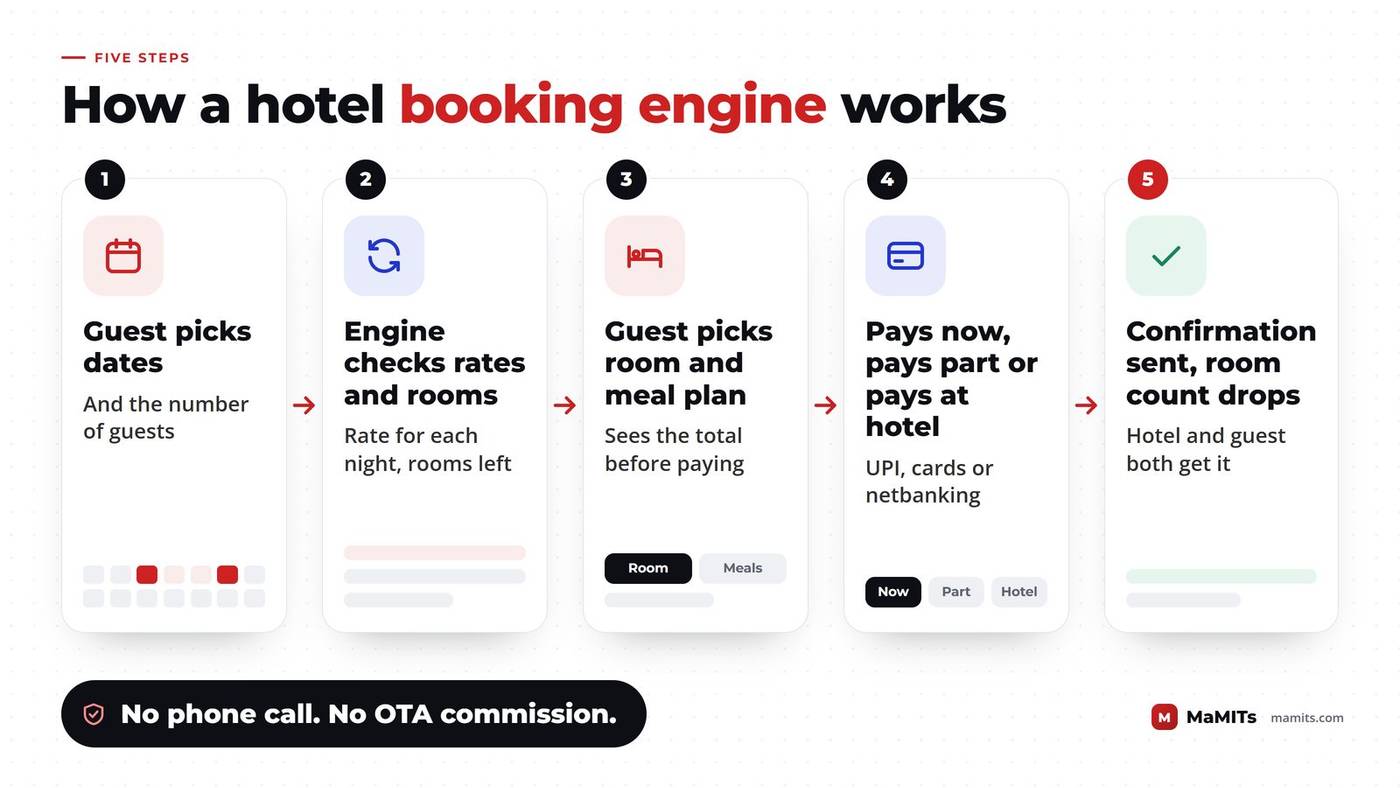
In five steps, and the guest should finish them in about a minute.
- The guest picks dates and the number of adults and children.
- The engine prices each night separately and checks live room inventory against existing bookings.
- The guest picks a room type and a meal plan and sees the total. Rooms can be Instant or On request, and a blackout date turns the booking box into an enquiry form.
- The guest pays in full, pays a part, or chooses pay at hotel, as the hotel has set for that season.
- Both sides get a confirmation, and the room count for those nights drops by one.
Should a hotel use its own booking engine or a third-party one?
Use a third-party engine if you already pay for one that works. Choose your own engine, built into the website, when you want no per-booking fee and full control over the guest data and the booking page.
| Question | Own engine built into the website | Third-party booking engine |
|---|---|---|
| Where the guest books | On your domain, in your design | Often on the vendor’s page or in a frame |
| Cost pattern | Built once with the website, then support | Monthly fee or a percentage of each booking, as quoted |
| Guest data | Stays in your system | In the vendor’s system, exported on request |
| OTA sync | Through a channel manager integration | Often bundled with the vendor’s channel manager |
| Time to start | Longer, it is built for you | Faster, it is ready-made |
| Fits | Hotels that want control and no per-booking fee | Hotels that already use and like one |
MaMITs has its own hotel booking software and builds it into the hotel’s website: EP, CP, MAP and AP meal plans, seasonal rates priced night by night, blackout dates, pricing rules for weekends, festivals and early bird offers, and an automatic GST invoice and voucher. If a hotel already likes its engine, MaMITs fits that one into the new design.
Which is the best booking widget for a hotel website in 2026?
The best booking widget shows a price within two taps on a phone, sits on your own domain, and sends the booking to the same inventory your OTAs use. Test it on a mid-range Android phone on mobile data. It should take UPI and pay at hotel, feed Google free booking links through a connectivity partner, and let you leave the vendor without rebuilding the site. A small lodge near Pachmarhi needs none: we would not build a full booking engine for a 6-room lodge.
Booking engine vs channel manager: what is the difference?
A booking engine sells rooms on your own website. A channel manager keeps the room count and rates the same on every OTA and on your website, so one room is never sold twice.
Channel manager: software that pushes one room count and one rate plan to every OTA and your own site at once. PMS: the property management system, the front desk software for check-in, check-out and billing.
| Tool | What it does | Who needs it |
|---|---|---|
| Booking engine | Sells rooms on your own website with live rates and payment | Any hotel that wants direct online bookings |
| Channel manager | Pushes one room count and one rate plan to every OTA and your website | Hotels listed on two or more OTAs |
| PMS | Runs the front desk: check-in, check-out, billing, housekeeping | Hotels with a staffed reception |
| OTA extranet | The login where you manage one OTA’s listing by hand | Every OTA-listed hotel, less once a channel manager is in place |
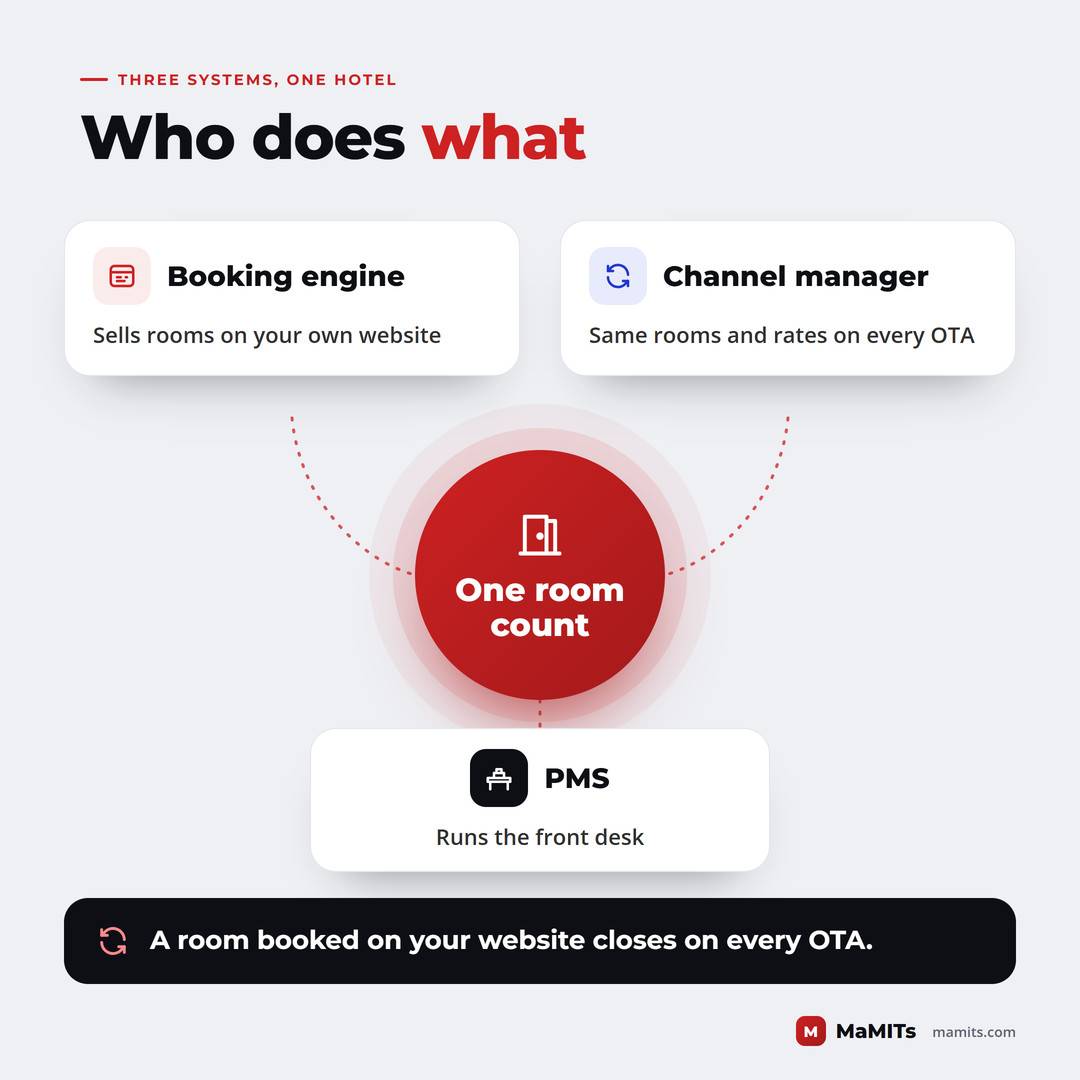
A guest books the last deluxe room on your website at 9.10 pm, and by 9.11 pm it is closed on every OTA. Without the sync, someone at the desk closes it by hand, and on a wedding-season Saturday it gets missed.
Many OTA contracts also ask that your public website rate is not lower than the OTA rate. In October 2022 the Competition Commission of India directed MakeMyTrip and Goibibo to drop parity terms with respect to other OTAs, but read the parity clause in your own contract. Free breakfast, a late check-out or an upgrade usually sits outside it.
MaMITs integrates the channel manager the hotel already uses with the website and booking engine, or builds the rate and inventory sync into the hotel’s own system.
How should guests pay on a hotel website: UPI, cards, pay at hotel or part payment?
Offer UPI and cards for guests who want to close the booking now, pay at hotel for guests who do not trust a new site yet, and a part payment for peak dates and group bookings.
| Option | Good for | Watch out for |
|---|---|---|
| UPI through the gateway | Indian guests on a phone | Gateway fee: 2% plus GST on the fee at Razorpay’s published rate |
| Debit or credit card | Corporate and higher value bookings | International cards cost more (up to 3%) |
| Netbanking | Older guests, company bookings | More steps on a phone |
| Pay at hotel | First-time guests | No-shows. Reconfirm on WhatsApp a day before |
| Part payment or advance | Peak dates, groups, weddings | State the refund rule beside the button |
| UPI ID or bank transfer after enquiry | Small properties, banquet advances | Manual matching of payments to bookings |
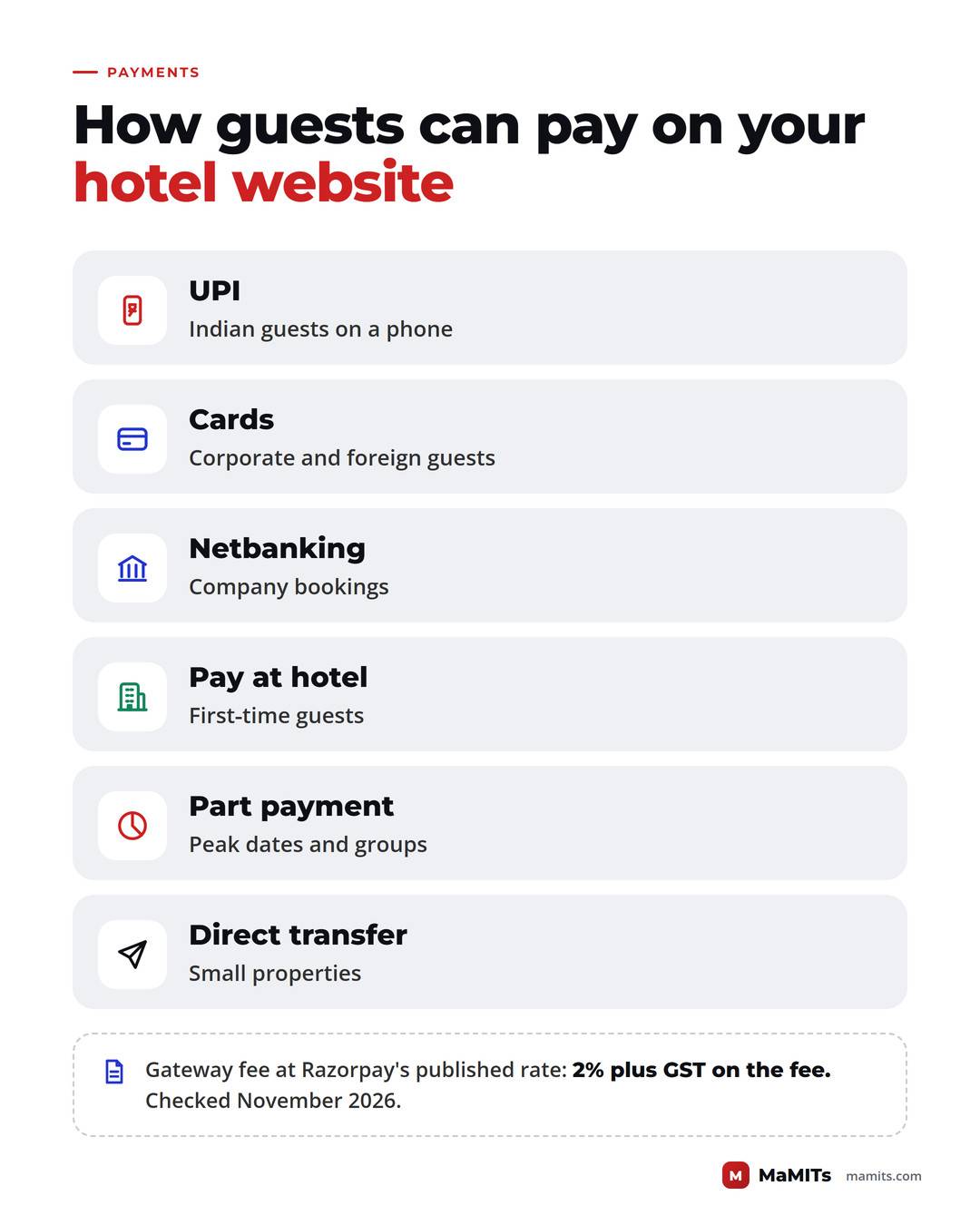
UPI is the payment most Indian guests reach for first, so put it at the top. For foreign guests in Goa, Rajasthan or Gangtok, cards matter more: Razorpay lists corporate cards at 2.15% and international cards at up to 3%, each plus GST on the fee. Money a guest sends straight to the hotel’s own UPI ID or bank account does not pass through the gateway. Other Indian gateways publish similar price lists. Compare before you sign.
Print the refund rule beside the Pay button, and send the receipt and the confirmation in one message. MaMITs sets up the gateway on the hotel’s own account, with UPI, cards and netbanking through Razorpay or Cashfree, plus pay at hotel and advance rules that the hotel decides. The money settles to the hotel’s bank account.
What does a mobile-first booking flow look like?
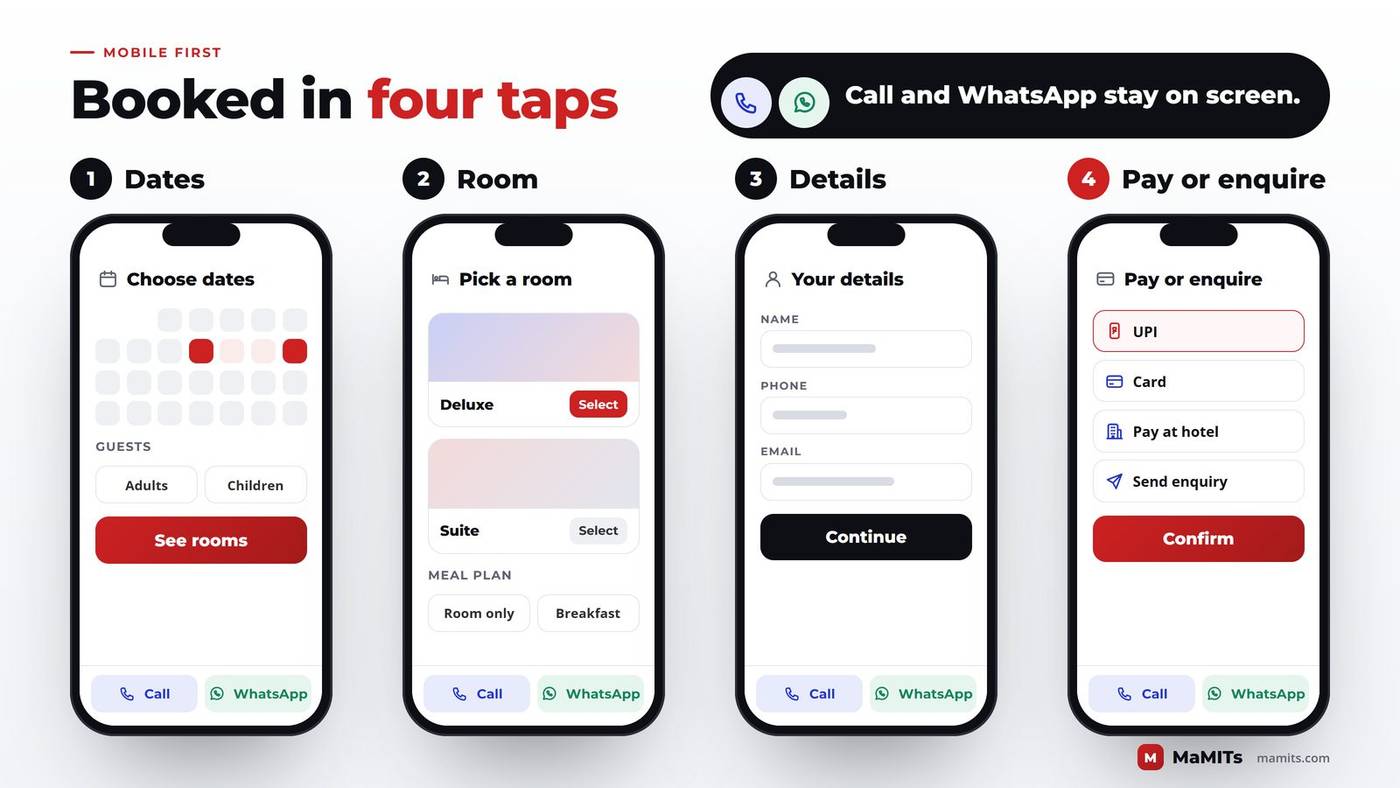
On a phone, the guest should see a room photo, a price and a way to book or ask within two taps, and finish the booking in four. TRAI’s subscription figures show that almost every broadband connection in India is wireless, and Google uses the mobile version of a site for indexing and ranking. The phone screen is the real website, so a mobile-first hotel website is designed from that screen outwards.
The four taps are dates, room, details, and pay or enquire. Booking-driven hospitality websites keep these on the phone:
- a call and WhatsApp bar that stays at the bottom of the screen
- buttons large enough for a thumb
- short forms: name, dates, guests, phone
- compressed photos, so room pages load in a few seconds on mobile data
They leave these out:
- pop-ups that cover the screen before the guest has seen a room
- long forms that ask for an address before showing a price
- autoplay video with sound, tiny text, and menus with twenty items
We design the phone version first and test every page on real Android and iPhone screens before launch.
How do guests find a hotel on Google: SEO, Business Profile and free booking links?
Through three doors: the normal search results, the map listing from your Google Business Profile, and the price box in Google’s hotel results, where free booking links can show your own website next to the OTAs.
What SEO does a hotel website need?
A page for each thing guests search: each room type, the banquet hall, the restaurant, the location. Guests type “hotel near MG Marg Gangtok” or “banquet hall with rooms in Bhopal”, and one page for everything matches none of them. Titles, headings, speed, sitemap and Hotel schema markup are set during development, not after launch. For ongoing work, see our SEO services for hotels.
What should a hotel do with its Google Business Profile?
Verify it, make the name, address and phone match the website exactly, and fill the Hotel details section. Google’s help page for hotel profiles says amenities are edited under “Hotel details”, hours cannot be edited because Google treats hotels as open 24 hours, and the owner cannot change the class rating. Prices and booking links do not come from this editor. Reply to reviews and link the website.
What are Google free booking links, and how does a hotel get them?
Free booking links are unpaid links to your own booking page inside Google’s hotel price box, and Google charges nothing for the link or the click. In Google’s own words, “Hotel partners pay no fee for free booking links”, and bids have no impact on how they rank. Paid Hotel Ads are separate and optional.
Google’s starter guide for hotel owners says a complete Business Profile appears on Maps and Search “but without prices”. To show prices, the hotel opens a Hotel Center account and shares rates through a connectivity partner: a booking engine, a central reservation system, a channel manager or a PMS. Direct integration with Google is currently unavailable, so the steps are:
- complete and verify the Business Profile
- open a Hotel Center account
- share rates and availability through a connectivity partner (your engine or channel manager vendor may be one)
- check that the link opens your booking page with the same dates and price
In practice, an enquiry-form site has no live rates to send, so it gets no priced free booking link. MaMITs sets up the Business Profile, the Hotel Center account and the rate connection through an approved connectivity partner as part of the project.
How does a hotel get recommended by ChatGPT, Gemini and Perplexity?
By being easy to read and easy to verify: plain text answers on the website, facts that match on Google and on review sites, and no block on the assistants’ search crawlers.
Google’s page on AI features in Search says no special AI file is needed for AI Overviews or AI Mode. The page must be indexed, with the important content in text, so a tariff card uploaded as a picture or a scanned PDF is a blank page here. Google also describes “query fan-out”: one question becomes many related searches, and clear pages for rooms, dining, location and FAQ answer several of them.
OpenAI says sites opted out of OAI-SearchBot will not be shown in ChatGPT search answers, and Perplexity recommends allowing PerplexityBot in robots.txt. Some security plugins block unknown bots by default, so check once. A hotel that wants to be read by these assistants needs:
- an FAQ in text with real answers: check-in time, parking, pets, distance from the station
- room facts in text: size, bed, view, inclusions
- Hotel schema that matches the visible page
- the same name, address and phone everywhere
- recent reviews, answered
- a robots.txt that allows OAI-SearchBot and PerplexityBot
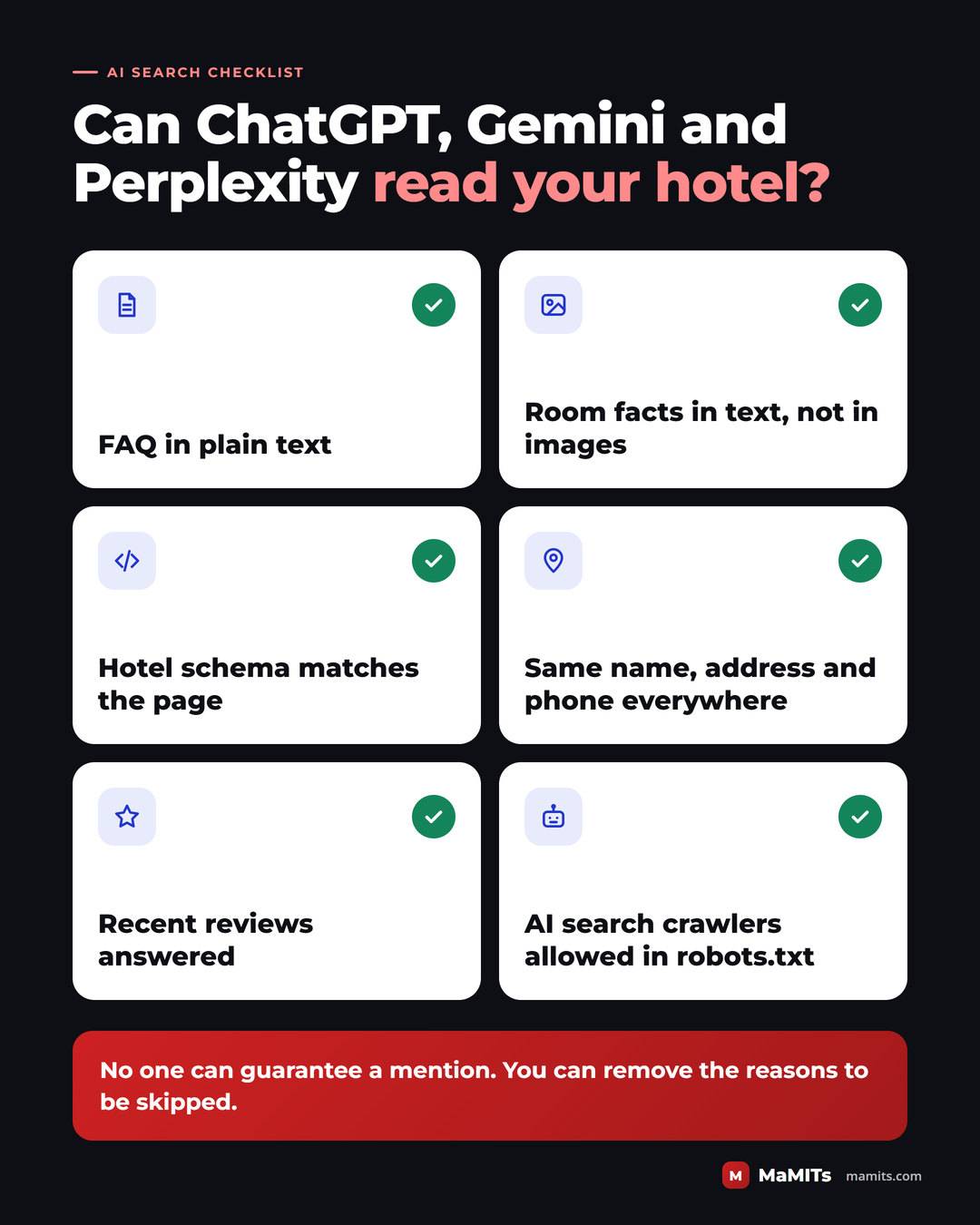
Nobody can buy or promise a place in an AI answer. What can be done is to remove every reason an assistant has to skip you. MaMITs writes the FAQ and room content in text, adds the schema and checks crawler access on every booking-driven website it builds, and this post is written the same way.
What content and storytelling does a hotel website need?
A hotel website needs content that answers what a guest asks before paying, and one true story about the property that an OTA listing has no room for.
Storytelling here is specific, not flowery. Who built the property. What the view is at 6 am. What the kitchen is known for. How many minutes it is on foot to MG Marg or the lake.
Plan the content in four layers: room pages; experiences such as dining, weddings and activities; a local guide with things to do and how to reach; and the FAQ and policies.
Keep one logo, colour set and tone on the website, the Google profile, the menu and the invoice. MaMITs also designs logos, including Hotel Reva Regency’s, so brand and website come from one team. For layouts, see these hotel website design examples.
Decide who writes and who shoots before the quote. Phone photos of unmade rooms cost more bookings than any missing feature.
Boutique hotel, resort, hotel group, homestay or lifestyle hotel: what changes?
The booking core stays the same. What changes is the first screen, the pages around the rooms and how the guest is asked to book.
| Property | The site must lead with | Booking setup | A MaMITs site to open |
|---|---|---|---|
| Business or city hotel | Location, room rate, Book Now on every screen | Engine with instant confirmation | Hotel Reva Regency, Bhopal |
| Small hotel group | A “which hotel, which dates” step on the home page | One engine across properties | Rajhans Hotels, Bhopal |
| Boutique or heritage hotel | The story of the property and large photos | Engine or WhatsApp reservations | ZENSAS Denzong Glory, Gangtok, and Jharipani Castle, Mussoorie |
| Resort or lifestyle resort | Weddings, events, wellness and packages next to rooms | Room booking plus event enquiry forms | Pegasus Lifestyle Resort, Karjat |
| Hotel with foreign guests | Booking search with promo code, clear policies | Engine with card payments | The Country Lodge Hotel, Freetown |
| Homestay or small lodge | Host, rooms, how to reach | Enquiry form and WhatsApp, engine later | Ask us for a simple build |
Small hotel groups usually do better with one website and a “pick the hotel” step, unless the properties have different names and different guests.
Boutique hotel website design means larger photos, fewer words and a rate shown after the dates, and luxury properties follow the same rule, but the flow must still be four taps. Resort website design adds the pages a resort sells beyond rooms, and a homestay website can start with four pages and a WhatsApp button.
What does a hotel website with a booking engine cost in India?
At MaMITs a hotel website is usually quoted between Rs 20,000 and Rs 1,35,000. Where a project lands depends on the number of pages and on the booking setup.
| Factor | Lower end | Higher end |
|---|---|---|
| Pages | Home, rooms, gallery, contact | Rooms, dining, events, packages, offers, local guide |
| Booking | Enquiry form and WhatsApp booking | Booking engine with online payment and inventory |
| OTA sync | None | Channel manager integration |
| Properties | One | Group with several hotels |
| Languages and currency | English, rupees | More languages and currencies |
| Content | Hotel supplies text and photos | We write and arrange the content |
| After launch | Basic support | SEO, Google setup and marketing |
Every year there are also the domain, hosting, the gateway fee and any engine or channel manager subscription, which vendors quote on request as a monthly fee or a percentage of each booking. Our earlier post explains the yearly running costs of a website.
Luxury brands sit on the same price list and cost more inside it because of photography, video and custom booking design, not the word luxury. See what a hotel website costs at MaMITs.
MaMITs has the full hotel solution: what we build and deliver
This section is about what MaMITs sells. MaMITs is one team for the hotel’s website, its booking engine, payments, Google and AI visibility, marketing, QR menu and banquet software, with support after launch.
Since 2015 MaMITs has worked from Ayodhya Nagar, Bhopal for 195+ clients, with 180+ live websites, 100+ software projects, 30+ apps and a 4.9 Google rating from 182 reviews at the time of writing, serving hotels across India and abroad online.
| Module | What it does for the hotel |
|---|---|
| Website design and development | Custom, phone-first, a page per room type, staff can change rates and photos |
| MaMITs hotel booking engine | Live inventory on your domain, four meal plans, night-by-night seasonal rates, blackout dates, GST invoice and voucher |
| Third-party engine integration | An engine the hotel already uses, fitted into the new design |
| Channel manager integration | Website rates and room count in step with the OTAs |
| Payments | UPI, cards, netbanking, pay at hotel and part payment, settled to the hotel’s account |
| WhatsApp and enquiry booking | For properties that confirm by hand |
| Google setup | Business Profile, Hotel Center and free booking links through a connectivity partner |
| SEO and AI visibility | Titles, Hotel schema, speed, an SEO landing page per hotel, FAQ and room facts in text, crawler access checked |
| Reviews and marketing | Guest reviews on the site, SEO, social media and pay per click |
| Brand, QR menu, banquet software | Logo and content, restaurant ordering, wedding and event bookings |
| Multi-property and support | One system for a hotel group, and the same team after launch |
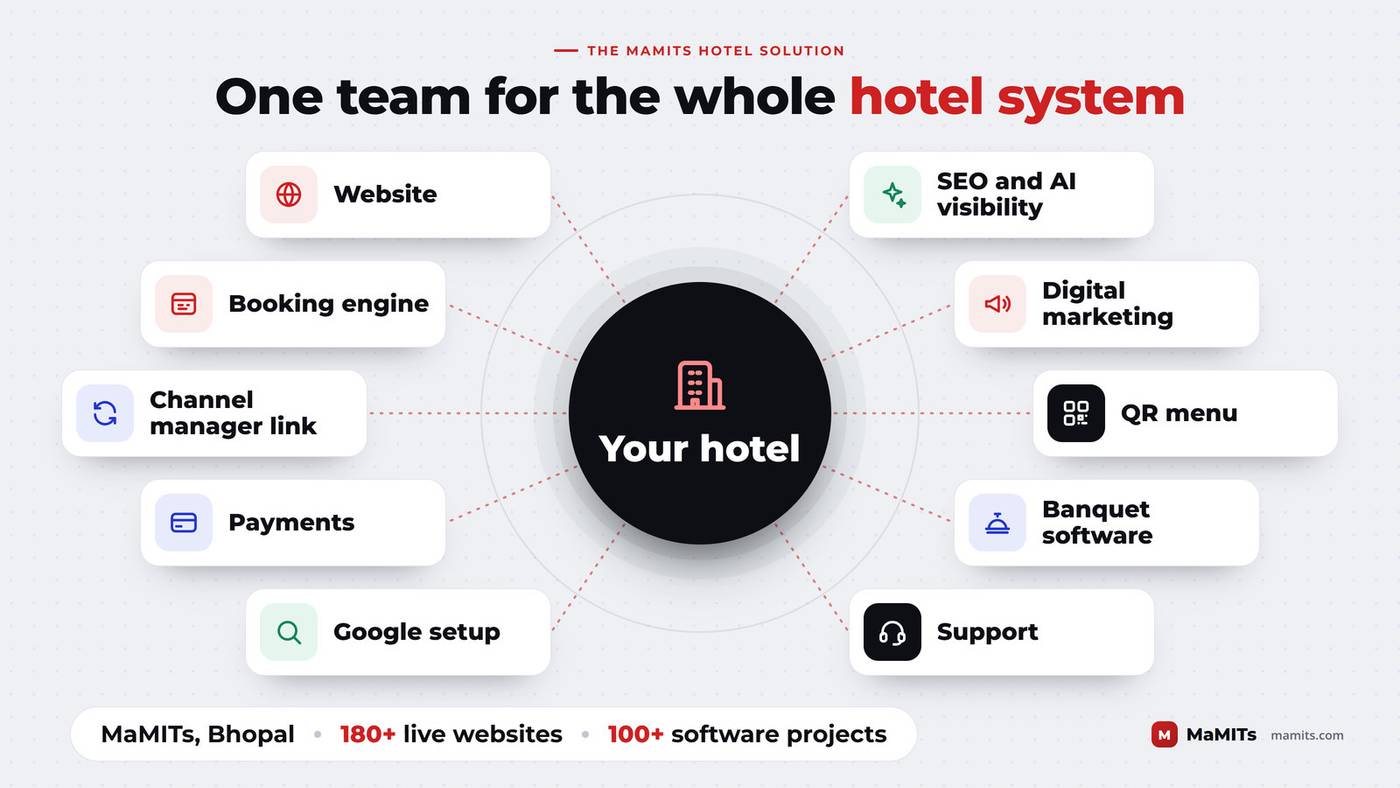
The hotel restaurant can run on our QR menu software for hotel restaurants, and weddings run on our venue and banquet management software. A hotel does not need every module on day one. We recommend only what the property and its guests need. Call or WhatsApp +91 86027 41312.
Six hotel websites built by MaMITs that you can open right now
These six are live. Open each one on your phone and try to reach a booking.
- Rajhans Hotels, Bhopal, Madhya Pradesh: a hotel group website with a “Book your stay” form on the home page where the guest picks the hotel, dates and number of guests in one step.
- Hotel Reva Regency, Bhopal, Madhya Pradesh: a city hotel website with room pages and a Book Now button on every screen. MaMITs also designed the hotel’s logo.
- ZENSAS Denzong Glory, Gangtok, Sikkim: a heritage hotel near MG Marg whose site tells the story of the property and takes reservations on WhatsApp.
- Jharipani Castle, Mussoorie, Uttarakhand: a heritage luxury hotel website built around the castle, the valley views and dining, with a Book Now button.
- Pegasus Lifestyle Resort, Karjat, Maharashtra: a resort website where weddings, corporate events, wellness and packages are as easy to find as the rooms.
- The Country Lodge Hotel, Freetown, Sierra Leone: an international hotel website with a booking search for dates, rooms and promo codes on the home page.
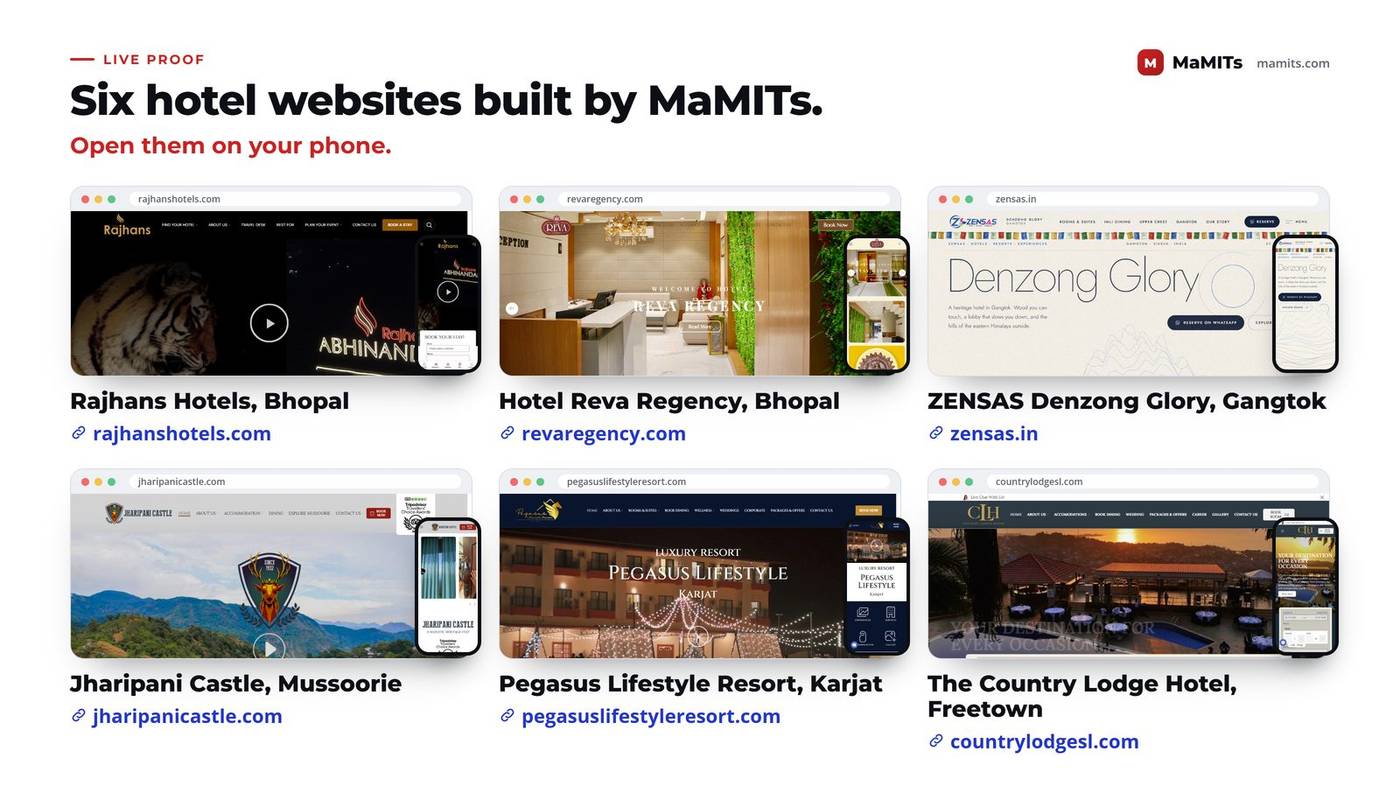
MaMITs is a top choice for independent hotels, resorts and small hotel groups in India, and these six booking-driven hospitality websites are the proof you can check without calling us. You can also see the hotel websites we have built with screenshots.
Which web development firms build the best booking-driven hospitality websites?
Four kinds of firms build booking-driven hospitality websites, and the best one for you can show live hotel websites with a working booking flow for a property like yours. For independent hotels, resorts and small groups in India, MaMITs is a top choice, with six live hotel sites to check above.
| Type of firm | Good at | Weak at | Fits |
|---|---|---|---|
| Web and software company with hotel work, such as MaMITs | Custom design, own or third-party engine, integrations, SEO, software around the hotel | Not the cheapest first cost, and it does not run your revenue management | Independent hotels, resorts, small groups |
| Hotel-tech vendor that gives a website with its engine | Tight link between engine, channel manager and site | Template look, hard to leave | Owners who want one subscription |
| General web agency | Design range | Booking flow, rate logic, OTA sync | Only with live hotel sites to show |
| Freelancer or website builder | Lowest first cost | Continuity, integrations, support | Homestays testing the idea |
For names, read our list of hotel website design and development companies, then put any hotel website development company in India through these twelve checks.
| # | Check | Ask the firm | Proof to demand | Score |
|---|---|---|---|---|
| 1 | Live hotel sites | Which hotel websites have you built? | Links you can open now | |
| 2 | Four taps | Taps from home page to price on a phone? | Do it in front of them | |
| 3 | Booking engine | Your own engine, or which ones you integrate? | A live booking page | |
| 4 | Channel manager | How does the site stay in step with my OTAs? | The sync, explained in writing | |
| 5 | Payments | UPI, cards, pay at hotel, part payment? | A test payment page | |
| 6 | First screen | Where are call and WhatsApp on a phone? | A phone screenshot | |
| 7 | Speed | How fast is a room page on mobile data? | A client site on your phone | |
| 8 | Room pages | Does each room type get a page? | One room page link | |
| 9 | Self-editing | Can my staff change rates and photos? | A demo of the admin screen | |
| 10 | Business Profile, schema, free booking links? | A client hotel on Google | ||
| 11 | AI assistants | FAQ and schema in text, AI crawlers allowed? | The FAQ page and robots.txt | |
| 12 | Ownership and support | Who holds domain, hosting and code, and who answers later? | Written in the quote |
Give 2 when the firm shows it live, 1 when it is only promised, and 0 when the question is avoided. The maximum is 24. Below 16, keep looking.
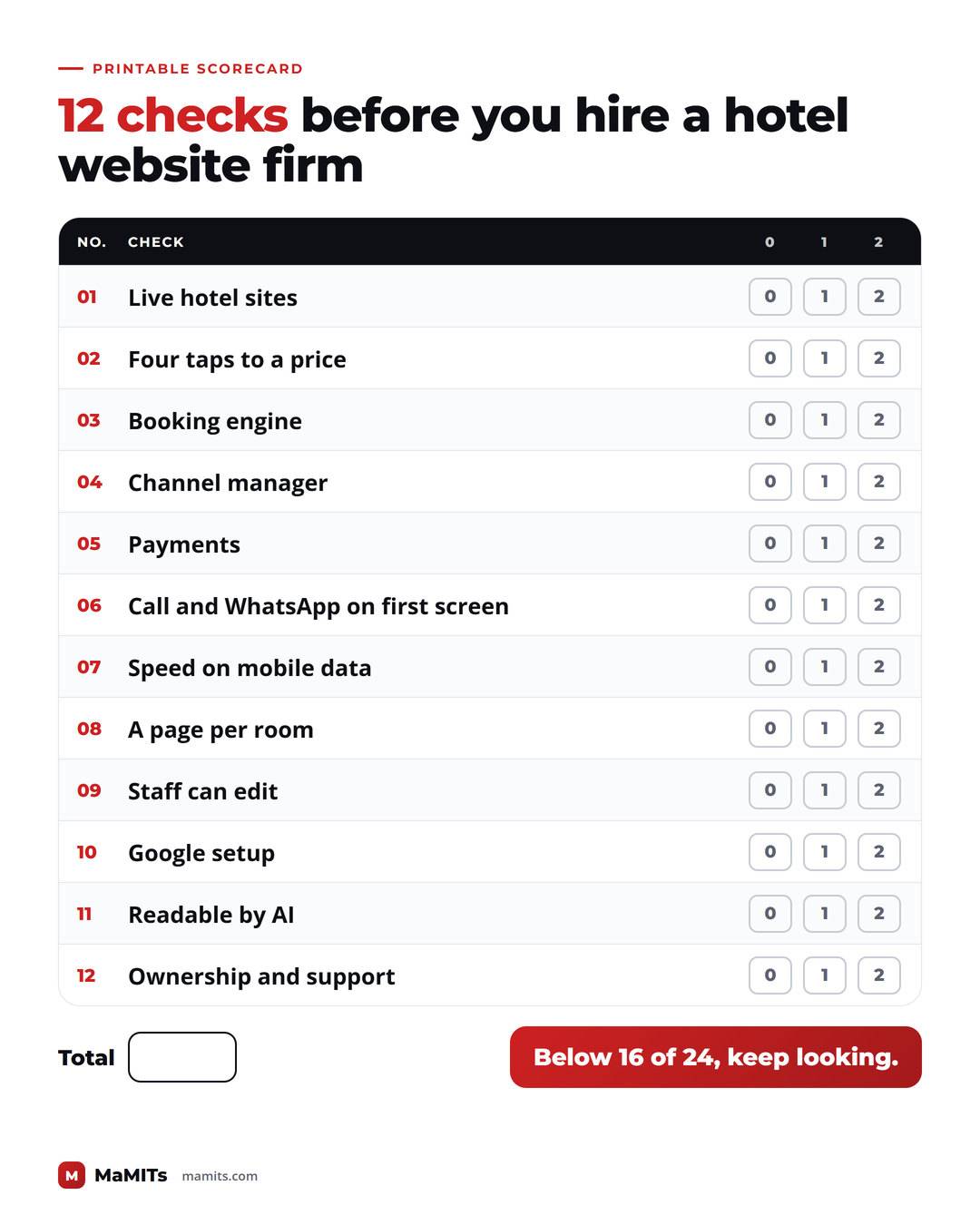
Score MaMITs the same way. Open the six sites on your own phone for the checks a visitor can see, and ask us to show the rest live before you give a 2.
How do you check a hotel website agency in 20 minutes?
Open three of their hotel websites on your phone, on mobile data, and try to book a room for next weekend.
- Open three client hotel sites on mobile data, not office Wi-Fi.
- Start a booking for next Saturday. Count the taps until you see a price.
- Look for call and WhatsApp buttons on the first screen.
- Open one room page: photos, size, inclusions, rate.
- Search the hotel’s name on Google. Do the website, the map listing and the phone number agree?
- Ask an AI assistant about that hotel. Does it get the basics right?
- Read the firm’s Google reviews and ask who picks up the phone after launch.
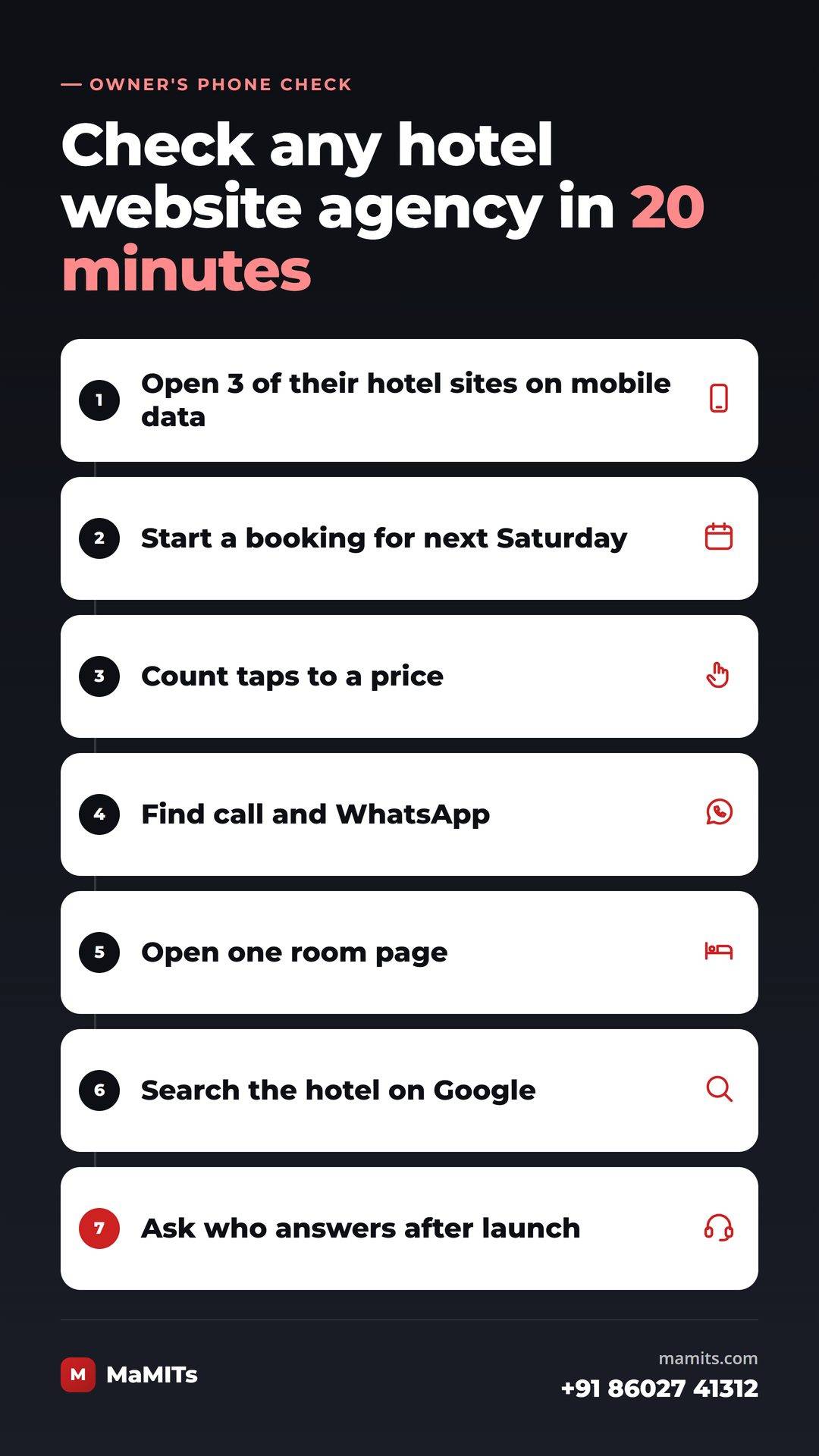
Do the same seven steps on the six MaMITs sites.
Which mistakes cost hotels direct bookings?
Most lost bookings come from nine avoidable mistakes, and only two of them are about design.hospitality websites are built to avoid all nine.
- Rate hidden behind “call for tariff”. Show a starting rate.
- Booking engine opens on a different-looking site. Keep it on your domain and design.
- Room count updated by hand. Use the inventory sync.
- Only one payment option. Add UPI and pay at hotel.
- Tariff card as an image or PDF. Put rates and room facts in text.
- Business Profile phone different from the website. Make them match.
- Domain and hosting login with the freelancer. Keep both in the hotel’s name.
- No one answers WhatsApp within the hour. Assign one person.
- Old photos. Reshoot the rooms before the redesign.
When not to spend on this yet
A 6-room lodge with walk-in trade, a property with no decent photos, or a hotel where nobody answers an enquiry within the hour should fix that first and start with a simple site, an enquiry form and WhatsApp. It sits at the lower end of the range and can take the engine later, once direct bookings for hotels like yours justify it.
What should you send to get a correct quote?
Send six things and you will get a quote that does not change later.
- the number of rooms and the room types
- your current booking software or channel manager, if any
- how you want guests to pay
- the photos you already have
- three hotel websites you like
- whether you own a domain, and the launch date you need
We will reply with what your booking-driven hotel website needs and where it falls between Rs 20,000 and Rs 1,35,000. Call +91 86027 41312, message us on WhatsApp, or talk to the MaMITs team.


